As rescue workers continued to search for survivors from Friday's deadly earthquake and tsunami, eyes were on the troubled Fukushima Daiichi complex where blasts have hit four reactors.
And a government spokesman added to fears, warning that radiation levels could be at dangerous levels.
News that makes sense
Your trusted source for staying up-to-date with the world around you. Get free daily news updates and analysis, straight to your inbox.
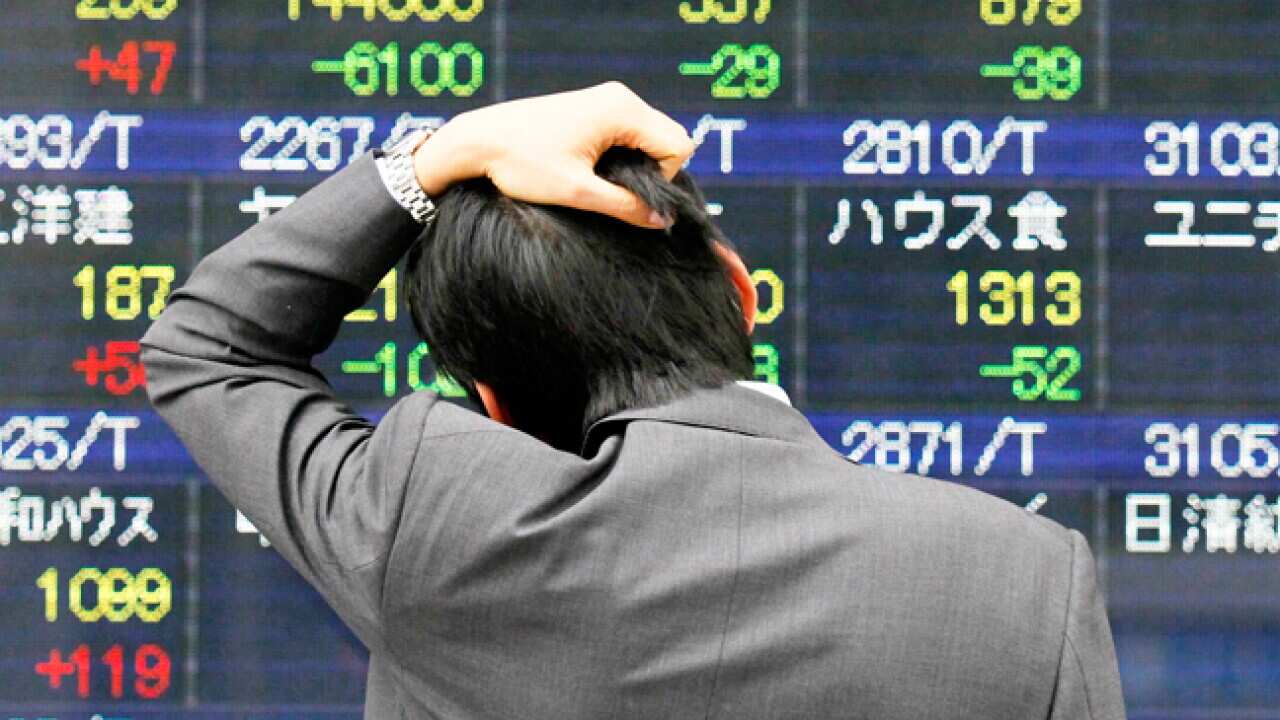
The crisis has led to a huge stock sell-off, with Japanese giants such as Sony and Toyota hit after they were forced to halt production in the country, while shares in nuclear plant operator TEPCO again fell after Monday's near 24 percent plunge.
Tokyo slumped 9.94 percent following Monday's fall of 6.18 percent to a two-year low.
Hong Kong fell 2.84 percent in the morning, Sydney plunged 1.46 percent and Shanghai lost 1.59 percent.
Seoul shed 1.07 percent and Taipei fell 1.28 percent while Singapore fell 0.89 percent.
The huge losses suffered by the Nikkei led the Japanese central bank to announce a five trillion yen ($61 billion) in short term funding -- on top of a record 15 trillion Monday -- as it tried to instill confidence in the markets.
However, the ongoing crisis at the nuclear station sent dealers running.
Early Tuesday a blast hit the number-two reactor at the ageing Fukushima No.1 plant, located 250 kilometres (155 miles) northeast of Tokyo, which has faced problems since Friday's quake and tsunami.
The government later said there was also an explosion which started a fire at the number-four reactor.
Similar hydrogen blasts had occurred at the number-one and number-three reactors on Saturday and Monday.
Government spokesman Yukio Edano said Tuesday: "There is no doubt that unlike in the past, the figures are the level at which human health can be affected."
Plant operator TEPCO, which dived 23.57 percent on Monday, was being sold again Tuesday and was ask-only while Sony was down 5.5 percent, while Toyota lost 4.2 percent.
Kenichi Hirano, an operating officer at Tachibana Securities, told Dow Jones Newswires: "Investors are starting to price in corporate damage from production halts, but the biggest worry continues to be the condition of the nuclear power plants."
In Australia uranium miners and explorers were hit with Energy Resources of Australia down 1.5 percent, Paladin off 3.8 percent and Bannerman sinking 12 percent.
The Bank of Japan's decision to pump more money into financial markets sent the yen lower against the greenback.
The greenback was trading at 81.77 yen in morning Asian trade as compared to 81.65 yen in late New York trade Monday.
The euro was at 114.29 yen compared with Monday's close of 114.53.
The dollar had touched four-month lows of 80.62 yen on Monday before the BoJ's injection on Monday.
On oil markets New York's main contract, light sweet crude for delivery in April gained 25 cents to $101.44 per barrel and Brent North Sea crude for April was down 37 cents at $113.30.
Gold opened at $1,424.00-$1,425.00 an ounce in Hong Kong, down from Monday's close of $1,427.00-$1,428.00.







