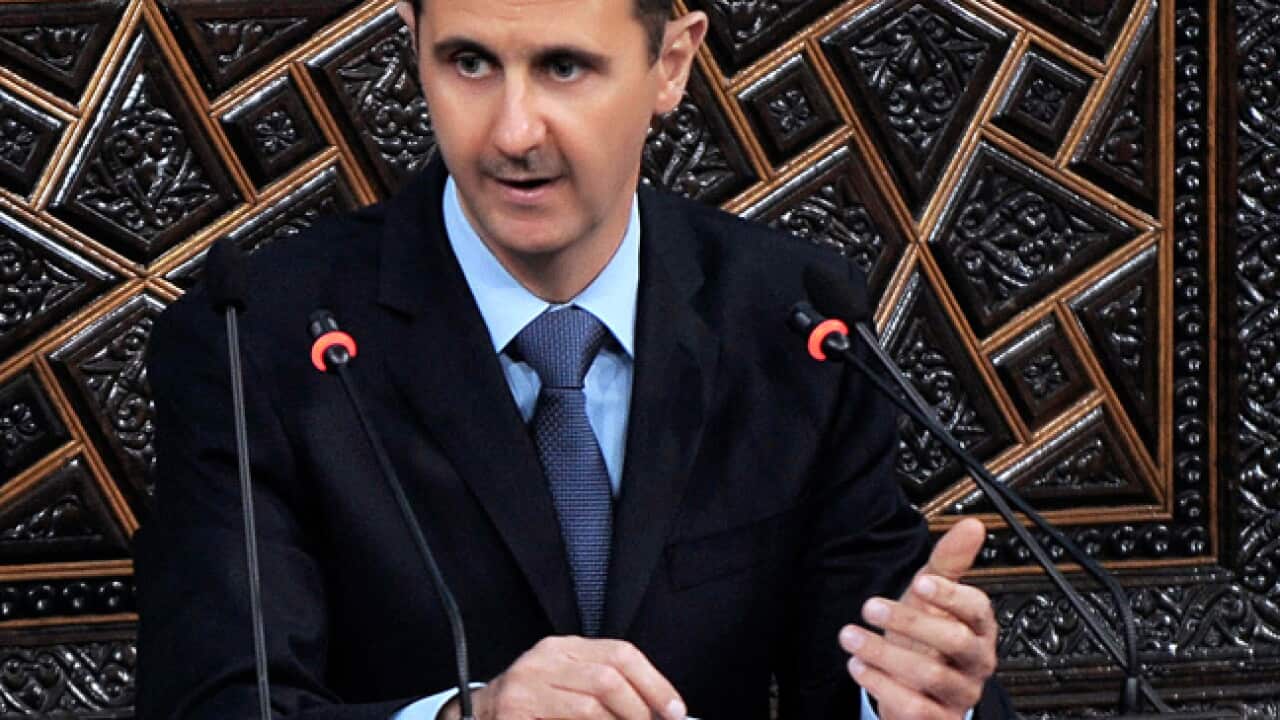
President Bashar al-Assad is quietly preparing to hold elections early in the northern summer aimed at winning another seven-year term, even as the Syrian conflict rampages into its fourth year with much of the country in ruins or under opposition control and nearly a third of the population scattered by civil war.
Amid the destruction, which has left more than 140,000 dead, presidential elections may seem impossible but Syrian officials insist they will be held on time.
They are central to the government's depiction of the conflict on the international stage.
At failed peace negotiations earlier this year in Geneva, Assad's delegates categorically ruled out that he would step down in the face of the rebel uprising aimed at ousting him.
Instead, they present the upcoming poll as the solution to the crisis: If the people choose Assad, the fight should end; if he loses, he will leave.
News that makes sense
Your trusted source for staying up-to-date with the world around you. Get free daily news updates and analysis, straight to your inbox.
Observers say it would be preposterous to think an election could reflect a real choice.
It would be impossible to hold a poll in areas controlled by rebels, and in those under government control, many would not dare vote for anyone but Assad.
"There is a gap between what goes on the mind of the Syrian president and reality. He has a fixation on the presidency and he doesn't see beyond it," says Hilal Khashan, a political science professor at the American University of Beirut.
"He can hold elections, and if the international community were to take these elections seriously then there is something really wrong in the international community."
In government-held areas, pro-Assad demonstrators have recently begun holding rallies in support of the armed forces, carrying Assad posters, Syrian flags and banners lauding "victories against terrorists", the term the government uses to refer to rebels.
Assad and his British-born wife, Asma, have emerged from months of seclusion, visiting with school students, mothers and displaced people in a campaign aimed at infusing confidence and optimism into the war-wrecked nation.
As the fighting on the ground shifts, there is no telling how the battlefield will look by poll time. But for now, Assad has overall good reason to feel self-assured.
Backed by Shi'ite fighters from the Lebanese group Hezbollah and Iraqi militias, Syrian troops have seized areas around Damascus and the central province of Homs that links the capital with Assad's stronghold on the Mediterranean coast.
Earlier this month, government forces recaptured two key rebel-held towns near the border with Lebanon. Troops also regained areas outside Aleppo and secured its international airport.
Underscoring the see-sawing conflict, rebels last week launched a major offensive in Assad's ancestral homeland in the coastal province of Latakia, capturing the last border crossing point with Turkey that was still under government control and several towns.
A second cousin of Assad, Hilal Assad, was killed in the fighting but it is still unclear how much it represents a shift.
"This has been a great year for Assad," says Fawaz A. Gerges, director of the Middle East Center at the London School of Economics.
"His army has become an effective killing machine that has made major tactical gains all over Syria, controlling Syria's cities and border area with Lebanon that is essential to his survival."
No date has been set yet for the vote, which must be held between 60 and 90 days before Assad's seven years ends on July 17.
This month, the Syrian parliament approved an electoral law opening the door - at least in theory - to potential contenders besides Assad.
It states that any candidate must have lived in Syria for the past 10 years and cannot have any other citizenship, apparently to prevent opposition figures in exile from running.
So far, no one has come forward to run against Assad.
Syria's ambassador to the UN Bashar Ja'afari said in mid-March a presidential election will be held in May or June, and called it "an internal affair".
Presidential adviser Bouthaina Shaaban said presidential elections would be held on time according to the constitution. She said Syria would not accept international monitors for the vote.
Preparations are underway. Authorities in government held areas have started issuing election cards and taking applications from people who lost or don't have identity cards.