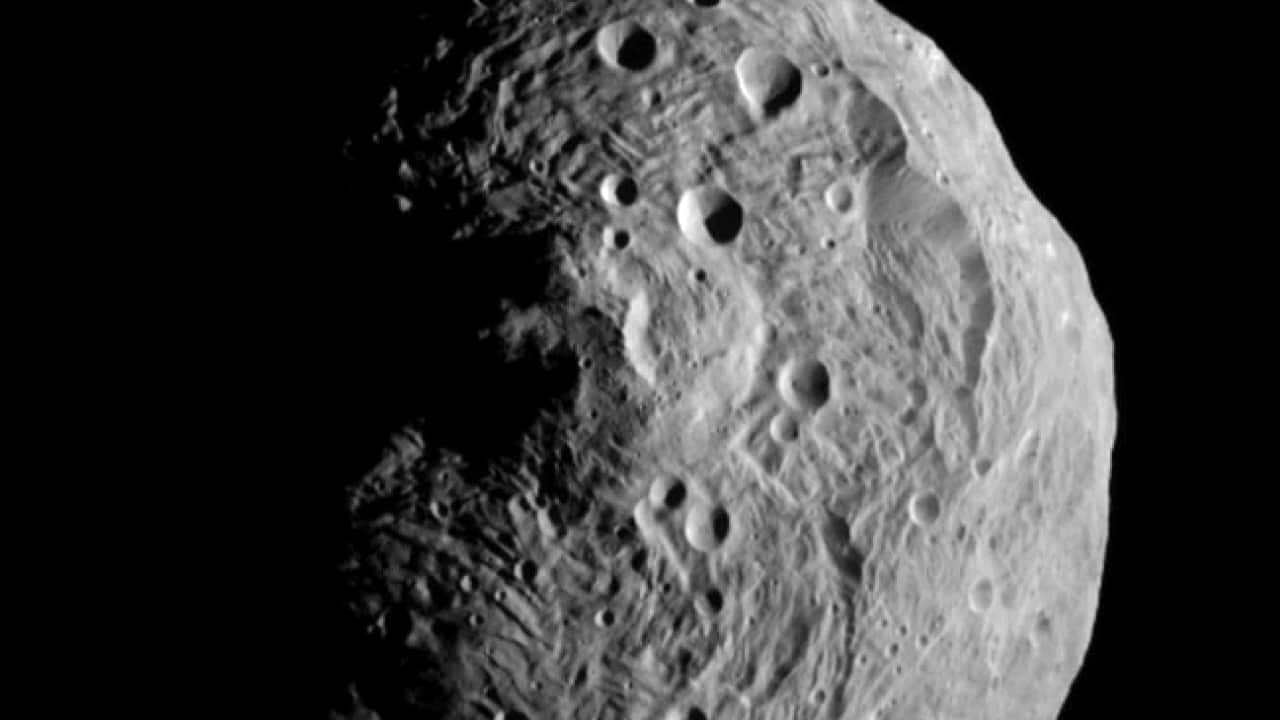
"This is not a potentially hazardous asteroid, just a good opportunity to study one," said National Science Foundation astronomer Thomas Statler.
The circular asteroid, named 2005 YU55, is about 1,300 feet (400 meters) wide and will come closer than the Moon, zipping by at a distance of 202,000 miles (325,000 kilometers), the US space agency said.
News that makes sense
Your trusted source for staying up-to-date with the world around you. Get free daily news updates and analysis, straight to your inbox.
The time of the nearest flyby is expected to be Wednesday at 10:28am AEDT.
The encounter will be the closest by an asteroid of that size in more than 30 years, and a similar event will not happen again until 2028.
Astronomers who have studied the object, part of the C-class of asteroids, say it is very dark, like the color of carbon, and quite porous.
It was first discovered in 2005 by Robert McMillan of the Spacewatch Project, a solar-system-scanning group of scientists near Tucson, Arizona.
While 2005 YU55 will stay a safe distance away, it is part of a crew of 1,262 big asteroids circling the Sun and measuring more than 500 feet (150 meters) across that NASA classifies as "potentially hazardous."
"We want to study these asteroids so if one does look like it may hit us someday, we'll know what to do about it," Statler said.
The asteroid's closest pass is set to take place in 2094, at a distance of 167,000 miles (269,000 kilometers), according to forecasts.
"The observations will give us a piece of the puzzle, one we don't get many chances to see," said Don Yeomans of NASA's Jet Propulsion Laboratory.
"At one time, we thought these were the asteroids that delivered carbon and other elements to the early Earth, so they are pretty important."
NASA said the last time a space rock this big approached Earth was in 1976, "although astronomers did not know about the flyby at the time."







