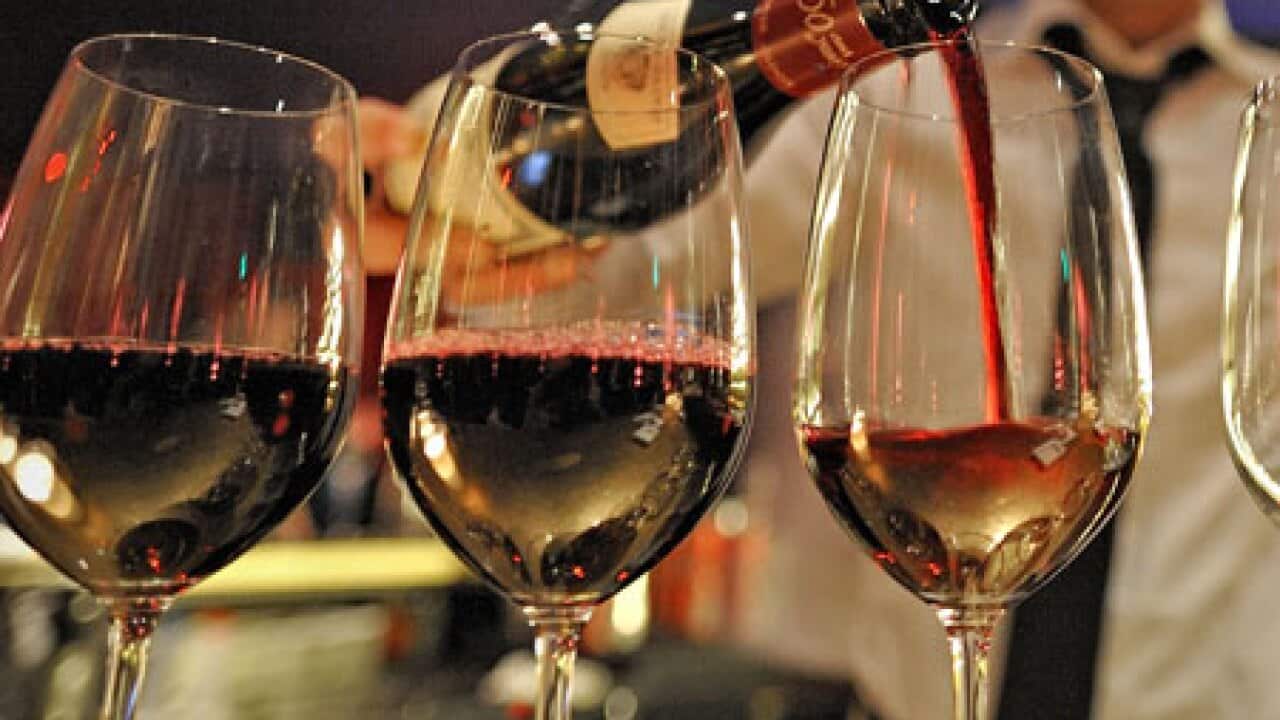
Ever paid top dollar for a bottle of wine that says on the label it's from a much-sought-after year, only to find that it tasted like cheap, non-vintage plonk?
Well, a team of researchers in Australia, who think "vintage fraud" is widespread, have come up with a test that uses radioactive carbon isotopes left in the atmosphere by atomic bomb tests last century to determine what year a wine comes from.
The test works by comparing the amount of carbon-12 and carbon-14 in grapes.
News that makes sense
Your trusted source for staying up-to-date with the world around you. Get free daily news updates and analysis, straight to your inbox.
Both are isotopes of carbon and are captured by the grape plants when they absorb carbon dioxide, the main nutrient used by living plants in their growth cycle.
Carbon-12 is the main isotope in the carbon absorbed by the grapevines, and is very stable, while only tiny amounts of carbon-14, a radioactive isotope, are found in the plant.
The amount of carbon-14 has varied over the years, too, which makes it a useful tool for judging the true age of a wine.
"Until the late 1940s, all carbon-14 in the Earth's biosphere was produced by the interaction between cosmic rays and nitrogen in the upper atmosphere," said Graham Jones of the University of Adelaide.
"This changed in the late 1940s up to 1963 when atmospheric atomic explosions significantly increased the amount of carbon-14 in the atmosphere," said Jones, who led the study and presented its findings Sunday at the annual meeting of the American Chemical Society, held in California.
More and more fossil fuel has been burnt since the bomb tests stopped in the 1960s and this has had the effect of diluting the radioactive carbon-14 in the atmosphere.
That is turn changes the ratio of carbon-14 to carbon-12 in plants, like grapevines.
For the study to see if a wine's vintage can be carbon-dated, much in the same way that fossils are, the researchers measured the carbon-14 levels in the fermented sugars that give wine its alcohol content, in 20 Australian red wines from vintages from 1958 to 1997.
They then compared the measurements to radioactivity levels of known atmospheric samples, and found they were able to reliably determine the vintage of wines to within the vintage year.
The researchers think carbon-dating fine wines could help nip in the bud the growing practice of vintage fraud.
According to the study, wine experts have estimated that up to five percent of fine wines sold today are not all they are cracked up to be on the label or in the price tag.
"The problem goes beyond ordinary consumers being overcharged for a bottle of expensive wine from a famous winery with a great year listed on the label, that isn't the right vintage year," Jones said.
"Connoisseurs collect vintage wines and prices have soared with 'investment wines' selling for hundreds of thousands of dollars a case at auction," he said.
None of the researchers was available to comment on how the tests would be put into practical use.
Would all wines be tested and include a mention on the label to say the vintage had been proven by carbon-dating to be that listed? Or would tests be applied after a complaint was lodged by a consumer?
And if testing were to become the norm, how much would it add to the cost of a bottle, given that the tests require the use of specialized equipment, including an accelerator mass spectrometer, to determine carbon-14 levels in wine?







