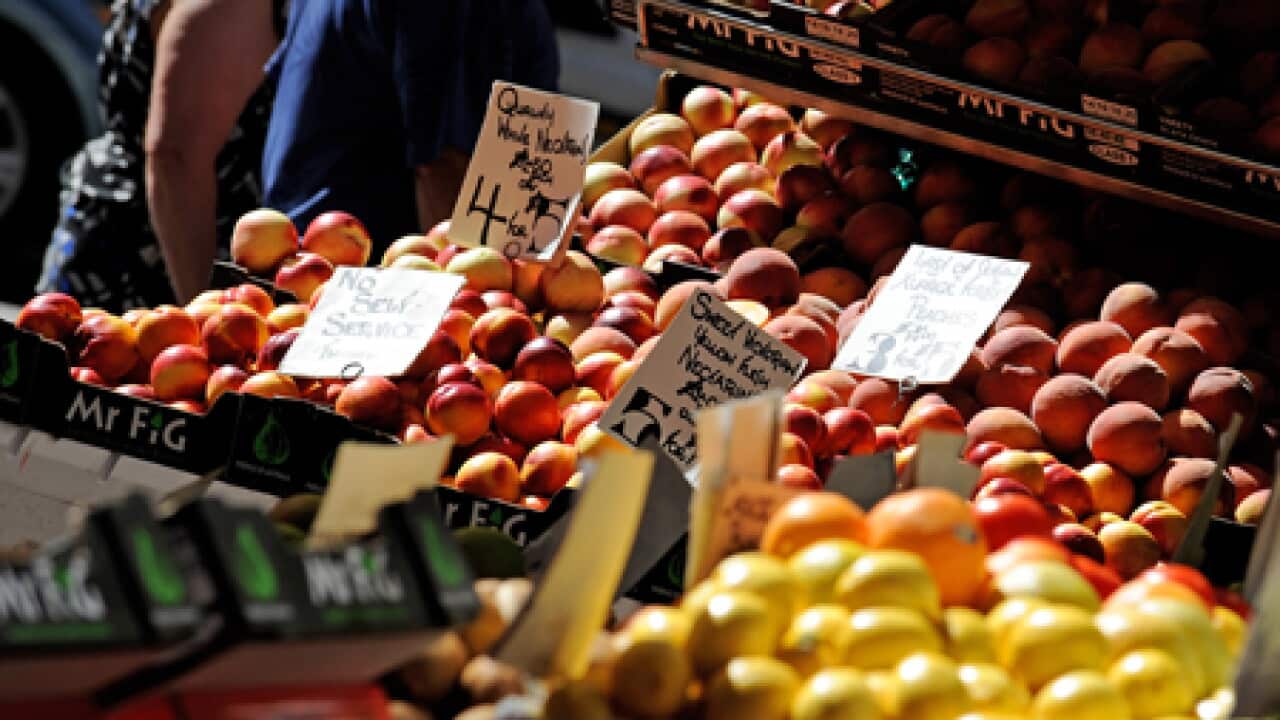
Community organisations are calling for a national food policy, saying Australia will face food shortages unless there's better planning to cope with the effects of climate change and population growth.
By 2050, Australia will be faced with feeding 36 million people.
"If we increase our population and we don't protect our agricultural land and think of ways to grow food to feed our growing population, we will experience serious food shortages," the President of the Sydney Food Fairness Alliance Lynne Saville told SBS.
News that makes sense
Your trusted source for staying up-to-date with the world around you. Get free daily news updates and analysis, straight to your inbox.
For the first time, Australia is now importing more fruit and vegetables than it exports.
Last year, $826 million worth of food came into the country while $749 million worth went out.
Most comes from New Zealand, but increasingly garlic, peas, broccoli, cauliflower, beans and corn are being sourced from China.
Store Manager Abilio Paiva says his customers are wary of where their food comes from.
"When we say it's from China or from America, they don't want it."
Sustainable agricultural expert at the University of Sydney Bill Billotti has also been advocating for a food policy.
"We don't currently have a national food policy in Australia and so our approach is fragmented. We stick food in agriculture, we stick food in health, we deal with food in environment but we're not getting that across-discipline view, wholistic view of food," he told SBS.
Rising food prices in recent years have made it more difficult for Australians to access fresh food, which is often more expensive than fast food alternatives.
"There's absolutely no doubt that food, some food, is becoming more expensive, some food is going to become more rare and some almost extinct if we carry on the way we do," OzHarvest's Ronni Khan told SBS.
“We need to look for alternative and innovative approaches to dealing with resource scarcity and environmental change. Over the next few decades the way people obtain their food, water and energy will undergo a major evolution, the Director of the Victorian Eco-Innovation Lab says.
“One pathway we can see is people no longer relying on industrial production units hundreds or thousands of kilometres, or even continents, away. Instead they will source a greater proportion of essential resources, goods and services from within their 'neighbourhood',” Professor Chris Ryan says.
“This evolution means a significant switch in people's role within the economy and in their identity as citizens, moving from one of passive consumption to a more active engagement in production and exchange of economic and social capital,” he said.
The federal government established a Preventative Heath Taskforce to deal with burden of chronic disease currently caused by obesity, tobacco, and excessive consumption of alcohol.
But there is no federal umbrella organisation to deal with food availability.
When asked whether it has any plans to act on calls for a state food policy, the NSW government did not comment.







