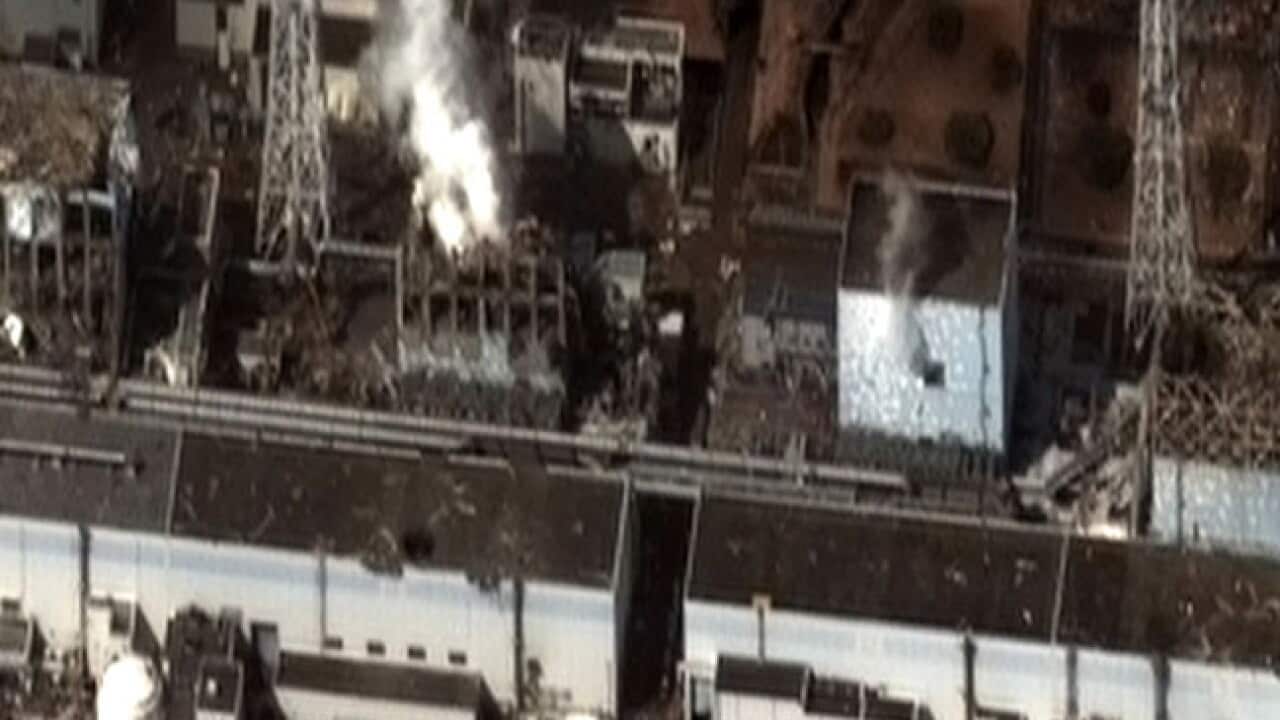
DFAT is now advising Australians in the worst affected areas of Japan to leave amid reports from the US that the radiation risk from reactor 4 at the Fukushima nuclear plant is 'extremely high'.
Foreign Minister Kevin Rudd said DFAT was advising Australians in the worst affected areas of Japan to leave because of the breakdown of infrastructure in those areas.
"The infrastructure in that part of Japan now is severely under pressure in terms of electricity, power supply as well as a whole range of other things," he said.
News that makes sense
Your trusted source for staying up-to-date with the world around you. Get free daily news updates and analysis, straight to your inbox.
"Because of these pressures on public infrastructure we're recommending that Australians should consider departing from Tokyo and those eight affected prefectures."
US warns of 'extremely high radiation levels'
There is no water left in the spent fuel pool of reactor 4 at Japan's Fukushima nuclear plant, resulting in "extremely high" radiation levels, the chair of the US Nuclear Regulatory Commission warns.
"In addition to the three reactors that were operating at the time of the incident, a fourth reactor is also right now under concern. This reactor was shut down at the time of the earthquake," said NRC chairman Gregory Jaczko.
"What we believe at this time is there has been a hydrogen explosion in this unit due to an uncovering of the fuel in the spent fuel pool," he said, noting the explosion happened several days ago but its effects were cause for concern.
"We believe that secondary containment has been destroyed and there is no water in the spent fuel pool and we believe that radiation levels are extremely high which could possibly impact the ability to take corrective measures."
Jaczko briefed lawmakers about the latest developments as part of a House of Representatives hearing on the US energy budget, after meeting with President Barack Obama at the White House.
Calls for Americans to leave nuclear area
He said that if the United States were facing a similar situation, it would order a much larger evacuation zone than Japan has (12 miles, 20 kilometers), and so the US has called on Americans within 50 miles (80 kilometers) of the Japan nuclear plant area to leave.
"Recently the NRC made a recommendation that based on the available information that we have that for a comparable situation in the United States we would recommend an evacuation for a much larger radius than has currently been provided in Japan," he said.
"As a result of this recommendation the ambassador in Japan has issued a statement to American citizens that we believe it is appropriate to evacuate to a larger distance, up to approximately 50 miles."
No. 4 rod pool 'major concern': France
France's Nuclear Safety Authority (ASN) earlier Wednesday described the No. 4 rod pool as "the major concern" in the crisis.
"The next 48 hours will be decisive," said Thierry Charles, director for factory, laboratory, transport and waste safety at the French Institute for Radiological Protection and Nuclear Safety (IRSN).
In an assessment issued at 0800 GMT on Wednesday 16th March, the IRSN said the water in the No. 4 pool was "boiling."
"Without water replenishment, the fuel-rod assemblies will start to be exposed in a few days. If the pool runs dry, this would eventually lead to the meltdown of the fuel.
"In such an event, the corresponding releases of radioactivity would be far higher than those that have occurred up till now."
The IRSN said that at around 2100 GMT on Tuesday 15th March, "responders were unable to approach the pool because of an excessive ambient dose" of radiation "of around 400 millisieverts per hour."
A single dose of 100 millisieverts is considered by some experts to increase the risk of several types of cancer.







