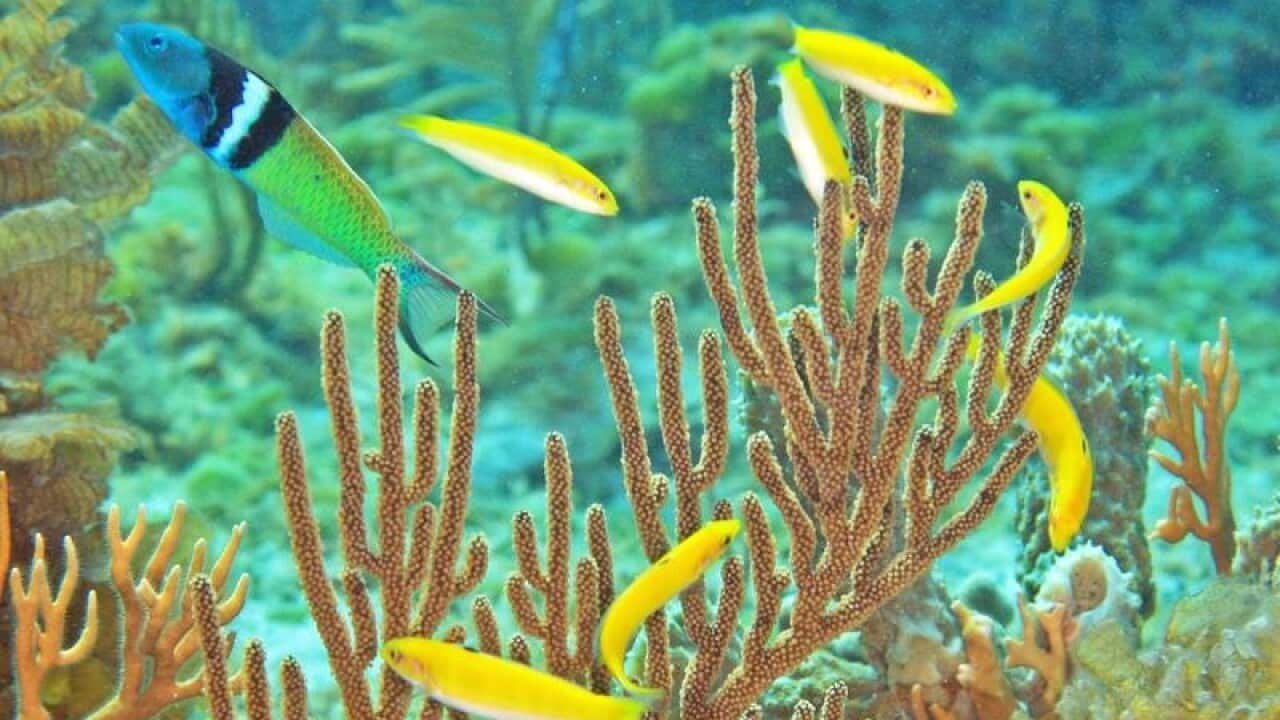
Females of a small tropical fish species have the ability to change from female to male in just 10 days, should the need arise.
Australian and New Zealand researchers made the discovery after a deep dive for answers on what happens when a male bluehead wrasse fish is removed from his post as "protector".
The blue-headed fish usually looks after a harem of 15 yellow females in the Caribbean's coral reef.
But when he's gone, the biggest female changes her colour within hours and turns into a male in just 10 days, her ovary becoming a testis and in 10 days she's producing sperm.
La Trobe University geneticist Jenny Graves, who co-led the research with New Zealand colleagues, said the sex change is triggered by a visual cue.
News that makes sense
Your trusted source for staying up-to-date with the world around you. Get free daily news updates and analysis, straight to your inbox.
"How sex can reverse so spectacularly has been a mystery for decades. The genes haven't changed, so it must be the signals that turn them off and on," Professor Graves said.
The research uncovered how and when specific genes are turned off or on in the brain and gonad so the sex change can occur.
"We found that sex change involves a complete genetic rewiring of the gonad," University of Otago co-lead author Erica Todd said.
"Genes needed to maintain the ovary are first turned off, and then a new genetic pathway is steadily turned on to promote testis formation."
About 500 species of fish change their gender in adulthood, with the study shedding light on what's going on in the deep blue and the environment's influence on the process.
The findings were published on Thursday in the journal Science Advances.







