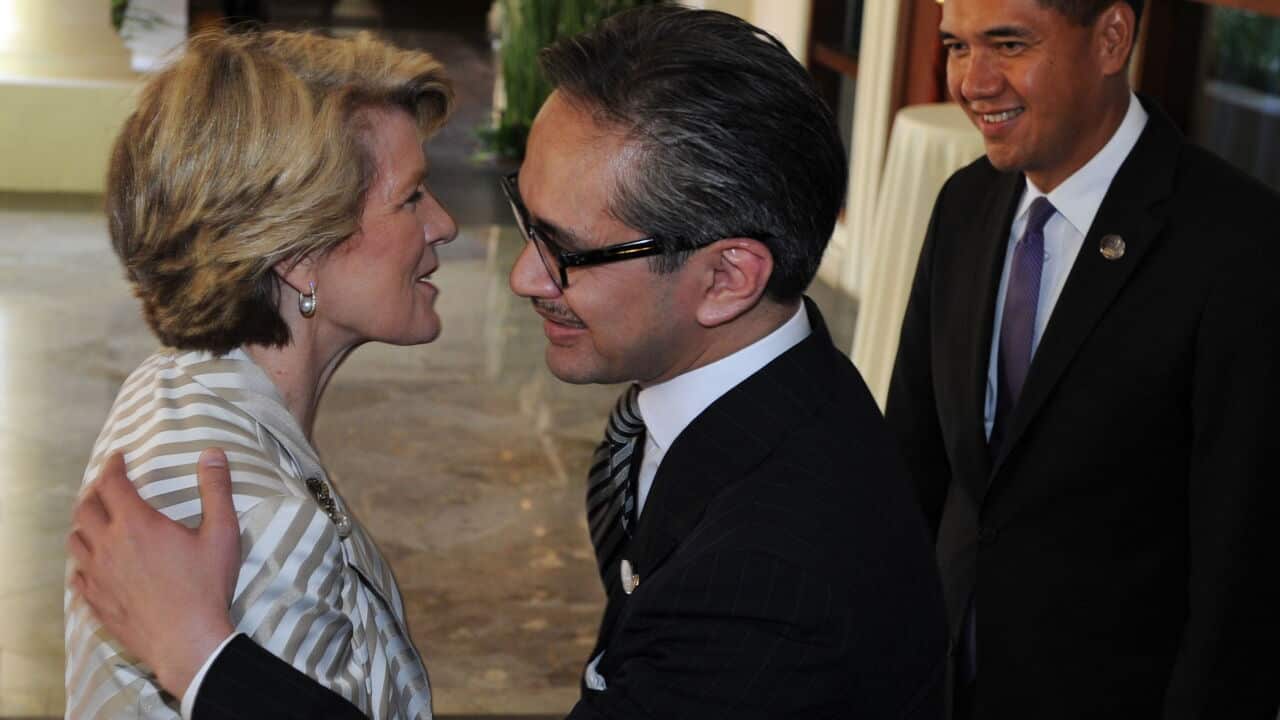
Canberra's relationship with Jakarta is under pressure after reports last week that Australia's overseas diplomatic posts were involved in a vast US-led surveillance network.
The problems were compounded by a report on Sunday citing a document from US whistleblower Edward Snowden showing that Australia and the United States mounted a joint surveillance operation on Indonesia during 2007 UN climate talks in Bali.
An angry Jakarta on Monday said it would co-sponsor a draft resolution at the UN General Assembly highlighting concern at US-led data snooping while threatening to review its bilateral cooperation with Australia.
News that makes sense
Your trusted source for staying up-to-date with the world around you. Get free daily news updates and analysis, straight to your inbox.
Despite this, Bishop denied relations were frayed.
"I don't accept that there has been a rift," she told ABC television late Tuesday.
"I'm looking forward to having a very productive conversation with Dr Natalegawa and other Indonesian ministers."
Bishop added that she had a "very fruitful" discussion with visiting Indonesian ministers on Tuesday about the mutual benefit of working together on issues such as combating terrorism and people-smuggling.
"The bilateral cooperation that exists between our two countries in areas such as people-smuggling and counter-terrorism is of mutual benefit, of mutual advantage to both countries, and that will continue to be the case," she said.
But Labor opposition foreign affairs spokeswoman Tanya Plibersek said it was clear the relationship was in trouble after some "serious mis-steps" since the new conservative government led by Prime Minister Tony Abbott was elected in September.
"The relationship with Indonesia was handed to the incoming Australian government in very good working order," she said, adding that former foreign minister Bob Carr had a "very close rapport" with Natalegawa.
"And now we have an Australian foreign minister having to fly to Indonesia to explain herself and apologise."
Plibersek pointed to the government's lack of consultation with Jakarta over asylum-seeker policy, a lock-out of Indonesian journalists at an Abbott press conference and its failure to adequately explain the spying claims.
Indonesian elections are expected in the coming months, but Bishop refused to speculate on whether the polls were influencing Jakarta's recent rhetoric.
"That's a matter for Indonesia to answer," she said.
The annual Bali Democracy Forum, established by Indonesian President Susilo Bambang Yudhoyono in 2008 to promote the development of democracy in the Asia-Pacific region, is being held from November 7-8.
Bishop will speak on the topic "Building and Strengthening Democratic Institutions".







