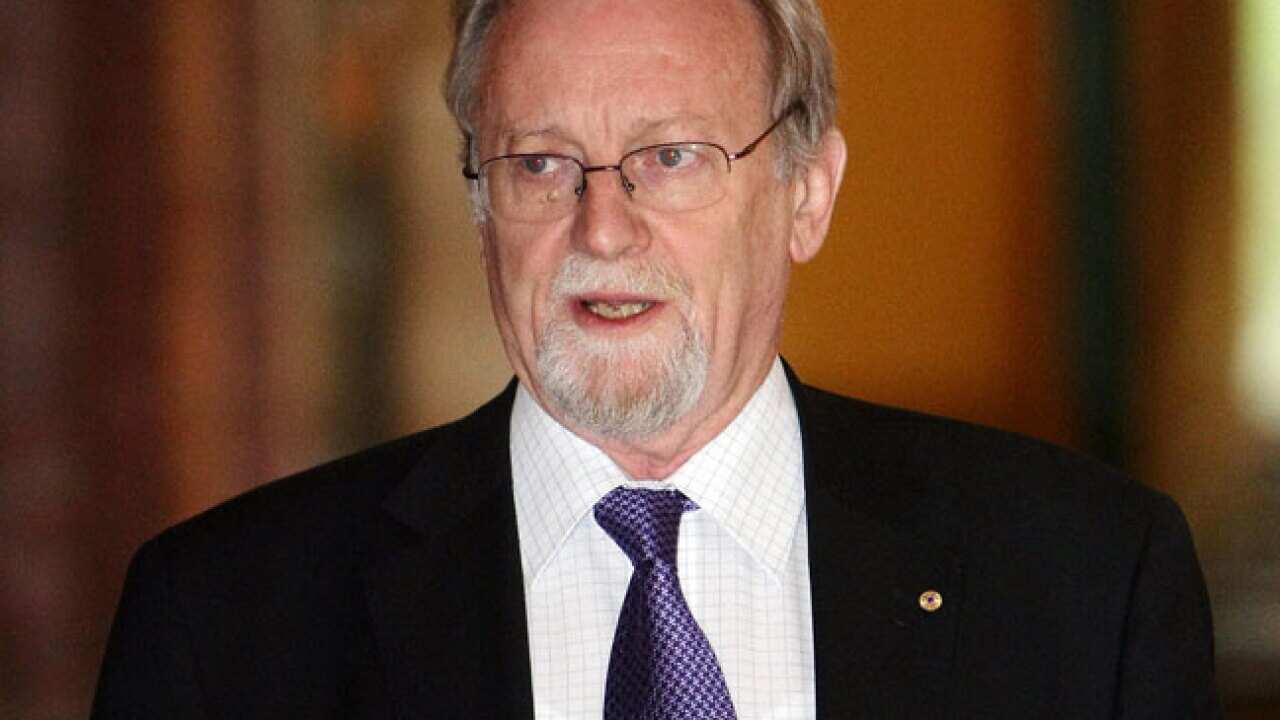
It's a matter of prime national interest for Australia to gain a seat on the United Nations Security Council, says former foreign minister Gareth Evans.
Professor Evans recently delivered the 2012 Charteris Lecture at the Australian Institute of International Affairs (AIIA) in which he talked about Australia's foreign policy, particularly areas could be strengthened like engagement with China and India.
SBS spoke to Mr Evans, chancellor at the Australian National University, about the deteriorating situation in Syria and the Palestinian bid for statehood at the United Nations.
In your lecture you said Australia's international engagement hinges on its effective leverage of middle power diplomacy, how do you see that working under the current government?
Australia is practicing it very effectively emphasising multilateral engagements, coalition building with like-minded powers and working towards the global public good.
News that makes sense
Your trusted source for staying up-to-date with the world around you. Get free daily news updates and analysis, straight to your inbox.
Our role can be seen of much like the Scandinavian countries with a robust style of diplomacy premised of making its voice heard through being persuasive on an international level.
With regards to the rising violence in Syria and the recent expulsion of diplomats from Australian shores, is Australia doing enough?
Our role has been making sure Syria behaves itself. Through expelling the diplomats we sent a message to other countries to follow suit.
We have been playing our part with the international community but the real action takes place in the Security Council and Kofi Annan's peace plan.
The Russians need to put maximum heat on the Syrian regime because no military option seems likely.
I'd like to see agreements take place through the Security Council indicting the Syrian regime to the International Criminal Court and tightening the arms embargo. Yet, the threat of the Russian veto looms.
As one of the intellectual architects of the R2P doctrine, is Australia doing enough to address the Syrian crisis or are we witnessing another Srebrenica or Rwanda, especially with mounting visual evidence of massacres?
We are certainly not complacent and not comfortable with the situation. We've come a long way from the 1990s and the responsibility to protect doctrine. But I would not be comfortable and willing to apply military force.
It's a bad situation and might make it even worse spilling into a full scale civil war. Plus, now there's the support [to Assad] of two major countries, Russia and China, who are unwilling to adopt a tougher stance towards Syria.
You mentioned China and its veto in the UNSC. Is Australia's 'soft power' approach the best way to deal with the ascending power?
You have to remember it's a big, strong, tough and authoritarian society. We can't develop a workable relationship without a strategic plan.
The importance is not to get hysterical and move towards a strategy of containment because that will end in tears through an escalation of an arms race.
Do you think Australia will eventually get a seat on the UN Security Council? Is it important?
It's in Australia's national interest to be in the highest decision making body in the world. But also a matter of prestige to the size and contribution Australia plays as a middle power.
We also have strategic interests at stake with troops stationed in Afghanistan and East Timor, sanctions against a whole raft of countries, we ought to be there and make a contribution as any self-respecting country would.
So far it's been a pattern of every 27 years so it's not a waste of time or money but unfortunately we did start late in our lobbying efforts.
Also, there is the strong possibility of blocking votes by EU countries restricting our accession and if we can avoid the particular obstacle of Palestinian statehood in October then we can gain a seat.
What is your view of the Palestinian bid for statehood and UNESCO approving its status as a member state last year?
My view is there's nothing adverse to Israel's interests. It's a further measure of pursuing the two-state solution.
There's no hostility that Israel should fear but of course the worry for the Palestinians is the funds will dry up from the United Nations via the United States.
Israel has been making life administratively and financially hard for the Palestinians so it can't possibly harm if Palestine is granted full statehood.
When included in Foreign Policy magazine's list of 100 Global Thinkers last year, you mentioned the late influential Jewish Anglo-American thinker Tony Judt's book 'The Memory Chalet' as part of your reading list. How have his views been integral to your approach to the Israel-Palestine conflict?
I was a friend of his. I gave him his last drink of wine, a fine Australian shiraz. He was fantastically acute, an instinctive social democrat advocating open and free societies.
I disagreed on Palestine though.
He was coming at it from the one-state idea towards the end of his career and I don't see that being in anybody's interests.
Especially for the Israelis, I think the two-state solution is the best hope for two democratic states alongside each other. The question of settlements can be solved if the political will is there.
We saw that with Gaza in 2005 under Ariel Sharon where the settlements were wound back and through one for one prisoner swaps. Political leadership in the coming period is what is needed.







