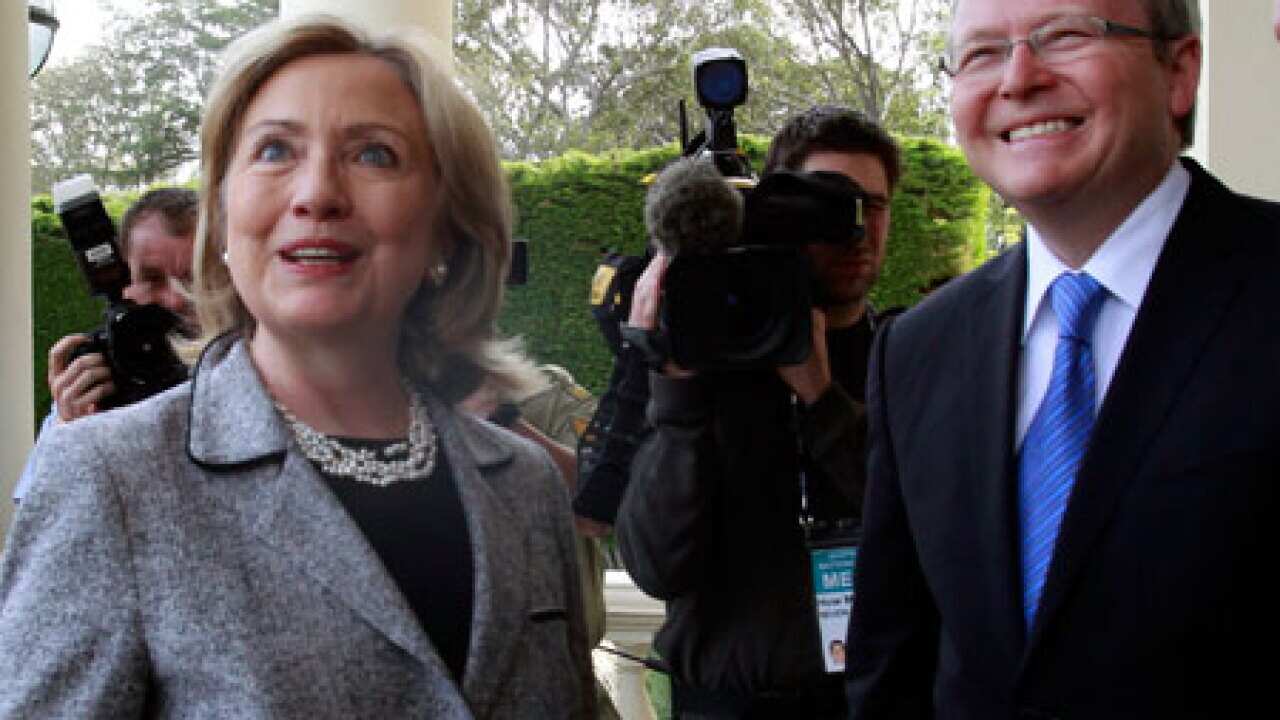
Australia and the US have made progress in co-operation in space surveillance and cyber-security, Defence minister Stephen Smith says.
The US and Australia began talks today on further aligning foreign policy goals and deepening defense ties, including possibly increasing US use of Australian military bases.
United States Secretary of State Hillary Clinton said the US Congress had finally passed the Australia-US defence trade co-operation treaty, designed to facilitate export of US defence equipment to Australia.
"That was a major accomplishment and ... we now wait for it to pass in the Australian parliament," she said.
Mr Smith said it was likely the defence trade treaty legislation would be introduced to parliament early next year.
News that makes sense
Your trusted source for staying up-to-date with the world around you. Get free daily news updates and analysis, straight to your inbox.
"We are of course only the second nation after the United Kingdom in respect of which such a treaty will exist," he said.
Mr Smith said they had discussed the yet to be concluded US Force Posture Review.
"We will continue to be in consultation with the US in the course of that force posture review and in due course see what implications if any arise for Australia," he said.
Mr Smith said Australia welcomed the ongoing operational arrangements with the US, either through joint facilities or visits to Australian facilities.
"As for any future enhancement of that, we will make that judgment once the force posture review has itself been delivered," he said.
"Having said that we welcome very much the US enhanced engagement in the Asia-Pacific and we see the force posture review as adding to that enhanced engagement."
US Defense Secretary Robert Gates said the meeting had decided to set up a group to look at better ways of working together, as part of the US's "global posture review".
It has been reported this could include expanding training opportunities and the US making greater use of Australian bases.
"Today we agreed to create a bilateral force posture working group to begin developing options for defence co-operation on Australian soil," he said.
Asked at a media conference for more details on the group, Mr Gates said he could not say until he had talked to the president and the security council.
"We are looking at an enhanced presence for the United States in Asia and not some kind of cutback," he said.
"We are a Pacific power, we have to re-engage in a major way and we are looking at the next steps in that."
The meeting also resulted in a statement of principles on ways to work more closely in the area of surveillance, intelligence and reconnaissance using space-based technology.
Discussions on this issue will take place in January, Mr Gates said.
"This alliance has never been more important," Mr Gates said. "We stand ready to confront the challenges of this new century."
Mrs Clinton said the US is committed to the strategy it is pursuing in Afghanistan and believes that security could be transitioned to the Afghan people starting next year.
That transition will be conditions-based and determined by analysis undertaken by commanders in the field.
"This is a tough fight that we're in, but we're convinced that starting next year there will be parts of Afghanistan that will be under the control of the Afghan government," she said.
"We can't stand here today and tell you when, or on what timetable, any of the details, because we will be making those assessments based on the conditions as they occur."







