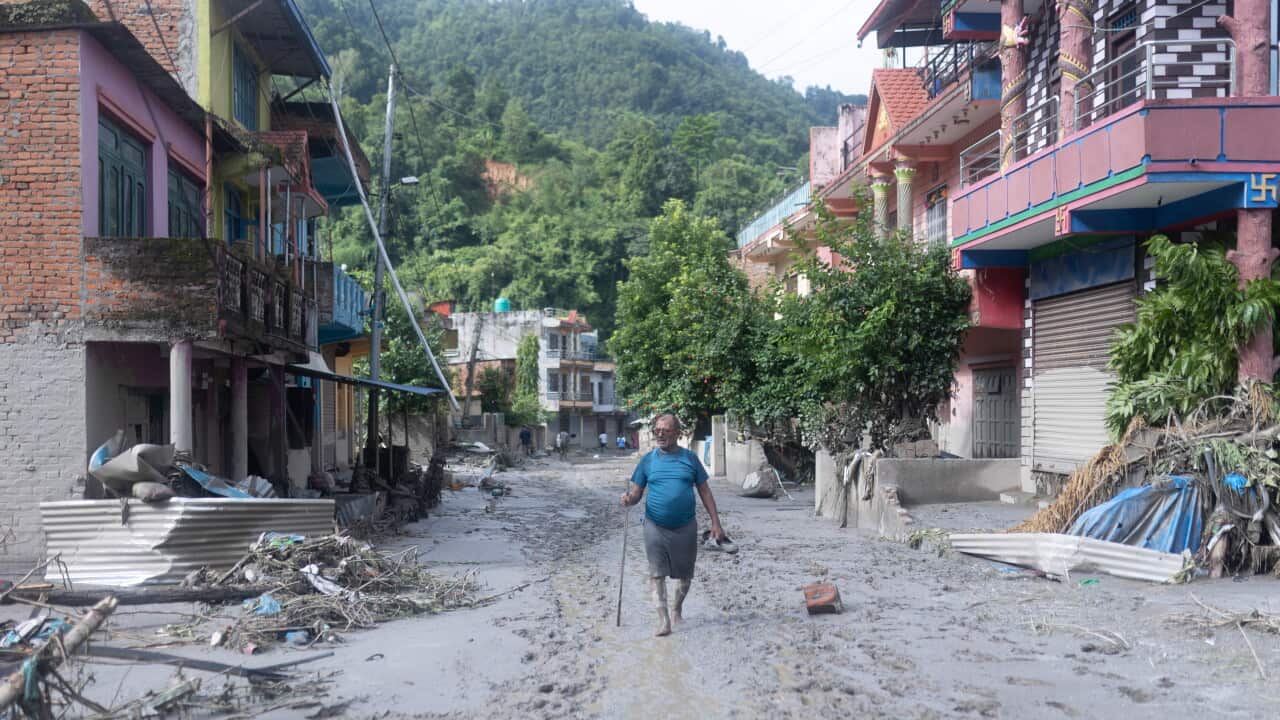
Australian authorities are urgently trying to reach a woman who made contact with family after surviving catastrophic flooding on the Nepal-China border.
The Department of Foreign Affairs and Trade (DFAT) is engaging with local authorities on plans to assist the woman, who is understood to have been last reported in a remote area several days' hike from Kathmandu.
At least 38 Australians remain missing after an ice avalanche on Wednesday triggered Nepal's worst natural disaster in more than a decade.
Heavy continued rainfall is making rescue conditions difficult and unpredictable.
Further severe flooding, landslides and debris flows are predicted in the affected areas of Nepal and Tibet while a lake formed by the landslide has started to overflow.
News that makes sense
Your trusted source for staying up-to-date with the world around you. Get free daily news updates and analysis, straight to your inbox.
At least 538 people have died, Nepalese authorities said, while almost 1,000 remain missing.
Australian woman Sumi Adhikari was on a pilgrimage on the China-Nepal border when the catastrophic flash flooding hit.
Her husband Kailash Mansowar, who has not heard from her since, has travelled to the region from Sydney to find her, guided only by her iPhone's last location.
"I am here in Nepal now (since) yesterday and working with local authorities to find further information," he told the Australian Associated Press (AAP) on Friday.
Like many missing Australians, Adhikari was undertaking a group tour, in her case with the Isha Foundation.
She left Kathmandu on 14 August after flying from Sydney to trek to a sacred site near Tibet's Mount Kailash.
"Even the smallest piece of information could help bring her home," a widely shared post on social media announcing her disappearance reads.
A separate group of 15 Australians, including two boys aged 11 and 14, were travelling with US-based tourism operator Himalayan Glacier Adventure and Travel Company.
Sydney doctor Manoj Dharmaratnam, who was invited to join the sacred pilgrimage but chose not to go, prescribed several of his friends altitude medication and conducted injury assessments before they left Australia.
"One of them had an injury and I did tell her, maybe you're not fit to go on this trek," Dr Dharmaratnam told AAP.
"She actually called up and cancelled her trip ... but then she said I've bought the ticket, so I might as well go."
The Himalayan Glacier group included a well-respected Sydney couple with two sons in their 20s, both studying medicine in NSW, he said.
At least four Australians were travelling separately to tour groups, Foreign Minister Penny Wong said on Friday.
Wong said the federal government would send additional personnel to the region and unveiled a $5 million assistance package and humanitarian support.
An initial team of three humanitarian response specialists will be sent to help 20 staff already on the ground in Nepal.
But Chinese and Nepalese authorities say local rescue efforts could be complicated by further flooding, caused by a build-up of debris.
Nepal's National Disaster Risk Reduction and Management Authority on Thursday warned a lake was forming above the Rasuwagadhi border.
By Friday it had begun to overflow.
The Lhendi River had been obstructed about 18 kilometres above the border, posing a risk to residents in areas below, it said in a statement on social media.
The threat of a second flood caused by a blockage upstream led to evacuation orders at Jilong Port on the Nepal-China border, according to the International Centre for Integrated Mountain Development.
Rocks, boulders and debris lodged in the valley, as well as lakes forming along the plateau, could cause further flooding, geoscientist Jakob Steiner told AAP.
"Unfortunately it's not over ... this material is only going to lie there. We cannot move it away," Steiner, a fellow at the Asian Mountain Alliance, said.
"Every time a new flood comes, it's going to move this, and this is just going to increase future flood events in terms of impact."
For the latest from SBS News, download our app and subscribe to our newsletter.







