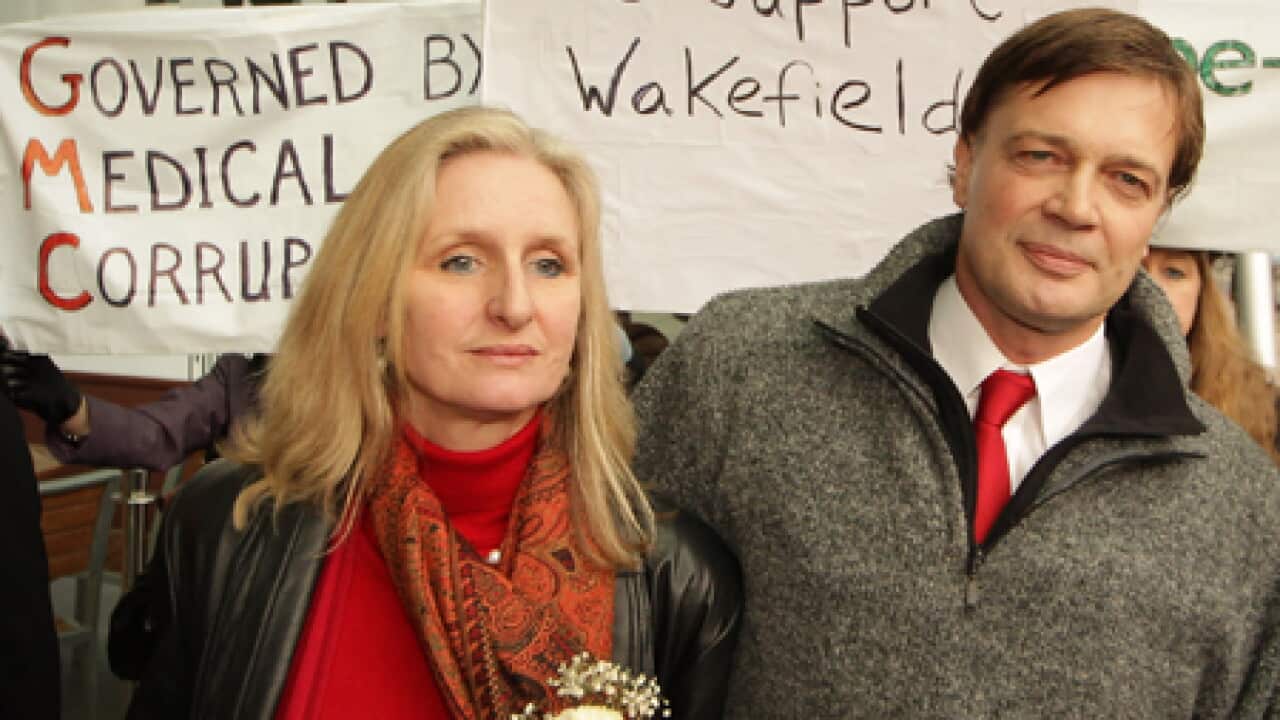
In an interview late Wednesday with CNN, Andrew Wakefield denied inventing data and blasted a reporter who apparently uncovered the falsifications as a "hit man" doing the bidding of a powerful pharmaceutical industry.
"It's a ruthless pragmatic attempt to crush any investigation into valid vaccine safety concerns," Wakefield said.
News that makes sense
Your trusted source for staying up-to-date with the world around you. Get free daily news updates and analysis, straight to your inbox.
"He is a hit man," Wakefield said of journalist Brian Deer. "He's been brought in to take me down because they are very, very concerned about the adverse reactions to vaccines that are occurring in children."
When asked who he meant by "they," he said Deer "was supported in his investigation by the Association of British Pharmaceutical Industries, which is funded directly and exclusively by the pharmaceutical industry."
In stunning charges Wednesday, the BMJ said the 1998 study that unleashed a major health scare by linking childhood autism to the measles, mumps and rubella (MMR) vaccine was an "elaborate fraud," and said the paper was a crafted attempt to deceive, among the gravest of charges in medical research.
The study unleashed a widespread parental boycott of the vaccine in Britain, and unease reverberated also in the United States, Canada, Australia and New Zealand.
Wakefield and his team suggested they had found a "new syndrome" of autism and bowel disease among 12 children.
They linked it to the MMR vaccine, which they said had been administered to eight of the youngsters shortly before the symptoms emerged.
But not one of the 12 cases, as reported in the study, tallied fully with the children's official medical records, and some diagnoses had been misrepresented and dates faked in order to draw a convenient link with the MMR vaccine, BMJ said.
Wakefield, a consultant in experimental gastro-enterology at London's Royal Free Hospital at the time of his paper, shot back, insisting the "truth" was is in his book about the long-running scandal.
"The book is not a lie, the study is not a lie. The findings that we made have been replicated in five countries around the world," he said.
"I did not make up the diagnoses" of autism."
Experts say the study's results have never been replicated.
When asked why 10 of his co-authors retracted the interpretations of the study, Wakefield said: "I'm afraid the pressure has been put on them to do so.
"People get very, very frightened. You're dealing with some very powerful interests here."







