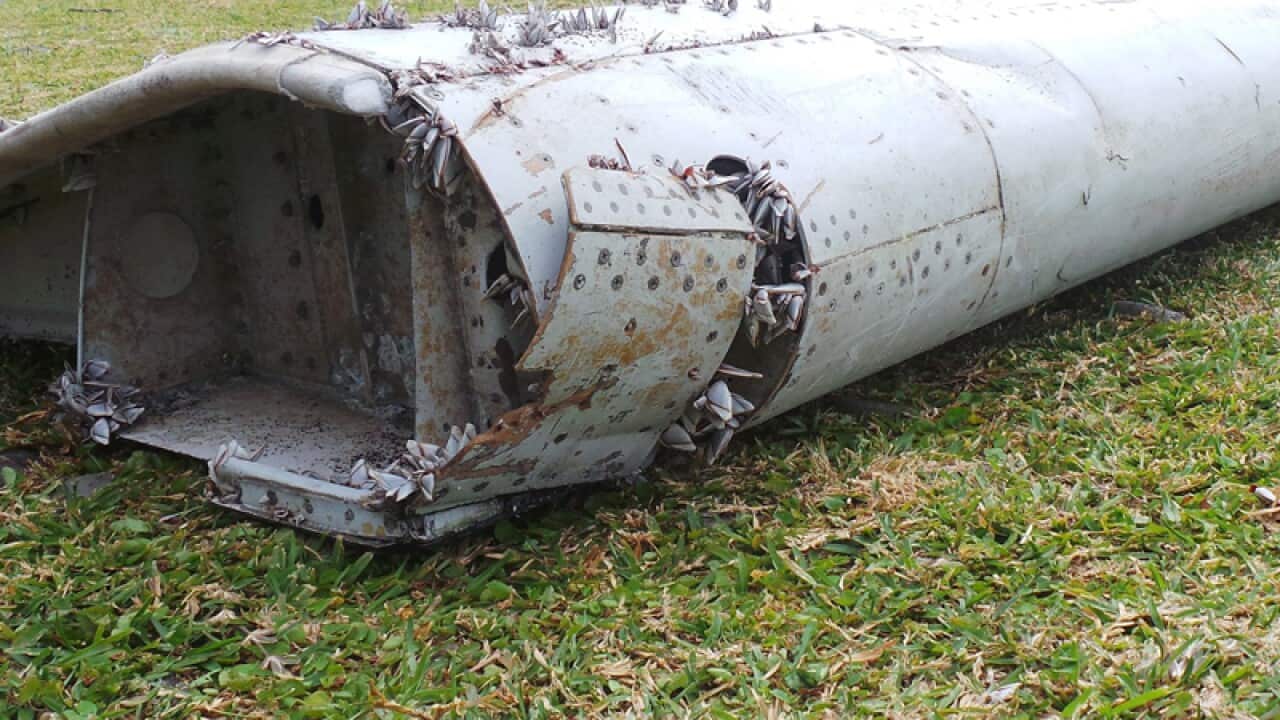
Barnacles encrusted on a piece of plane debris that washed up on the French island of Reunion might help unravel the mystery of missing Malaysia Airlines flight MH370 that disappeared last year with 239 passengers and crew on board.
Malaysia said on Sunday the piece of debris, a 2-2.5 metre (6.5-8 feet) wing surface known as flaperon, had been identified as being from a Boeing 777, the same model as the missing Malaysian plane. Investigators in France are expected to determine whether the piece came from MH370 or not by Wednesday.
MH370 is believed to have crashed in the southern Indian Ocean, about 3,700 km (2,300 miles) away from Reunion.
Based on photographs, ecologists in Australia believe the crustaceans clinging to the wing piece are goose or stalk barnacles.
"Barnacle shells ... can tell us valuable information about the water conditions under which they were formed," said Ryan Pearson, a PhD student at Australia's Griffith University who is studying the shell chemistry of barnacles to determine migration patterns of endangered loggerhead turtles.
News that makes sense
Your trusted source for staying up-to-date with the world around you. Get free daily news updates and analysis, straight to your inbox.
The technique is also used to study the movement of whales. Experts analyse barnacle shells to determine the temperature and chemical composition of the water through which they passed to help reveal their origin.
While the technique could help narrow the area of the search for MH370 to within tens, or hundreds, of kilometres, it was unlikely to pinpoint an exact location, Pearson said. Barnacles can be aged, based on growth rates and size.
If the barnacles on the debris are older than the date MH370 went missing, it would rule it coming from that plane, said Melanie Bishop a professor at the Department of Biological Sciences, Macquarie University.
Ecologists would look at whether the barnacles were on the surface of the flaperon or confined to the sides as that could indicate whether the debris moved on the surface of the water or was submerged.
The investigators in France would also be on the lookout for other organisms such as tube worms, coralline red algae or shellfish that could also provide clues. Marine archaeologists study barnacles for clues about shipwrecks but this was believed to be the first time they will be studied to determine the fate of an airliner.
"It's a nice example of the unexpected ways that discovery research can be surprisingly useful in tackling new problems in different contexts," said professor Angela Moles, evolution and ecology research centre at the University of New South Wales.
(Reporting by Swati Pandey; Editing by Robert Birsel)







