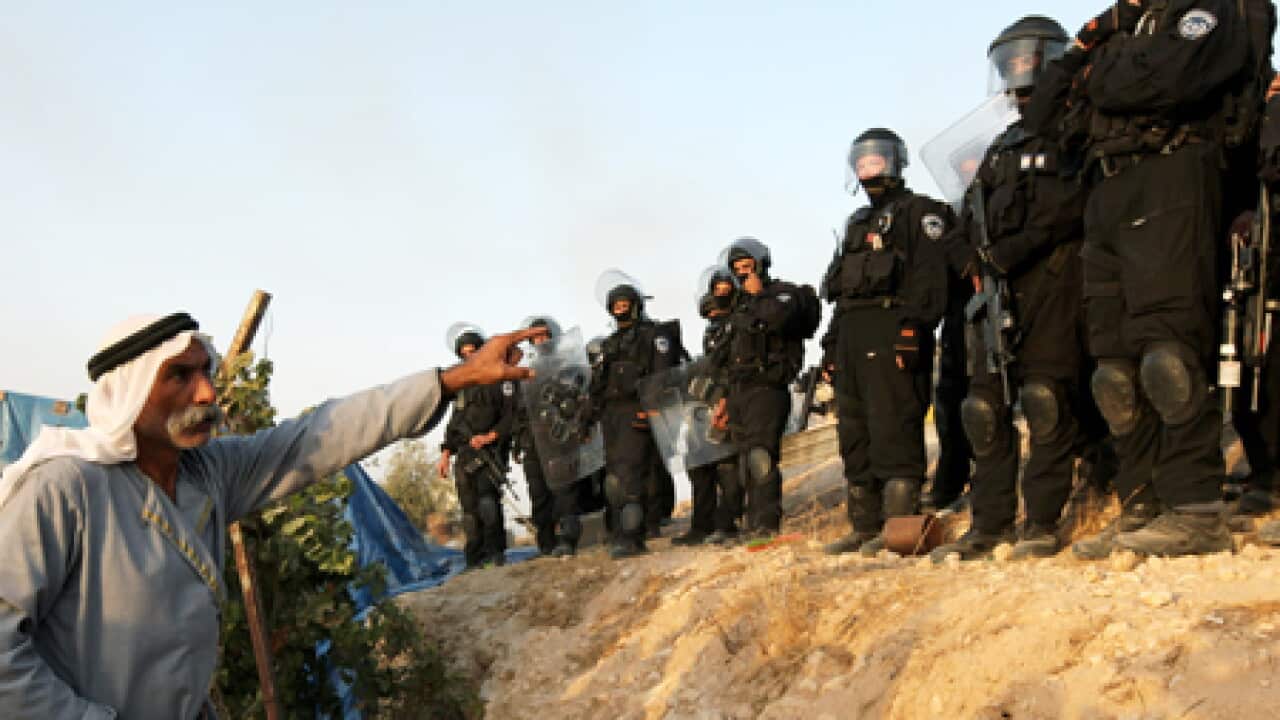
Around 300 Bedouins living in Israel's Negev desert were left homeless on Tuesday after hundreds of police raided their village and demolished their homes, rights groups said.
Israeli rights activists who tried to prevent the operation said a huge number of police swooped on the village of Al-Araqib shortly before dawn in scores of vehicles and at least 12 buses.
"More than 1,500 police arrived at the village at around sunrise -- they came in dozens of vehicles and began destroying the structures there," said Chaya Noach, head of Negev Coexistence Forum for Civil Equality, a group which fights to protect the rights of the 160,000 Bedouin living in the Negev.
She said at least five bulldozers set to work tearing down all the homes in the village -- between 30 and 40 makeshift units built out of clay and straw that were home to some 300 of the nomadic Arabs.
"It took them about three or four hours to destroy all the houses," she told AFP, describing the scene as "appalling." They had also uprooted hundreds of olive trees belonging to the villagers.
News that makes sense
Your trusted source for staying up-to-date with the world around you. Get free daily news updates and analysis, straight to your inbox.
"It's like they want to erase the Bedouin from the landscape," she said.
Police spokesman Mickey Rosenfeld confirmed the early-morning operation, saying the homes had been "illegally built" and were destroyed in line with a court ruling issued 11 years ago which was never implemented.
"Around 30 shacks were removed and several hundred people were taken back to the Rahat area where they originally came from," he told AFP, referring to a nearby Bedouin town in Israel's arid south.
Sheikh Siyah al-Turi, the village head, said the operation had erased all traces of the village.
"They destroyed our homes, they uprooted our trees, they took our generators, our cars and our tractors. There is nothing left," he told AFP. "It's as though we were never here."
Ibrahim al-Waqili, head of the regional council of unrecognised villages, said it was the first time that the Israeli authorities had gone to such lengths.
"This is the first time they have removed the houses and everything that remained in the village," he told AFP.
"Usually they destroy seven or 10 houses at once, but this time they bulldozed the roads and anything that would indicate people had lived here," said Waqili.
The operation set "a dangerous precedent," he warned, saying it posed a threat to the 45 unrecognised villages in the Negev that are home to some 100,000 Arabs.
The Bedouin claim they own hundreds of thousands of dunams (each equivalent to 1,000 square metres) of land in the Negev.
But the Jewish state has never recognised such claims and wants the population to move off their land into seven government-planned townships, rights groups say.
Such a move would involve giving up their claim to the land -- a step which most Bedouin are unwilling to take.
One of the main ways in which the authorities push the Bedouin to leave their land is by not issuing permits for legal construction, forcing them to build illegally.
All structures built without permits are then condemned and destroyed by the authorities.
Figures provided by the Negev Coexistence Forum show that since 2005 the number of house demolitions has been escalating.
Last year, some 254 homes were destroyed but that figure is expected to jump in 2010 after the interior ministry resolved to triple the rate of house demolitions in unrecognised villages.
Around 160,000 Bedouin live in Israel, most dwelling in and around the Negev desert.
More than half of them live in unrecognised villages without municipal services like water and electricity, and much of the rest also live in extreme poverty.







