
In brief
- Australians are resorting to eating expired food to save money, according to a new survey.
- At the same time, more than 7 million tonnes of food is wasted in Australia each year, amid confusion over what's actually expired and what isn't.
As Australians look for ways to cut grocery costs, confusing food date labels could be driving people to throw out food that's still perfectly safe to eat.
New survey data from financial comparison site Finder suggests 14 per cent of Australians say they've resorted to eating expired food to save money, while 68 per cent of the 1,010 survey participants said they've taken money-saving measures to afford food.
At the same time, confusion over what "use-by" and "best-before" dates actually mean could be costing households at the other end.
OzHarvest has been campaigning for reforms to Australia's date label system, arguing that "evidence has moved on" since it was established more than two decades ago.
The food rescue organisation says date labelling is a major driver of unnecessary food waste.
News that makes sense
Your trusted source for staying up-to-date with the world around you. Get free daily news updates and analysis, straight to your inbox.
Research commissioned by the group found food reaching its best-before or use-by date was the most commonly cited reason for disposal, reported by 58 per cent of high-wasting households and 44 per cent of low-waste households.
"Consumers are really confused by the difference between best-before and use-by," said RMIT associate professor Lukas Parker, who has authored research on the topic with End Food Waste Australia.
"We know it's around 50 per cent or more of people just don't know the difference," he told SBS News.
A 2021 government-backed national study estimated Australian households throw away up to $2,500 worth of food each year, with 7.6 million tonnes of food wasted annually — around 300kg per person.
When is food actually expired?
The term "use-by" means the food carrying the label can only be guaranteed safe to consume until that date. Highly perishable products like fresh meat might carry this label.
A "best-before" date, on the other hand, means the product is still safe to consume after that date, but it might no longer be at its best. Products like cereals and pasta might come with a "best-before" label.
Food suppliers are responsible for putting these dates on their products.
According to Food Standards Australia New Zealand, you can still eat foods for a while after the best-before date. They may have lost some quality, but they can still be sold and consumed after the best-before date has passed.
Foods cannot legally be sold after the use-by date, the food standards regulator says.
But many consumers treat both dates the same, according to OzHarvest, meaning food that's safe to eat ends up in the bin.
The 'sniff' test?
OzHarvest says people should trust their instincts and senses when deciding whether food past its date needs to go in the bin or is still safe to eat.
"Sniff a product, look at a product, taste it to see if it is okay," its national policy and advocacy lead Katinka Day says.
"We're really supportive of additional information on packets next to that best-before label that encourages people to think, to sniff, look, taste."
The organisation is also advocating for certain products, including milk, to be moved from "use-by" labelling to "best-before", encouraging consumers to use their senses to assess whether a product is safe to consume.
In the UK, some major supermarkets have replaced use-by dates with best-before dates on milk in a bid to reduce the hundreds of thousands of tonnes of milk wasted each year. Consumers are instead encouraged to use a sniff test to determine whether it has spoiled.
Food safety experts agreed that sensory cues can be useful for foods past their best-before date, but warned the "sniff test" shouldn't be treated as a blanket rule for determining whether any food is safe to eat.
Food Safety Information Council CEO Lydia Buchtmann warned that relying on a smell alone for certain products can be dangerous, telling SBS News that food can smell completely normal and still contain disease-causing bacteria or viruses.
Julian Cox, an associate professor of food microbiology at the University of New South Wales, said the level of risk depends on the type of food.
For example, he told SBS News shelf-stable products like cereals that have passed their best-before date are generally safe to assess via a smell test.
For more perishable foods, however, the picture is more complicated. While it's easy to detect if an orange has gone mouldy, he said, a piece of cut rockmelon is a "beautiful growth medium for bad bugs" that might still look and smell normal.
For items like meat, he said, a use-by date means exactly that.
Preventing food waste — and saving money
Clearer date labelling could help consumers keep food for longer, reducing both household costs and the environmental impact of food waste.
Parker said his research initiative has been working to reimagine the way labels are presented to consumers.
"[We are] looking at ways to help avoid the confusion of the dates, but also providing consumers really helpful ways to extend the life of their food," he said.
Some brands have already started implementing changes, including Nestlé, which has introduced a label on some of its MAGGI instant noodles products that reads: "If past the date, sniff, look or taste to avoid food waste".
Parker said: "Something like instant noodles, for instance, is going to last a very long time, and they're really well kept inside plastic and very stable."
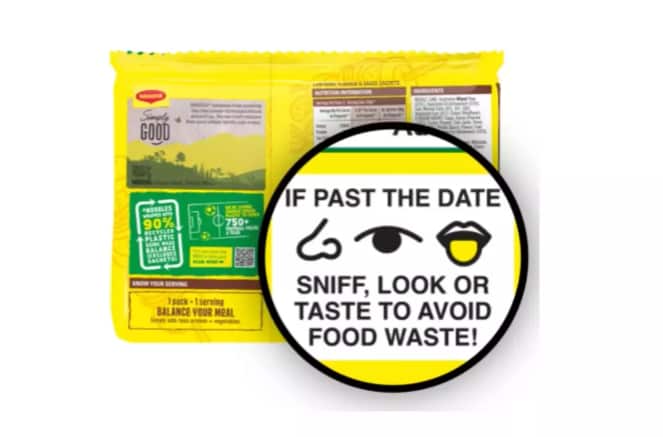
"So the best-before is really just a date that people should be using as a means to rotate the food in their house, rather than actually something that would you would use to throw out food."
Cox said consumers can extend the shelf life of food with a best-before date by paying attention to storage conditions and whether the packaging has been opened.
"The idea of the cool, dark place for even quite shelf-stable foods is really important," he said.
— With additional reporting by the Australian Associated Press.
For the latest from SBS News, download our app and subscribe to our newsletter.







