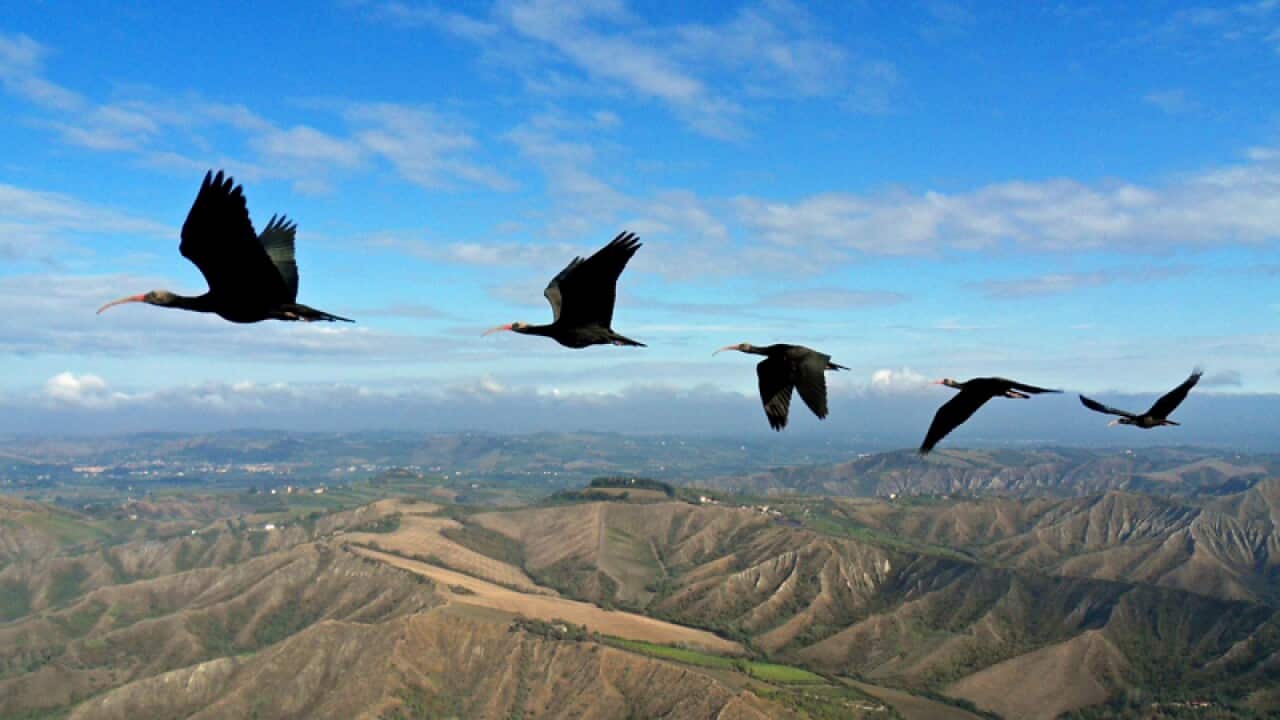
The next time you see birds flying in a V, consider this: A new study says they choreograph the flapping of their wings with exquisite precision to help them on their way.
That's what scientists concluded after tracking a group of large black birds - each equipped with a tiny GPS device - that had been trained to follow an ultralight aircraft.
One expert in animal flight said just gathering the data, which included every wing flap, was a remarkable accomplishment.
Scientists have long theorised that many birds like these rare northern bald ibises adopt a V formation for aerodynamic reasons.
When a bird flies, it leaves a wake. The idea is that another bird can get a boost from an updraft of air in that wake by flying behind the first bird and off to the side. When a bunch of birds use this trick, they form a V.
News that makes sense
Your trusted source for staying up-to-date with the world around you. Get free daily news updates and analysis, straight to your inbox.
It's been difficult to study this in the wild, but researchers from the University of London's Royal Veterinary College and elsewhere met that challenge by partnering with a conservation program that is trying to reintroduce the endangered wading bird in Europe.
For about a decade, the program has hand-reared ibises from zoos and taught them their migration route by leading the way with a piloted ultralight craft. Normally, the leader of a V-formation would be a parent bird.
With the program's help, the researchers tracked 14 juvenile ibises as they migrated between Austria and Italy.
An analysis of a seven-minute period showed that when the ibises flew in a V, they positioned themselves in just the right places to exploit the updraft in another bird's wake, which lets them conserve their energy.
They also appeared to time the flapping of their wings to take full advantage of that updraft, by making a wingtip follow the same undulating path through the air as the wingtip of the bird up ahead. It's like one car following another on a roller coaster.
And when one bird flew directly behind another instead, it appeared to adjust its flapping to reduce the effects of the wake's downdraft.
So birds can either sense or predict the wake left by their flock mates and adjust their flapping accordingly, a remarkable ability, the researchers say.
The scientists reported their results online on Wednesday in the journal Nature.
It's the first experimental evidence that birds can adjust their flapping to take advantage of the wake, Florian Muijres and Michael Dickinson of the University of Washington wrote in an accompanying commentary.
Kenny Breuer of Brown University, who did not participate in the work, said collecting the study data from the free-flying birds was "quite an astonishing feat."







