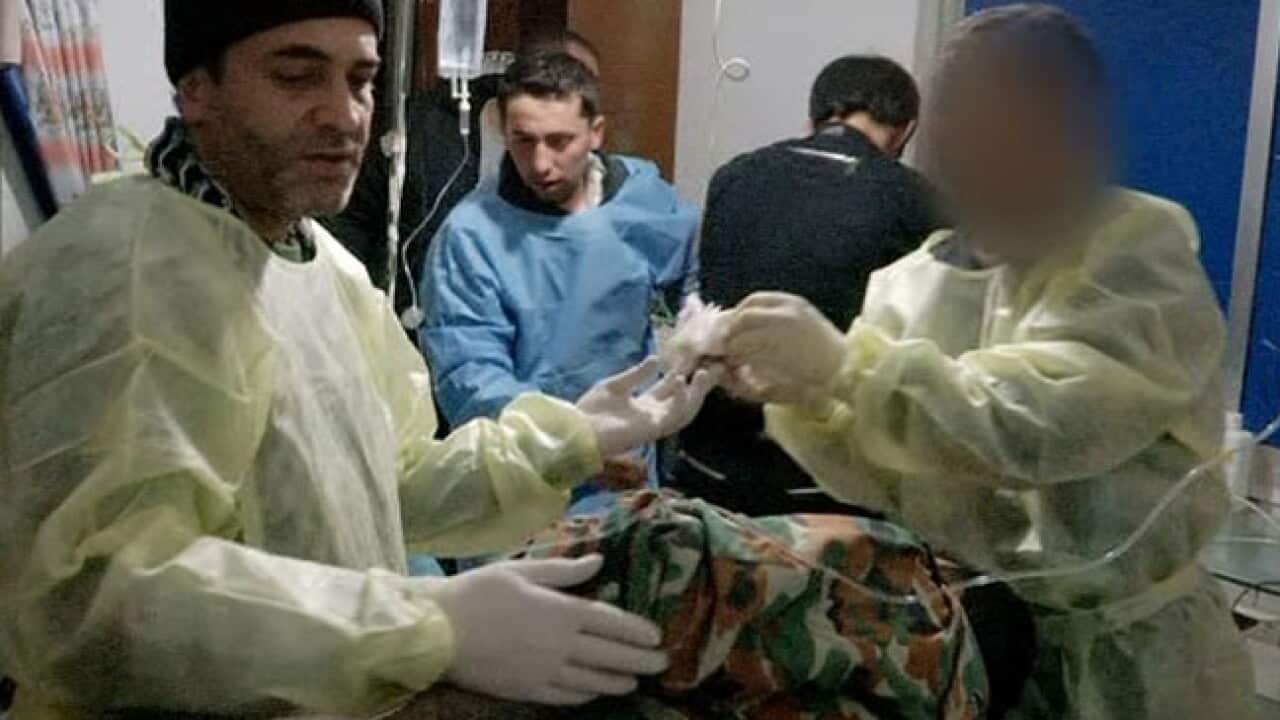
On Dateline, Evan Williams gets a fascinating insight into life on Syria's frontline through the eyes of Dr Rami Habib. He constantly risks his life to run a makeshift hospital to care for sick and injured locals. Evan blogs about the challenges facing ordinary people in Salma every single day.
The darkness of night enveloped our van as we moved slowly along the empty freeway. The road led from the Turkish border directly towards the frontline of Syrian government forces and their merciless roaming militia.
We were with Dr Rami Habib, a paediatrician who'd lived for nine years in Leicester in the UK. He was heading back to Salma, a town right on that frontline that was in the hands of the Free Syrian Army. We were in fact in Free Syria, a swathe of mountainous countryside controlled by the Sunni rebels.
News that makes sense
Your trusted source for staying up-to-date with the world around you. Get free daily news updates and analysis, straight to your inbox.
It was in Salma that Rami had set up a frontline field hospital. The town and all the villages around it were regularly hit by artillery shells, tank rounds and rockets fired by government forces on three main mountaintops around Salma.
And there was another threat… barrel bombs thrown out of helicopters that hover directly over their targets. They are basically barrels filled with high explosives and scrap to create razor-sharp fragments of red-hot steel that rip through brick, bone and flesh.
"My mother asked me why go back, you have a nice job, a good future," said Rami from the front seat as we got closer to Salma. "I said, mum, if every mum thought like that there would be no-one left to work. I am competent to do this work, and I want to do it."
The van struggled up a hill and the men fell silent. Rami turned to us, "We are now entering the HD road, it's called this because it means High Definition. It's kind of a joke because the government gunners can see this section of the road very very clearly and often fire shells at vehicles using it."
We put our helmets on. The men all started praying in Arabic, "I bear witness. There is no God but Allah, and Mohammed is his messenger." Rami turned again, "This may be our last prayer, our fate is in the hands of Allah, a shell either has your name on it today or not."
I couldn't help wondering how unfair that would be if someone had their number come up and he was in the van and we all died because the shell got him. Then maybe it would be my number and it would be unfair on everyone else. "Let's hope we are lucky tonight, God willing," smiled Rami, turning back to face the front.
The driver then switched the lights off and sped up as we swerved down the HD's 500 metres of terror. It's amazing how much can go through your mind in those few minutes, every second waiting to hear the thump of a tank gun firing at you. Rami and his team do this several times a day, every day.
We spent almost two weeks inside Salma with Dr Habib and his team at the frontline hospital. They treated people who had crashed their motorbikes because they had turned off their lights to avoid being hit by shells, adults on the brink of diabetic comas, children with chest infections, a man with a small piece of shrapnel in his knee and many more. It was a constant stream.
All of them have to risk death by travelling on exposed roads that can be shelled at any time. Rami could be hit by a shell every time he drives out to a house call or on one of his many logistical missions essential for the running of the hospital.
On one mission, we followed him as he checked up on a small girl called Rasha. He had treated her for a chest cough. She had recovered and showed us the tiny cave she and her family use to hide from the shells and barrel bombs.
As we sat down for a cup of strong Turkish coffee, Rasha came up to me away from the other men and almost whispered to me fixing me with her huge brown eyes, "We have suffered a lot already, please help us."
Watch Evan's story on Dateline and read more now on the Dateline website.







