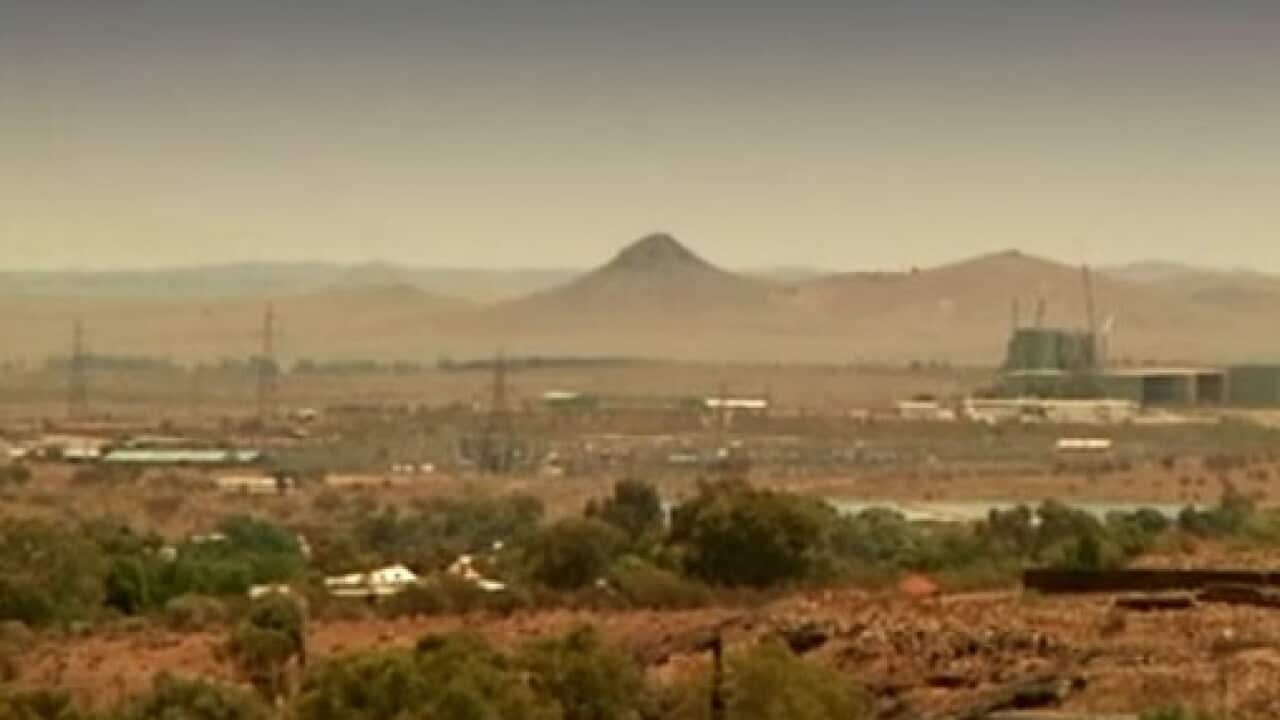
Spend time in Broken Hill, and a few things become quite clear.
This is a mining town. It has always been a mining town, and as far as the locals are concerned, it's not set to be anything but a mining town any time soon.
News that the NSW government has permitted uranium prospecting drew a few headlines last year, not to mention condemnation from anti-nuclear activists.
News that makes sense
Your trusted source for staying up-to-date with the world around you. Get free daily news updates and analysis, straight to your inbox.
But here in far western NSW, where the state's best deposits of uranium are thought to be, hardly anyone's blinking an eyelid.
If there's a person in the industry who knows his way around Broken Hill's future mining prospects better than Wolf Lehy, I'd be hard pressed to meet him or her.
He's a freelance geologist who has worked under the beating sun around the Barrier Ranges for decades.
Lehy takes me to the top of Big Hill, where land which has supported miners for generations, stretches to the South Australian border.
Broken Hill Prospecting (not the same BHP) holds the rights to prospect for cobalt here, and it's put in an application for uranium prospecting on the block of land.
He says those in the industry have long known there's uranium around Broken Hill.
'No it's never been a secret', he laughs from under his sunglasses and cap.
'There are showings in the district.'
The end of the NSW government's ban on uranium applications has prompted a rush in exploration applications.
39 applications have been made across the state - many around Broken Hill and far western NSW. Broken Hill Prospecting have made a handful of them, but this is the only site they're letting on to.
Many in the industry, Lehy included, say it is an odd step for the government to only allow applications for prospecting at this stage, not mining; everyone in Broken Hill seems to know it is there, waiting to be dug up and sold overseas.
'It's been proven both in the basement rocks and the overlying younger sediments to be present', he says.
JOBS FIRST
It's no surprise when Lehy backs up what everyone else in town thinks - at least on the record - another mine would be good news, whatever the resource.
While here on assignment I try endlessly to find someone opposed to the idea of uranium mining. Balance, after all, is what journalists are taught to strive for. Even 'vox pops' - that tried and tested last resort - wield little in the form of opposition to uranium mining. Jobs are jobs, seems to be the logic.
There have been demonstrations in the past against uranium, but I hear several people criticise the 'rentamobs' who allegedly brought them to town.
Several prominent unions and NSW Labor and are opposed to mining uranium, hence the ban on prospecting which had stood for several decades.
Victoria is the only state with an outright ban on prospecting for, with the exception of Tasmania.
But Broken Hill is a long way from Sydney, physically and psychologically. Amongst the unions, one official tells me he is in favour - in contrast to his party's official line. But he's not keen on chatting on camera.
With mining the very cause of its founding, it's not the type of place where environmental concerns play strongly locally. With a global market for uranium - that view's reflected by the local state MP.
'If there is a brighter future it is about mining,' John Williams begins. 'It is probably not the most desirable material to mine but it employs people and it creates an economy.'
He talks about the need to replace fossil fuels and, when it comes to safety, says that many Broken Hill miners have already worked in uranium mining just over the border in South Australia - in places such as Roxby Downs, without noticeable downsides.
'Clearly to me over the years that they've mined at Roxby we've seen no evidence of people being affected by exposure to radiation', Williams says, before he dryly bets that he'll 'get a load of emails now.'
INDIGENOUS DECISIONS
Reports late last year claimed the Broken Hill Aboriginal Land Council was considering its own application for uranium prospecting. But try as I might, the council was not keen on elaborating.
The NSWALC put in its own application to prospect for uranium on the East Coast, and, as a looming demonstration shows, there's unhappiness amongst some local land councils at its alleged strong-arming.
In the end the Broken Hill Land Council did not put an application in before the deadline. The NSW Aboriginal Land Council was prepared to confirm it had discussed an application for uranium mining on behalf off BHALC, but said that was protocol.
There's no doubt that talk on uranium mining in western NSW is still in its very early stages.
But in the area, there are some traditional owners of the land who are far from convinced of its benefits.
Wilcannia lies on the banks of the Darling River east of Broken Hill. These days, many traditional owners from Western NSW live here.
One of them is William Bates, a man who fought against uranium mining in South Australia in the early 1980s.
He's the chair of Broken Hill's neighbouring Mutawintji land council. Because of the nascent stage of development, whether there's uranium under that arid piece of NSW taken up by the indigenous-run national park is not certain, but he is sure the prospectors will come knocking sooner or later.
'I'm against it because it's not safe, mining companies are always stuffing up' he says when I pull up in Wilcannia on a scorching afternoon. 'They might have an accident.'
He's not opposed to mining and the potential economic benefits for Indigenous people in the region.
We discuss Marcia Langton and her recent Boyer lectures on economic development via mining, before Bates tells me he and colleagues have been looking into mineral sands exploitation south of Wilcannia.
But not everyone is looking to make money from uranium
'My grandmother always said 'don't you welcome people to country son'
When I hit the baking tarmac to drive back East, his words ring in my ears.
Follow @billcode on Twitter.







