Lime blossom, coffee, chanterelles. That's what sommeliers detected sampling two centuries-old Champagne salvaged from the wreckage of a schooner at the bottom of the Baltic Sea.
The flavours that came to my mind were yeast, honey and - I dare say - a hint of manure.
The antique bubbly was barely bubbly after its long sleep in the cold and murky Nordic waters. But I couldn't help feeling a thrill as I took a swill of history captured in that cloudy, golden liquid.
After all, I was drinking the world's oldest Champagne - or at least one of the oldest.
Connoisseurs haven't been able to exactly date the 168 bottles raised from a shipwreck near the Aland islands, a windswept archipelago between Sweden and Finland. All they can say is they are from the early 19th century and astonishingly well-preserved.
News that makes sense
Your trusted source for staying up-to-date with the world around you. Get free daily news updates and analysis, straight to your inbox.
I was among 20 people invited to the tasting in Mariehamn, the capital of the island group. We were given a choice between two bottles: a Veuve Clicquot or a Juglar, a now defunct champagne house.
"Easy," I thought. "The Juglar doesn't exist anymore. Got to try it."
I raised a wine glass containing about a few centimetres of champagne, tiny pieces of cork and very little fizz. A mushroomy flavour soon gave way to sweet notes of honey. It tasted like a sugary desert wine.
That's not unexpected - Champagne in the 19th century was a lot sweeter than it is today.
A standard bottle of Champagne now has about nine grams of sugar, said Stephane Gerschel, a spokesman for Veuve Clicquot, founded in 1772. In the 1830s, the house used more than 100 grams of sugar per bottle - and even that wasn't sweet enough for some.
"In Russia, the trend was to serve Champagne with a spoonful of sugar," Gerschel said.
Tastes have dramatically changed since then, and some contemporary Champagnes are now lauded for their bone-dry finish.
At least three of the 11 bottles opened so far from the Baltic wreckage have "with absolute certainty" been identified as Veuve Clicquot, the company said.
The bottles don't have labels but experts could tell they were Veuve Clicquot by the branding of the corks, which featured a comet - added to pay tribute to one that crossed the skies of Champagne in 1811 "and was rumoured to be the cause of a harvest of remarkable quality."
The shipwreck was discovered in July near the Aland Islands by a group of divers. Researchers say the ship was probably en route from northern Germany to the west coast of Finland with its prestigious cargo when it sank, sometime in the second quarter of the 19th century.
It's not hard to grasp why it went down here. From the air these waters look almost unnavigable, littered with hundreds of skerries and islets, some barely breaking the black surface. One can only imagine the treacherous rocks hiding underneath.
"All bottles are not intact but the majority are in good condition," said Britt Lundeberg, Aland's culture minister.
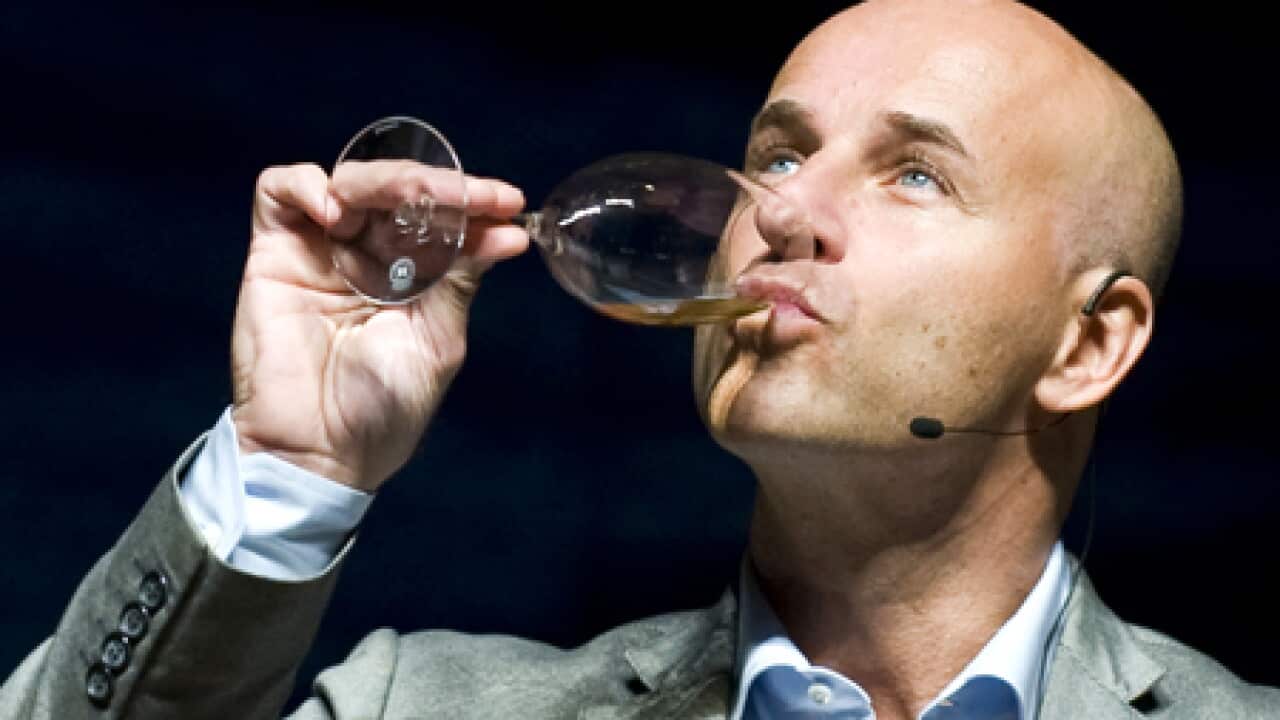
After a presentation showing the diving operation, an archaeologist wearing white gloves presented the two bottles to champagne specialist Richard Juhlin, who sampled both in front of scores of journalists.
"Great! Wonderful!" he exclaimed. Then he paused, soaking in the flavours.
"What strikes you the most is that it's such an intense aroma," he continued. "It's so different from anything you've tasted before."
He found hues of chanterelles, honey, orange and peach in the Juglar; linden blossoms and lime peels in the Veuve Clicquot.
Champagne loses its fizz over time as minute amounts of gas gradually pass through the porous cork. In this case most of the gas was probably lost due to pressure changes when the divers raised the bottles, Juhlin said.
Some of the bottles will be sold by the Aland government, which owns them, at an auction, where Juhlin said they could fetch more than $70,000 apiece. Bottles that are not expected to last may be mixed with newer Champagne to create a fresh blend. The government will hold on to five bottles as archaeological artifacts.
Champagne house Perrier-Jouet, a subsidiary of Pernod Ricard, has earlier stated that their vintage from 1825 is the oldest recorded champagne in existence.
Essi Avellan, editor of Fine Champagne Magazine, said after tasting the Juglar that it resembled the old Perrier-Jouet.
"It's quite sweet, it's very velvety, and has a round smoothness. But perfectly fresh still," she said. "I've also tasted the 1825 in Champagne and it's quite in line with the sweetness level."
The Veuve Clicquot had "a toasted, zesty nose with hints of coffee, and a very agreeable taste with accents of flowers and lime-tree," said Francois Hautekeur, of the company's winemaking team.
Beyond its cultural connotations of festivity, Champagne typically is loved for its freshness, a zesty luxurious quaff that opens the taste buds and stomachs for a big meal to come.
The overwhelming majority of Champagnes serve exactly that purpose. Then there are the ones that are more than aperitifs, mixing the typical headiness with a robustness of taste that can make it at star for almost any course. Often, this is where aging comes in.
Experts were amazed at how well preserved the champagne was. The reason is the Baltic Sea offers perfect conditions for storing Champagne: The temperature is constantly around five degrees C (41 F), there is total darkness, and the water pressure is about 5.5 bars, similar to what's inside the bottle, said Veuve Clicquot's Gerschel.
He believes the taste is very close to what it was when the Champagne was bottled.
"It's like a time machine," he said. "We think it's exceptional that its not only drinkable, but that it still has some fizz, after 200 years."
And about that hint of manure? It doesn't necessarily put me among the philistines.
Sommeliers do find whiffs of cat pee in some French whites.







