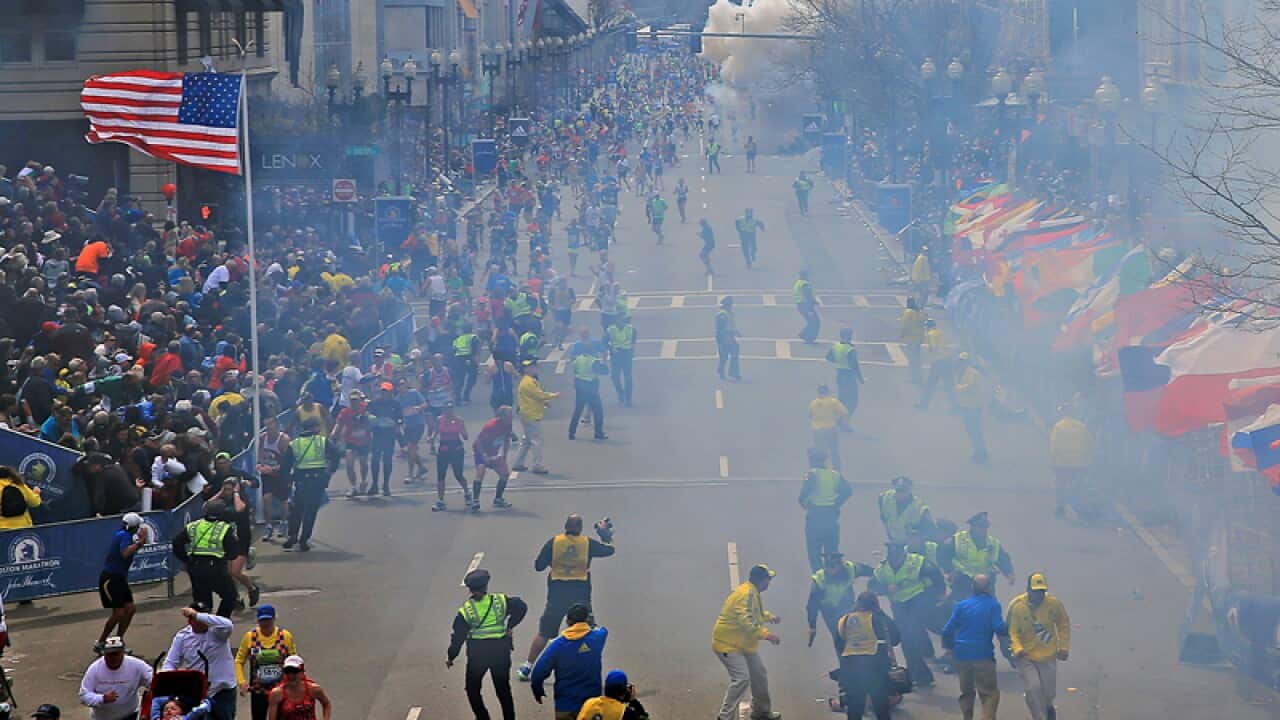
Boston Marathon competitor Phil Vaughn was less than a kilometre from the finish line of when he heard a noise he describes as a 'boom' along the road ahead.
“I didn't even think of it as being anything other than maybe a celebration,” he says. “It didn't even enter my mind that a bomb had gone off.”
Mr Vaughn, who works for an affiliate of CBS News in Boston, was running the race as he'd done twice before, with a GoPro camera strapped to his head.
He knew something had gone wrong when police stepped onto the course to stop runners.
MORE: Phil Vaughn full interview
News that makes sense
Your trusted source for staying up-to-date with the world around you. Get free daily news updates and analysis, straight to your inbox.
“I knew that they don't stop the Boston Marathon for anything trivial.”
“I was one of the first people to be stopped, and I looked back after about 20 seconds."
"Runners were just piling up behind us; there were still a lot of runners of the course.”
He describes the next few minutes as confused and chaotic.
“We started seeing SWAT teams going by us into the finish line area… and then we started seeing spectators come running away from the finish line area towards us, and they looked like they were panicked.”
The Boston Marathon finishes on Boylston Street, in the Back Bay area of Boston.
At the time of the first explosion, about 2.50pm local time, the lead runners had already crossed the finish line.
Mr Vaughn says it was mostly “mid-pack runners, and people who run for charity,” who were in the vicinity at the time.
“And a lot of spectators,” he adds.
An estimated 500,000 people gather in Boston to watch the race, with some 27,000 runners taking part.
“Spectators line the entire course, but for the last, I would say, five kilometres, there are lots of spectators,” says Mr Vaughn.
“I can't even guess to imagine how many there are. They are lined up sometimes ten deep, back from the road."
“And once you get onto Boylston… they're even deeper than that.”
Mr Vaughn didn't have a clear view of the finish line because of a turn in the road. He says police teams prevented him from getting any closer.
"We weren't told to do anything. We were just told that we weren't going to continue towards the finish line."
Reports coming from police and other sources were scarce and often confusing, he says.
"From what the Boston Police Chief was saying, there were two bombs placed in garbage containers. They were relatively small devices."
"I did hear that people were blown through store windows, but I don't know if the explosions occurred outside [or inside]."
University student Patrick Loggins, who attends Berklee College of Music -- also located on Boylston Street -- was on a train under the city when the rail network suddenly stopped.
MORE: Patrick Loggins full interview
"We weren't really sure what was going on at that point, none of us really had cell service," he said.
"Eventually we realised we weren't moving, so people started getting out of the train."
At street level, crowds emerging from the shut-down rail network spilled onto streets already clogged with spectators from the marathon.
Mr Loggins emerged near the Prudential Center, around two blocks from the finish line.
"I couldn't actually see it myself, because by the time I walked up there, they'd started blocking it off," he says.
What he could see was "about a hundred" ambulances heading to and from the scene.
"They were pretty rapidly picking people up... and they were getting police escorts."
"There was definitely a rush to get all those people to the hospitals."







