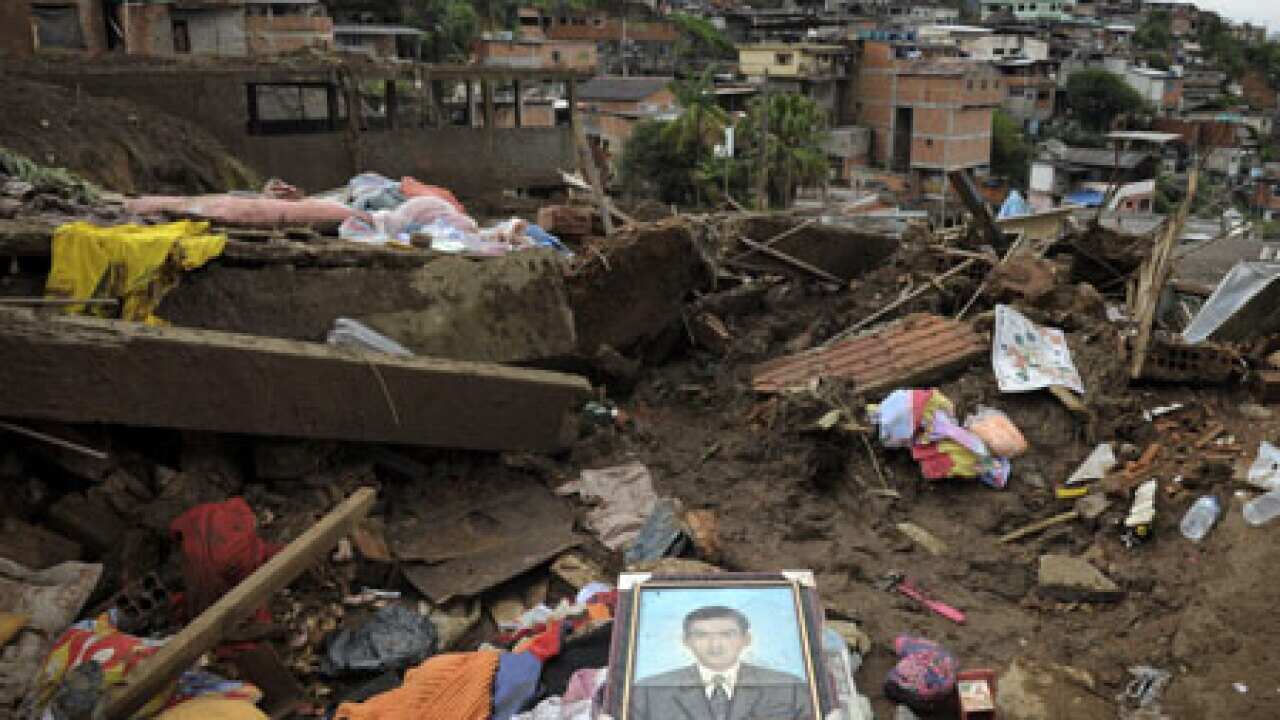
Brazilians emerged on Saturday to face the chaos and destruction left by three days of torrential rains, rivers of mud and landslides that have killed nearly 560 people in the country's worst flood disaster on record.
Emergency workers in the disaster zone, in the Serrana region just north of Rio, were overwhelmed by the body count. Refrigerator trucks had to be brought in to store corpses.
Workers transporting bodies said they feared the overall death toll could more than double as rescuers reached outlying hamlets.
News that makes sense
Your trusted source for staying up-to-date with the world around you. Get free daily news updates and analysis, straight to your inbox.
President Dilma Rousseff declared three days of national mourning to grieve the victims, government news agency Agencia Brasil reported. Rio de Janeiro state authorities said their state will observe a full week of mourning starting on Monday.
As of late Saturday, the toll stood at 558, with the worst-hit towns being Teresopolis, Nova Friburgo and Petropolis. Outlying villages also reported deaths.
"I think in the end we'll see more than 1,000 bodies," said a funeral worker in Teresopolis, Mauricio Berlim. "In one village near here, Campo Grande, there were 2,500 homes and not one is left standing," Berlim said.
Authorities also made an urgent appeal for donations of blood, bottled water, food and medicine.
At least four refrigerated trucks were parked out the front of an overflowing makeshift morgue inside a church in Teresopolis.
At the town's cemetery, a dog curled up at the grave site of his mistress, a woman named Cristina Maria de Santana, refusing to leave even though she had been buried two days earlier, workers told AFP.
Body-recovery efforts have been hampered by tons of mud that, in some cases, have cut villages off and made them accessible only by helicopter - but flights were limited by persistent rain that limited visibility in the rough terrain to just a couple of hundred metres.
At least a dozen remote hamlets remain out of touch, and one witness reported seeing a group of people buried in their car by a river of mud.
Some 14,000 people have been forced to flee their homes, Civil Defence officials said.
Worst tragedy in Brazil's history
The disaster, which media called the worst tragedy of its kind in Brazil's history, struck Wednesday before dawn, as families were sleeping.
Seasonally heavy rains were suddenly intensified by a cold front, dumping a month's worth of precipitation in just eight hours.
Water, food and electricity were lacking in some areas of the Serrana, with authorities struggling to deliver supplies over fully or partially collapsed roads. Telephone communications were unreliable though progressively being restored.
A municipal official in Teresopolis, Solange Sirico, told Brazilian television there was a risk of epidemics breaking out as bodies decomposing in the tropical heat mingled with water runoff.
The official said the 1,200 doctors working in the town were overwhelmed, and medical supplies were needed.
"Also, in all the mountain region, there is a danger of snakes and scorpions," she said.
National guardsmen and soldiers were sent to the region to reinforce police and prevent looting.
Wet weather continues
Forecasters warned that the wet weather was likely to last into next week.
"It will keep raining until at least next Wednesday in the Serrana region of Rio de Janeiro. We are predicting a light but steady rain, which is not good because it could lay the conditions
for more landslides," said the head of the national weather institute, Luiz Cavalcanti.
Forecasters have blamed the unusually wet weather on the La Nina phenomenon which has increased rainfall in southeast Brazil.
"The forecast of more rains is not reassuring," said Rio governor Sergio Cabral, urging residents to abandon their homes in the disaster zones and move to safer ground.
In downtown Nova Friburgo, a layer of mud blanketed the plaza in front of a white church. Bulldozers were brought in to help clear the area.
"It's a total calamity. The town is finished. It was a tourist city, now it's finished," said local resident Zaquequ Pereira Gonacalves, 37.
Originally a 19th century getaway for Brazilian aristocracy, the Serrana region increasingly relied on tourism for their livelihood. As the towns grew, newcomers built on unstable hillsides.
Hotels say they have lost millions of dollars, wiped out by mudslides at the start of their usually lucrative summer vacation season.







