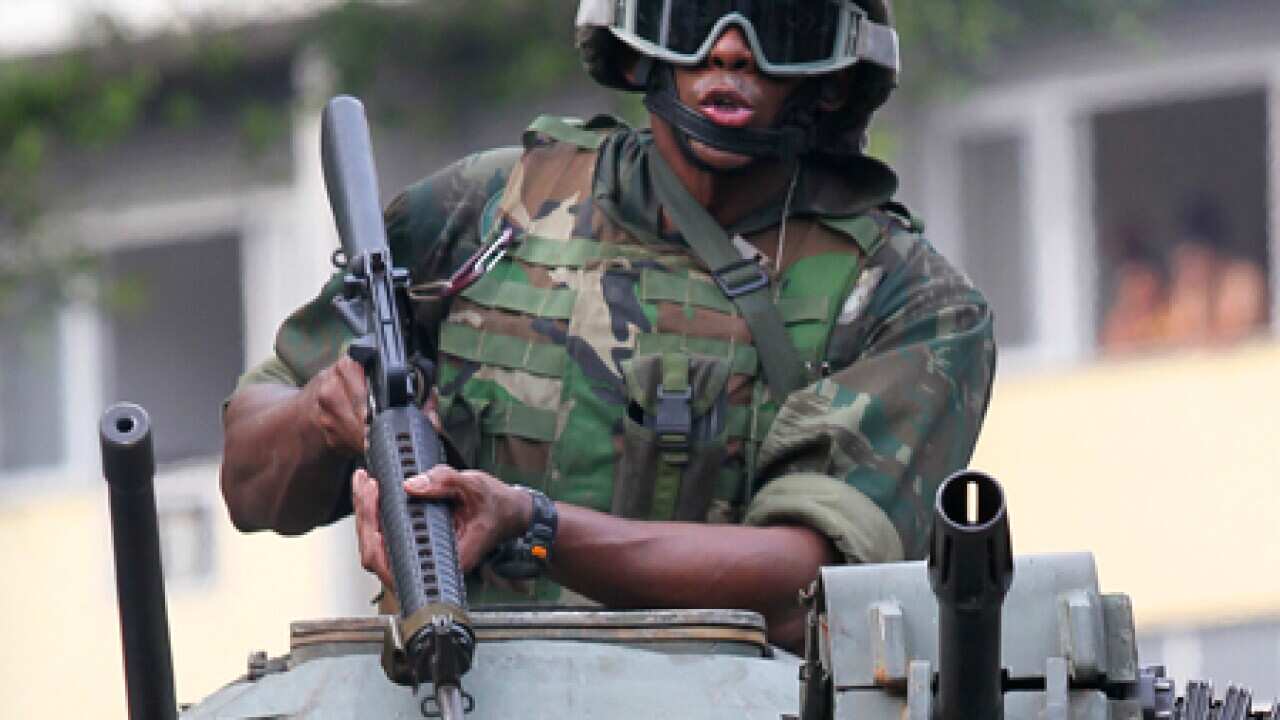
Armored vehicles rumbled through the pockmarked streets of a swollen Rio slum as police stepped up a days-old crackdown on drug gangs that has killed at least 30 people.
Gunfire crackled through the streets and residents took cover as six M113 armored personnel carriers armed with .50 caliber machine guns drove through Vila Cruzeiro, a shantytown in northern Rio de Janeiro where police said the gangs had taken refuge after being forced out of other neighborhoods.
The gangs have fought back by spraying police posts with machine gun fire and torching buses, sending dark smoke high above the ramshackle skyline.
News that makes sense
Your trusted source for staying up-to-date with the world around you. Get free daily news updates and analysis, straight to your inbox.
Residents expressed shock at the scale of the operation, but many welcomed what they said was long-overdue action to combat the gangs and, in a sign the crackdown may be working, spoke out openly in support of the police.
"I've never seen anything like this! It's a real war operation," said Elias, a 44-year-old principal. "But it is necessary. This is the only way to confront the drug traffickers."
"Many will die, but we need things to change here," said Jefferson, a 27-year-old bartender.
At the same time, he blamed local authorities for allowing the situation to fester, and attributed their new-found urgency to the city's hosting of the 2014 World Cup and the Olympics two years later.
Police say they have killed 30 suspected drug traffickers since the operation began on Sunday and on Thursday claimed to have retaken the slum.
"At this moment, Vila Cruziero belongs to the state," police spokesman Rodrigo Oliveira said.
TV helicopters hovering above had earlier showed knots of men, many with packs and automatic rifles strapped to their backs, scrambling up the hills behind the slum ahead of the operation. Others fled by car and motorcycle.
The police's armored vehicles were backed by helicopters, snipers and thousands of heavily armed agents, many wearing black uniforms with the skull-and-dagger insignia of an elite unit.
Military police were heading the Vila Cruzeiro operation, while navy personnel were driving the M113s. Some 17,500 reinforcements were "on alert" for the operation, police said.
The armored tracked vehicles, also known as Gavins, are nimble enough to climb the steep hills where the favelas are located, and yet can "roll over any obstacle they face," a police spokesman told local media.
Police said they were battling two factions of drug dealers that have joined forces seeking to disrupt a two-year-old pacification program aimed at wresting the densely populated areas from the gangs' grip.
Violence erupted late Sunday when gang members attacked police stations in northern Rio.
At least 180 people have been detained since then, including many who were caught holding bottles of gasoline, according to police, who said they had also seized weapons and drugs.
At least 60 vehicles, including nearly a dozen city buses, have been set ablaze since the violence began, they said.
The urban warfare has paralyzed a large part of Rio, as local television has been dominated by images of buses engulfed in flames and heavily armed police and special forces fighting their way through the slums.
Around two million of Rio's inhabitants -- a third of the population -- live in more than 1,000 slums, locally known as "favelas."
In October 2009 drug gangs shot down a police helicopter near the Maracana stadium -- one of the main sites of the upcoming World Cup -- killing three officers.
State Governor Sergio Cabral announced a vast crackdown on crime soon after taking office in January 2007, and began full-time operations in the several city favelas.







