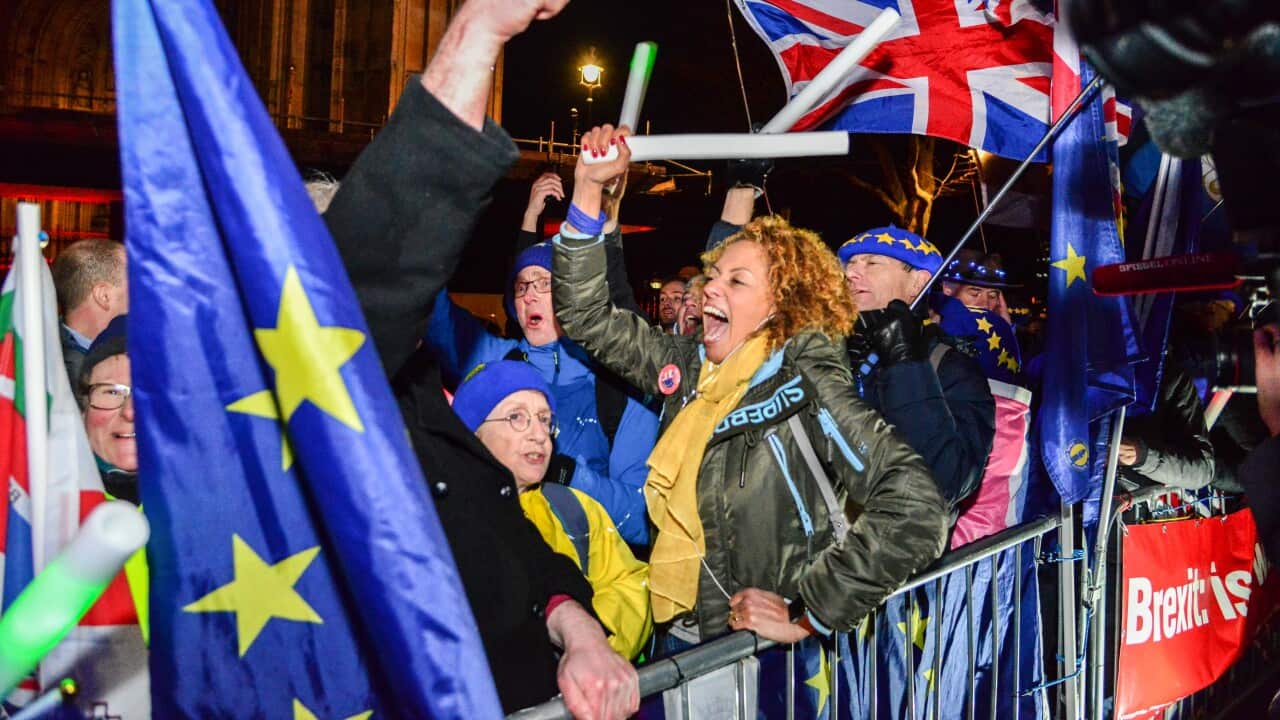
Parliament's vote against the deal raises the possibility both of Brexit being indefinitely delayed - suiting the pro-EU camp - and of Britain being forced to leave the European Union without an agreement - favoured by Leave voters.
In the more numerous camp, Europhiles wearing starry berets proudly waved European Union flags and signs reading "Stop Brexit" under Westminster's windows, chanting "Brexit is dead!" as the results were announced.
The British parliament on Wednesday rejected leaving the European Union without a deal, further weakening Prime Minister Theresa May and paving the way for a vote that could delay Brexit until at least the end of June.
After a day of high drama, MPs defied the government by voting 321 to 278 in favour of a motion that ruled out a potentially disorderly “no-deal” Brexit under any circumstances.
News that makes sense
Your trusted source for staying up-to-date with the world around you. Get free daily news updates and analysis, straight to your inbox.
It went further than the government’s position of keeping the threat of a “no-deal” Brexit on the negotiating table — a stance many in her party said was essential to push Brussels to make further concessions to the deal they have rejected.
Responding to decision to reject a no-deal Brexit, British opposition leader Jeremy Corbyn said a solution to the ongoing crisis must be found.
"In the last 24 hours parliament has decisively rejected both her deal and no deal," he said.
"While an extension of article 50 is now inevitable, the responsibility of that extension lies solely and squarely at the prime minister's door."
The government had instructed conservative MPs to vote to keep the no-deal option on the table.
But thirteen government ministers instead decided to abstain from the vote while one voted against it.
Work and pensions minister Sarah Newton, who voted against government orders, and has now resigned.
If the parliament fails to back an agreement by June 30 it could be delayed longer.
The vote taken by the British Parliament is not binding and could still lead to the UK leaving the European Union on March 29.
A European Commission spokesperson in response to the vote stated: "There are only two ways to leave the EU: with or without a deal. The EU is prepared for both."
"To take no deal off the table, it is not enough to vote against no deal - you have to agree to a deal."
"We have agreed a deal with the prime minister and the EU is ready to sign it."
The European Parliament's Brexit coordinator Guy Verhofstadt had backed taking a no-deal off the table before the vote.
"I hope a no deal is massively rejected today & the UK Parliament position on an extension is known tomorrow," he tweeted.
Earlier, President of the European Council Donald Tusk also delivered this message to a 6-year old wanting to "be friends" following any Brexit deal.
"We will always be friends Sophie," he wrote on Instagram.
Meanwhile, Brexit supporters expressed their concern about taking a no-deal option off the table.
Brexit campaigner, Nigel Farage tweeted that the decision made the parliament "outright liars."
Fellow Brexit supporter and British businessman Richard Tice said he was concerned the vote would mean the UK will stay inside the EU.
"MPs voting to prevent no deal are voting to end negotiations and keep UK inside EU," he tweeted.
"No deal isn't on the table, no deal IS the table."
While the approved motion has no legal force and ultimately may not prevent a no-deal exit, it carries considerable political force, especially as it passed thanks to a rebellion by members of May’s own Conservative Party and her cabinet.
Ms May, who still insists it is not possible to rule out a no-deal Brexit entirely, said MPs would need to agree a way forward before an extension could be obtained.
Positive comments from Germany and Ireland suggested that EU members at last saw a prospect that a viable deal would be found, and were inclined to help.
German Chancellor Angela Merkel said "I will be able to say exactly what will happen next when I have seen the next two days with the British votes, which will perhaps give us a bit of direction on what direction we can move in."
"But there’s no guarantee the EU will agree a delay… and its official stance… is that the only way to take no deal off the table completely… is to agree to a deal," she added.

'We must leave the EU'
Security was a major concern for anti-Brexit protester Peter Benson, 55, who was born near Dublin but has lived in the United Kingdom for 35 years.
"I think terrorism could return to the UK if there's a Brexit," he said, referring to explosive packages found in London and Glasgow last week and claimed by a group calling itself the Irish Republican Army (IRA).
Chris Hammond, 53, hoped that a second referendum was now on the table.
"I won't stop fighting, if there is a campaign for second referendum, I will be working everyday," he said.
Emma Knaggs, 37, gave up her "well-paid" job in telecoms to become a full-time anti-Brexit volunteer, and was outside parliament hoping to defend her "freedom of movement" rights.
"My whole family benefited from EU citizenship: my parents lived for 28 years in Belgium and I was born there," she said.
"I wanted to do something else with my life and realised Brexit was the thing I cared the most about," she said.
In the middle of the pro-EU crowd, pro-Brexit supporters said they were concerned May's deal would have maintained too close relations with the EU.
"We voted to leave the EU so we must leave the EU, we're a democracy," said Suzanne Nicholson, who vowed to keep making the 185 mile (300 kilometre) trip from Yorkshire to Westminster to demonstrate "until we're out".
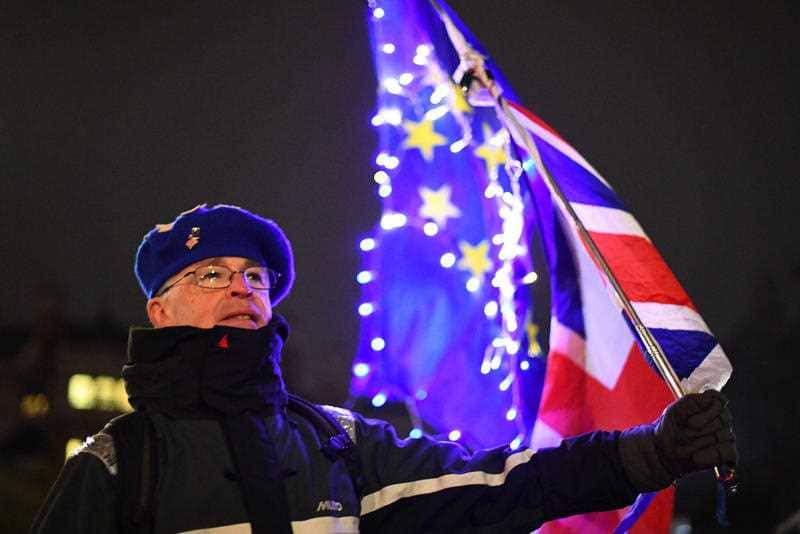
Harriett, a retired Londoner, hoped that Brexit would solve overcrowding in London.
"I hope leaving the EU will change London, London is very overpopulated, we want to get many people to leave," she said.
"I don't usually demonstrate, I have to do my bit... because I'm a leaver."
Pensioner Magdalena Williams said she was "happy because Theresa May has lost", and that the possibility of an extension of the departure date meant "we have time for a better campaign for another referendum".
Mike Ransom, 52, said he was glad the deal was rejected, but that he was "confused".
"Where do we go now? I don't know. If we don't get Brexit there is going to be unrest in the streets."







