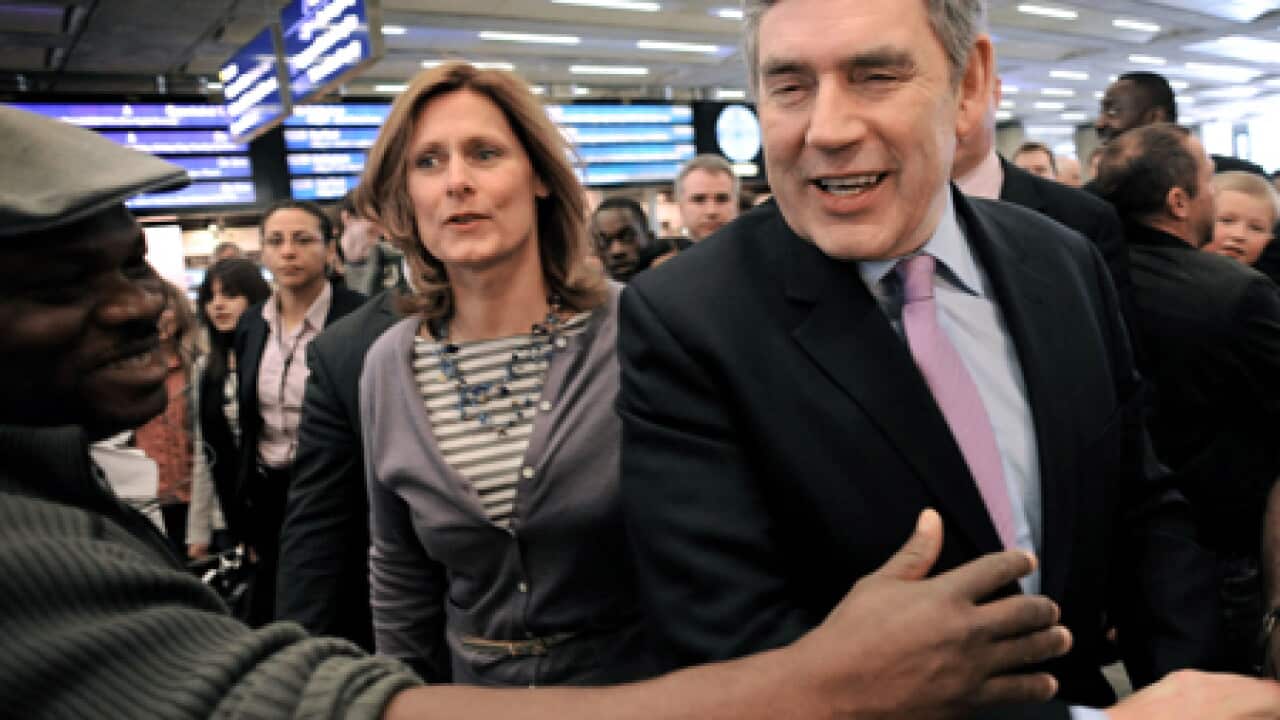
British Prime Minister Gordon Brown and opposition leader David Cameron clashed over the economy, scoring points on a key campaign issue in their final parliamentary face-off.
In a boisterous session in the House of Commons, each man accused the other of threatening Britain's recovery from recession, an issue which has taken centre stage in the increasingly tight race for votes on May 6.
Brown's centre-left Labour party is fighting for a historic fourth term against Cameron's centre-right Conservatives, who have seen their double-digit opinion poll lead shrink in recent weeks to just a few points.
News that makes sense
Your trusted source for staying up-to-date with the world around you. Get free daily news updates and analysis, straight to your inbox.
Conservatives tipped to win
Cameron is still tipped to win, however, and took the opportunity of what could be Brown's last prime minister's questions to try to turn the tables on Labour claims that the Conservatives cannot be trusted on the economy.
The Conservatives want to scrap Labour's planned rise in payroll taxes, warning it will damage economic growth and any chance of cutting Britain's 167-billion-pound (254-billion-dollar, 188-billion-euro) budget deficit.
"This prime minister would wreck the recovery by putting a tax on every job," Cameron declared, ahead of a visit to businesses in northwest England and Wales where he highlighted what he said was the damage the tax could do to small firms.
Brown attacked over defence spending
He also attacked Brown's record on defence spending, a highly emotive issue given Britain's current involvement in Afghanistan, where 280 troops have died.
Hitting back, Brown said that scrapping the planned rise in the payroll tax, known as National Insurance (NI), would take billions of pounds out of the economy at a time when it was most fragile.
"To withdraw six billion pounds from the economy now would put jobs at risk, put business at risk and put recovery at risk," he said.
Against a backdrop of jeering lawmakers from both sides, Brown spun around a phrase Cameron once used against Tony Blair when he was prime minister, telling the Conservative leader: "To think you were the future once."
PM takes questions from Twitter
Brown faced a different kind of prime minister's questions (PMQs) later Wednesday when he fielded queries from members of the public submitted via email or Twitter, in a session his party dubbed "people's PMQs".
After a series of parliamentary scandals in Britain, plans to overhaul the political system are likely to feature alongside the economy as a major election issue.
Both Brown and Nick Clegg, leader of the third Liberal Democrat party, unveiled plans for reform Wednesday.
In a speech in central London, Brown announced plans for "the most comprehensive programme of constitutional reform in this country for a century."
He pledged fixed-term parliaments -- at the moment the government can decide when a general election is called during its five-year term, a system which has been criticised for giving the ruling party an unfair advantage.
Brown also promised to give voters new powers to recall lawmakers found guilty of financial misconduct and to hold a referendum on introducing elected members into the House of Lords and on changing the voting system.
Political donations under the spotlight
Nick Clegg, leader of the centrist Liberal Democrats, earlier outlined his proposed reforms, including a cap on political donations, and insisted only his party could offer a real break from the "stench of corruption" in parliament.
In the House of Commons debate, he attacked Labour in particular, saying: "We all remember, back in 1997, the hope and the promise of this new government. Look at them now. You've failed, it's over, it's time to go."
The Lib Dems have struggled to make their mark as a third party, although they could be key players if there is a hung parliament with neither Labour nor the Conservatives winning a majority.







