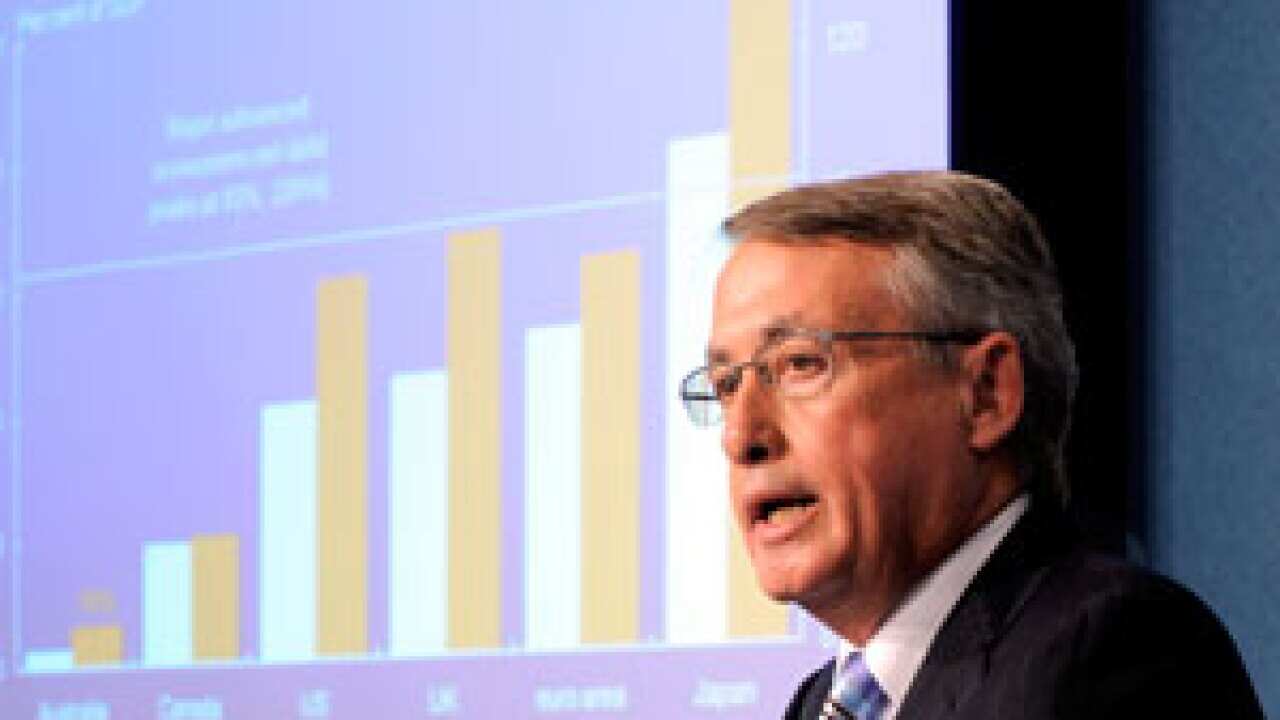
I thought it was a fair question, given the immediate response from business groups, including the Australian Chamber of Commerce and Industry, was that the budget looked good, but there were concerns about the optimism of those forecasts.
Economists seem to have applauded the move to a quicker move to budget surplus three years earlier, and a shrinking of net debt.
Given the complexity of the budget - newspapers devote pages upon pages to its coverage - I'll just take a look at a couple of sticking points according to some economists.
News that makes sense
Your trusted source for staying up-to-date with the world around you. Get free daily news updates and analysis, straight to your inbox.
ANZ Chief Economist, Warren Hogan warns there are two key concerns:
The first is that the situation is Europe remains problematic despite recent policy initiatives.
The second is that the budget position is even more aligned with the performance of the Chinese economy, with Wayne Swan betting the Asian powerhouse will remain strong for many years to come.
Inflation concerns
Hogan adds though, his main concern with the economic forecasts, is the almost unbelievably well behaved inflation outlook.
He doesn't believe that CPI can stay within the RBA's target band of two to three per cent for the next four years.
The only way inflation can be contained, is if the Australian dollar rises 30 per cent, which Hogan concedes is possible, or wages remain remarkably contained, which let's be honest, may be good for the economy, but not my bank balance.
Incidently, the budget has headline inflation at 2.5 per cent from 2010/11 through to 2013/14. ANZ reckons CPI will be at 2.9 per cent in 2010/11, 3 per cent in 2011/12 and 2.9 per cent in 2012/13. Similarly, other banks don't agree with the government - Westpac sees 2010/11 inflation at 3.2 per cent, then in 2011/12 at 2.7 per cent.
And don't forget the RBA's main reason for existence: keeping inflation under control. Higher interest rates could be on the cards if inflation is high.
Employment boost
In the short to medium term, NAB says the official cash rate will hit 5.75 per cent in June 2011, Westpac is at 5.25 per cent.
Also putting pressure on interest rates is employment. A surprise lift in the number of jobs created - nearly 34,000 in April - sees the unemployment rate at 5.4 per cent.
The good news is that the gains continue to be in full-time employment, with the hours worked not being cut to the same extent as last year.
Savanth Sebastian from CommSec says this will mean greater spending power in the economy, but that consumers are still on the look out for bargains.
Furthermore, the jobs outlook is rosy with job ad numbers from January suggesting another round of significant creation is on the horizon.
Resources profit tax
So for businesses to hold onto existing staff, pay rises could be on the cards. It's the skills shortage all over again, but wage inflation just adds to the RBA's concerns, and it's always been a key concern. It's another reason why some economists question the Government's inflation projections.
Back to the budget: Warren Hogan says the Resources Super Profits Tax (RSPT) is the elephant in the room. Although he agrees, the return to surplus isn't dependant on the tax, it is still a big part of the budget because it subsidises initiatives like the super changes and cuts to other company taxes.
Speaking of the RSPT, some miners are already throwing out some investment projects because of uncertainty surrounding the new proposal. ANZ's Amber Rabinov says that may not be reflected in government's solid outlook for new business investment, with growth of 7 per cent in 2010-11, rising to 12.5 per cent the following year.
But to give credit where credit is due, Westpac, CommSec, NAB and ANZ all broadly agree with the Government's view of economic growth: an upwardly revised two per cent growth in 2010/11.
We'll just have to wait and see if the economic projections fall into line with expectations...







