This audio is voiced by AI and may occasionally mispronounce words.
Share your feedback and help us improve this feature. Read more about how we use AI at SBS here.
Images of Australia's 'Red Centre' transformed into a sea of green after record rainfall have spread across social media and television.
While many have marvelled at the rare spectacle, for people in Alice Springs, a town in the Northern Territory, the changing landscape is also a warning.
The rain has fuelled an explosion of buffel grass — an invasive species estimated to make up about 80 per cent of the ground cover around Alice Springs, which environmentalists describe as 'ground zero' for its spread in Central Australia.
As environmentalists and Traditional Owners push for buffel grass to be listed as a weed of national significance, pastoralists warn any changes must also recognise the plant's importance to the cattle industry, setting up a debate over how one species has come to define the future of Australia's arid heart.
But the impact of buffel grass is not only being measured in hectares lost — it is being felt by the people who live, work and create in this changing landscape.
News that makes sense
Your trusted source for staying up-to-date with the world around you. Get free daily news updates and analysis, straight to your inbox.
A fight on the doorstop
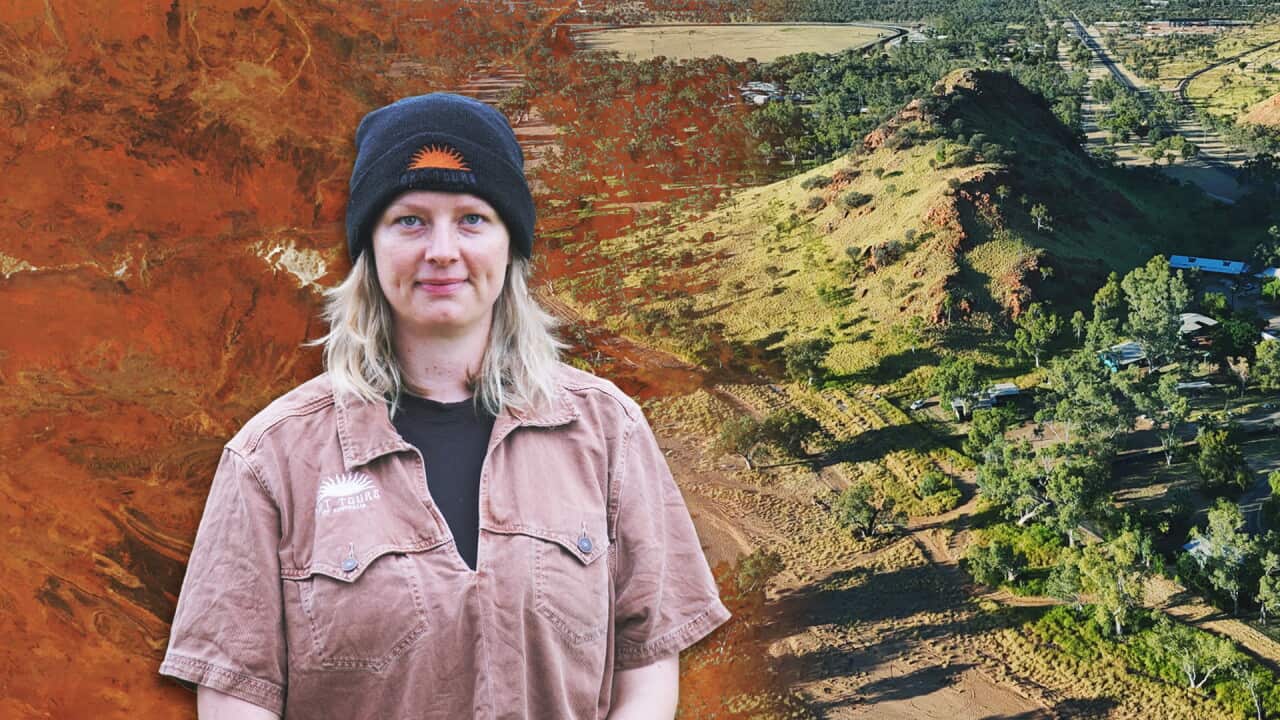
Few people have witnessed that transformation more closely than Anna Dakin.
She fell in love with Central Australia more than a decade ago and moved from the United Kingdom to work as a tour guide. Today, she runs her own business, taking visitors into landscapes she says are increasingly being transformed by buffel grass.
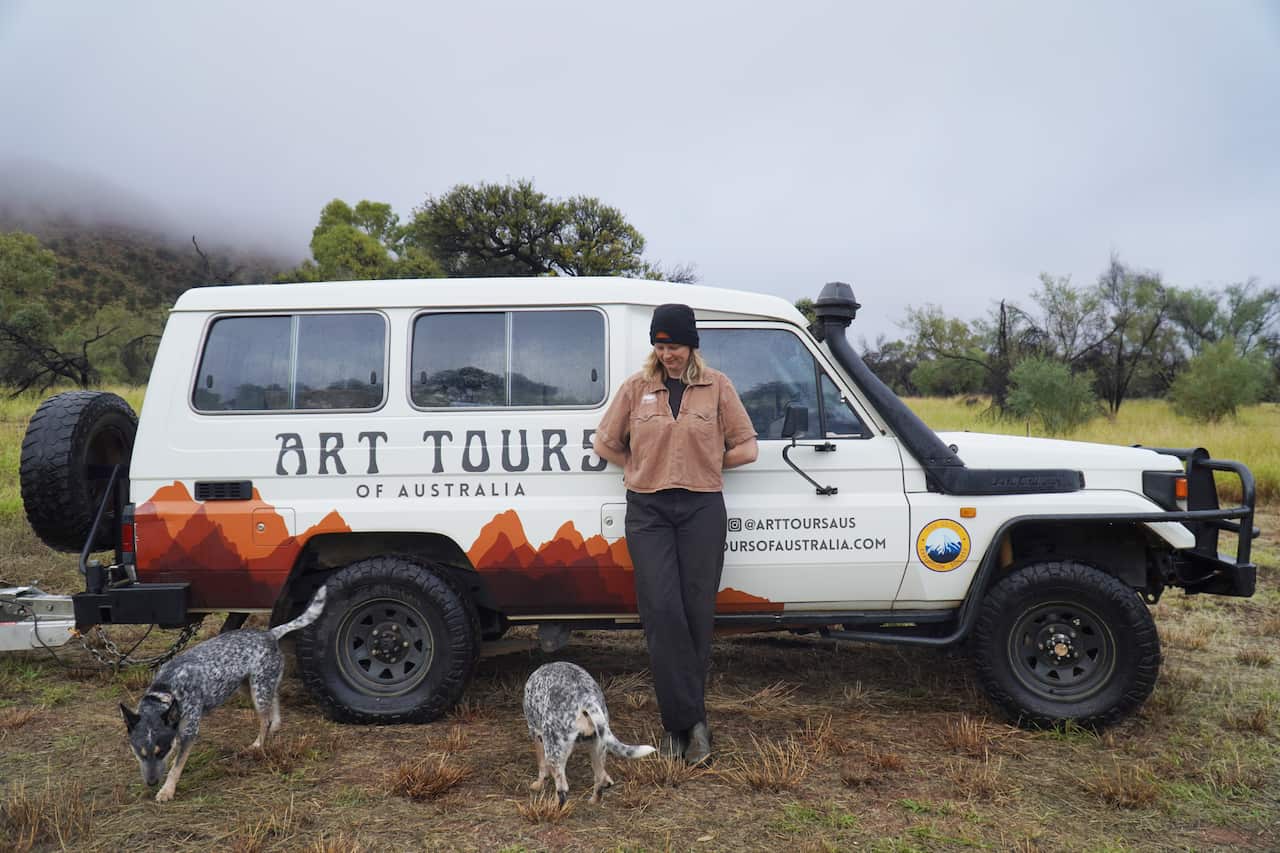
Despite cost of living pressures reducing visitor numbers, compounded by Qantas' decision to end its Melbourne to Alice Springs service, Dakin says the biggest challenge facing her business is growing outside her front door.
Her eight-hectare property just outside of town has been "absolutely overrun" by buffel grass, impacting her day-to-day operations and plans to open a campsite for visitors.
Dakin says during three weeks of heavy rain, she spent up to 10 hours a week mowing the grass.
It is a big emotional drain. It's a big financial drain. It takes a huge amount of time and it causes stress like I can't explain.
Dakin is concerned about the impact on tourism, because she says visitors are "fascinated" by Central Australia's unique desert landscapes.
"When I start to talk about buffel grass to groups, I personally feel quite embarrassed at the lack of management that we do in the Northern Territory," she tells SBS News.
"There are plants that have not been documented by science yet, and the buffel grass is outcompeting those plants."
Earlier this year, NASA's Terra satellite captured Australia's iconic Red Centre blanketed in green following exceptional rainfall.
Watch the images below change and see how buffel grass is transforming the Red Centre:
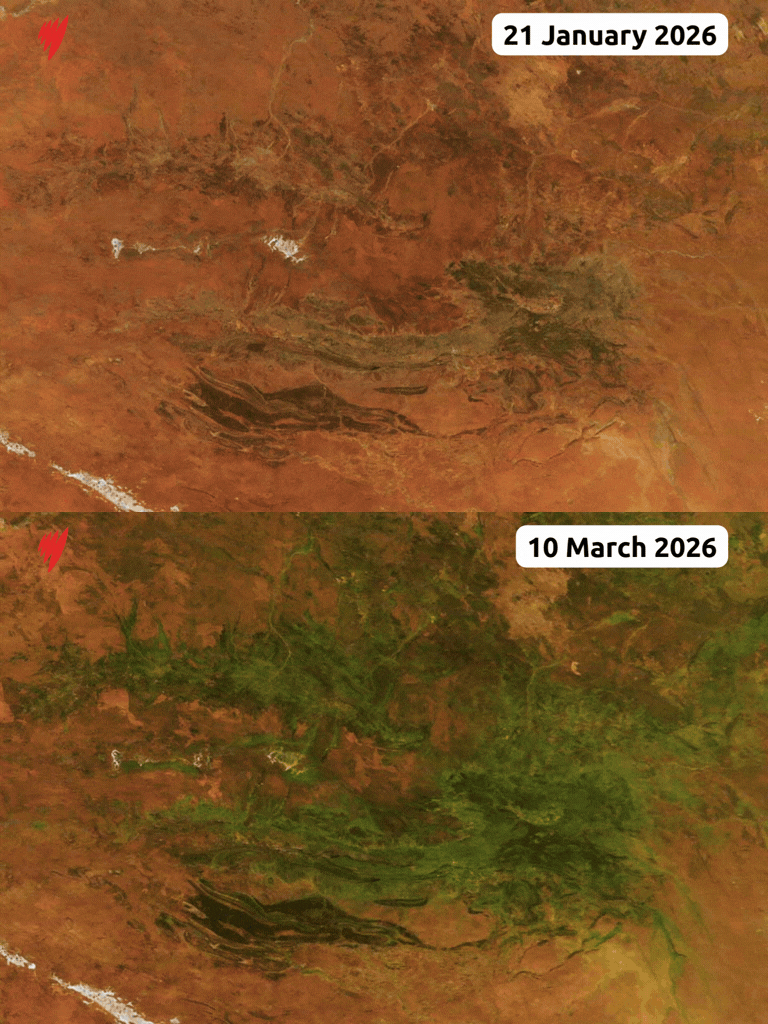
The region is best known for its red landscapes, coloured by iron-rich soils and rock formations, including Uluru, but unusually wet conditions triggered widespread vegetation growth across Central Australia.
February 2026 brought an average of 239 millimetres of rain — the territory's third-wettest February on record, according to the Bureau of Meteorology.
Rain has continued since, with a cold band in mid-May bringing unseasonable rainfall to the southern parts of the territory.
Alex Vaughn, policy advocacy coordinator at environmental organisation, Arid Lands Environment Centre (ALEC), describes the transformation as "the canary in the coal mine".
"The green buffel grass growth cures and dries into a tinderbox before it goes up in flames and creates blackened landscapes," he tells SBS News.
"We're talking about iconic and widespread places from the Victorian Mallee to Kati Thanda-Lake Eyre, Uluṟu-Kata Tjuṯa, towns like Alice Springs and Larapinta Trail, as well as huge parts of Western Australia and Queensland."
For Dakin, the changes are most obvious through the eyes of her customers.
She takes beginner artists into the landscape to paint the region's beauty and says the spread of buffel grass has turned once-diverse scenes into what she describes as a "monoculture" with only "one texture" at the end of the paintbrush.
"It's something that we talk about pretty much on every tour, and it is massively devastating environmentally, but also the look of the landscape is impacted," Dakin says.
"When we're painting in places that are buffel-free, you tend to see a lot more bird life, a lot more wildlife. In my opinion, native grasses are much more beautiful. There's a diversity to them."
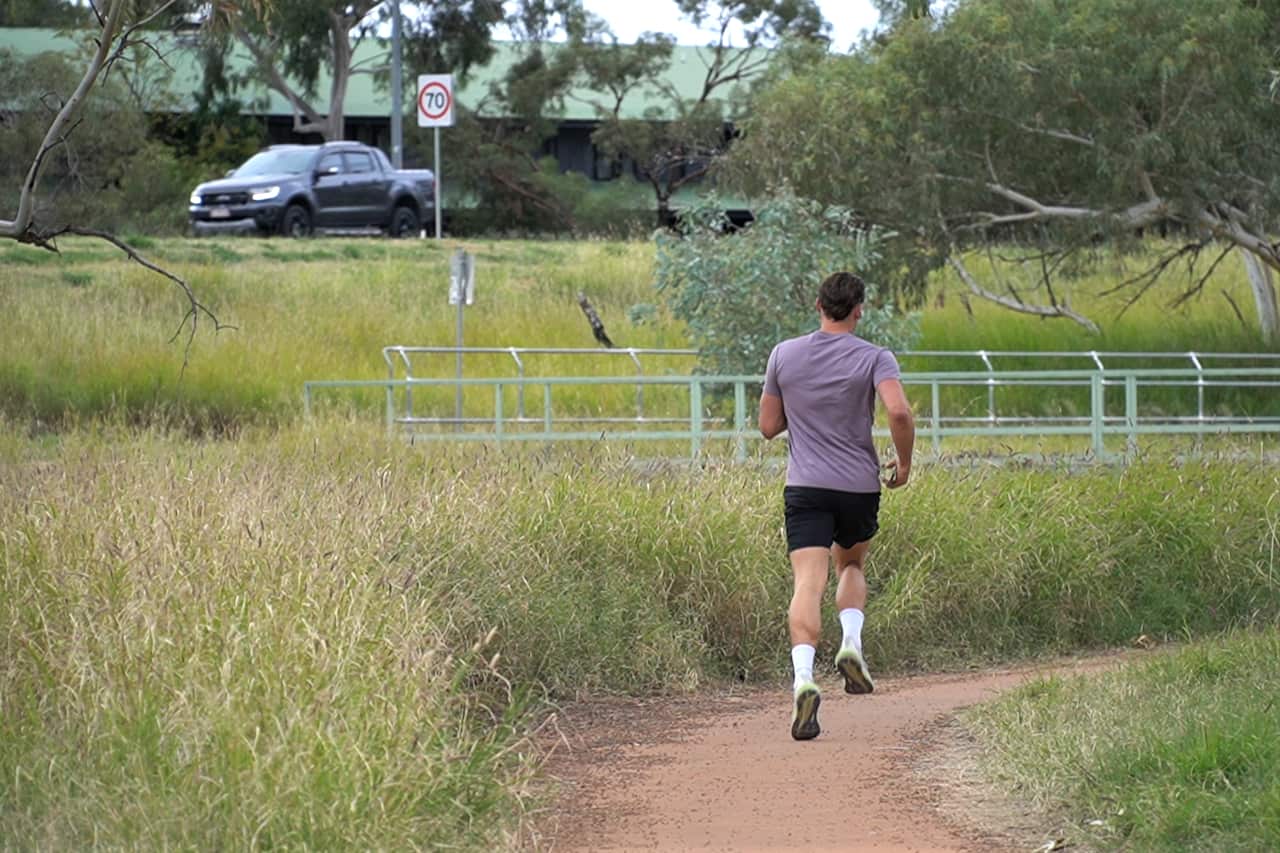
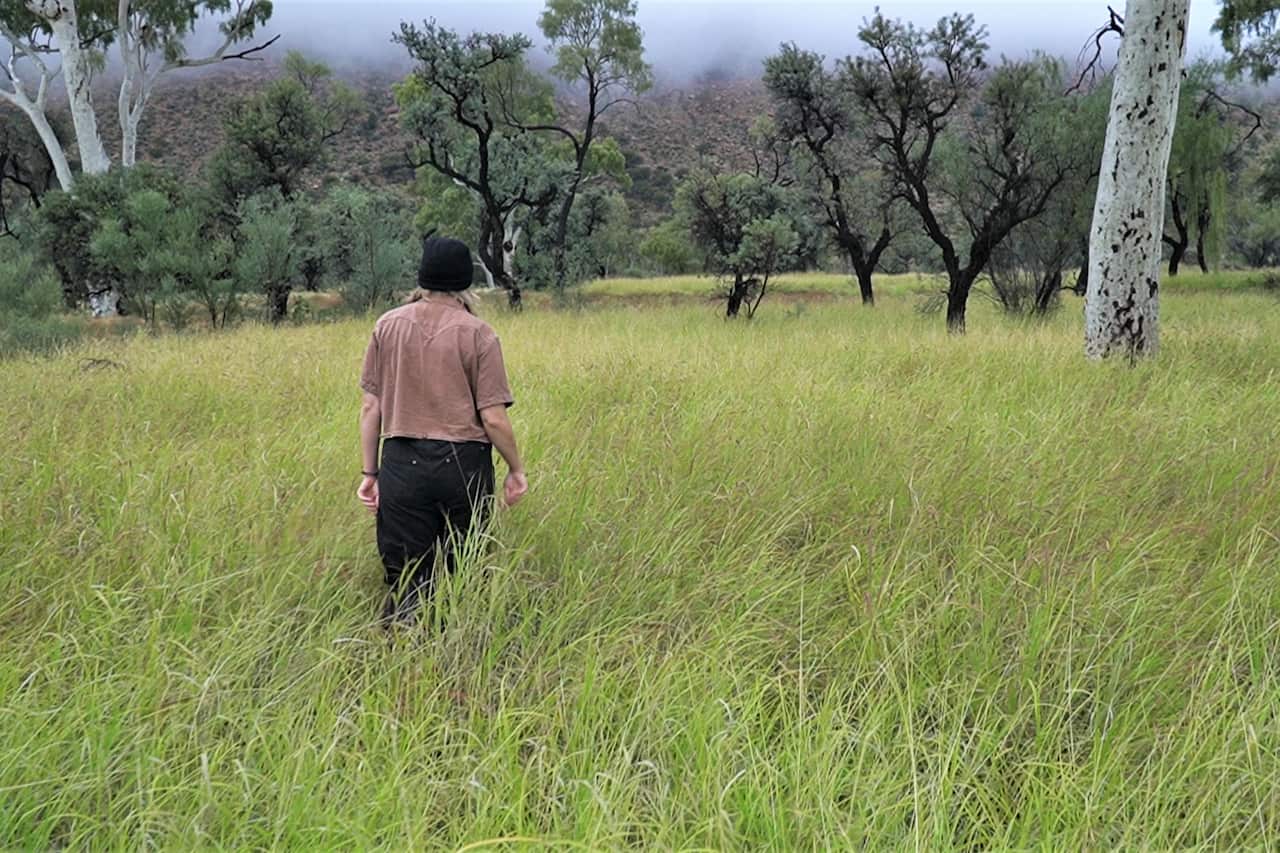
Around Alice Springs, buffel grass is hard to miss. Its deep root system allows it to thrive after rain and outcompete native vegetation, with plants growing to around 2m tall.
Can buffel grass be contained?
Environmentalists agree there is little realistic prospect of eradicating the weed entirely, but they argue governments could do more to control the spread — including securing a listing as a national weed of significance.
Since 1999, the federal government has listed 32 weed species based on criteria including invasiveness, potential for spread, and environmental, social, and economic impacts.
So far, buffel grass has not been added to the list, although it remains under consideration for a potential national listing. Former Greens leader Adam Bandt, who is now CEO of the Australian Conservation Foundation, said during a recent trip to Alice Springs that he was "horrified" by the situation.
"Here in Central Australia is ground zero for buffel grass and serves as a warning for other places; the federal government needs to step up to protect places not yet invaded," he said in June.
In 2015, South Australia became the first jurisdiction to declare buffel grass a weed, and the Northern Territory followed in 2024, setting up a six-year management strategy.
However, the NT government has also granted a permit to import buffel grass seed for use on pastoral properties around Alice Springs, where the species continues to be used for cattle production.
Kathleen Herbert, policy and advocacy officer at ALEC, says: "Bringing more buffel grass seed into the environment undermines the hard work on the ground to control it. It doesn't recognise fence lines, it will spread by wind, fire, water."
Explore a 3D model of buffel grass (Cenchrus ciliaris) below:
NT Environment Minister Joshua Burgoyne told the territory's estimates committee last month that was the reason a management plan had been introduced."On pastoral properties, buffel grass is managed through grazing of the buffel grass, and that does not happen in towns, in city centres or national parks," he said.
"Not only do I recognise the impacts; they are written in the plan … there is $750,000 annually, ongoing, to address its impacts."
But Burgoyne admitted the territory needs more help.
"I look forward to hopefully receiving additional funding and resourcing from the federal government. Just like they fund gamba grass management in the Top End, in Central Australia, we will require additional resources to deal with buffel grass."
Lifeline or liability?
For many pastoralists, buffel grass is not a weed but an essential source of feed.
First brought into the Northern Territory by Afghan cameleers in the late 1800s, buffel was later intentionally planted around the 1950s and 1960s to suppress dust and erosion, with its extensive root system helping stabilise fragile soils.
In times of drought or after fire, buffel grass often recovers quickly, providing feed to sustain cattle on pastoral land.
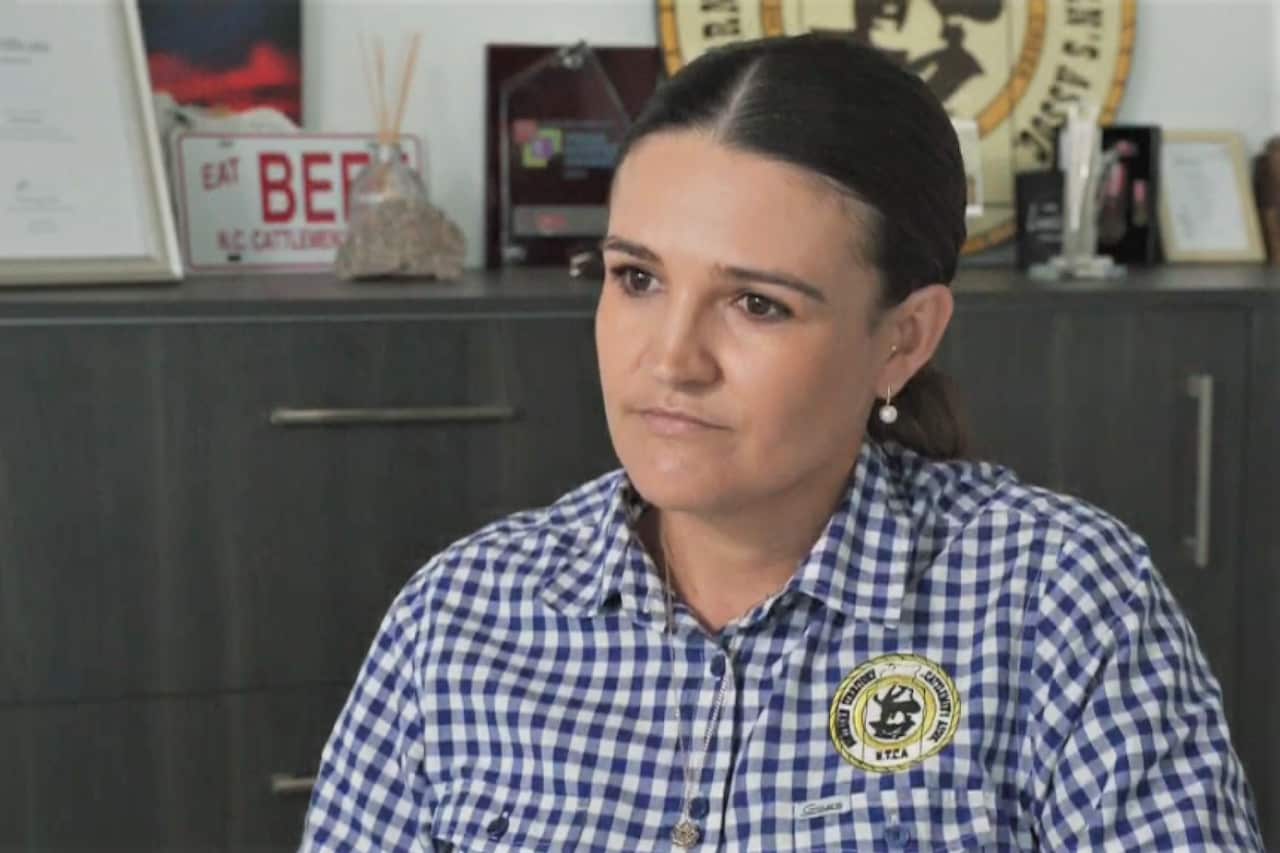
Romy Carey, CEO of the NT Cattleman's Association, says the grass is "vital" for the industry but agrees that where it's not actively managed, it can "pose a risk".
"I think it's really important that we move beyond whether buffel grass is good or whether buffel grass is bad," she tells SBS News.
"In our arid and semi-arid areas, [we] cannot have an industry without it … it's an industry that has been here since the beginning and really is a powerhouse for our economy, and I think that's the piece that can't be missed here."
Carey says there's still uncertainty about what a national listing would mean for producers, pointing to existing weed management frameworks.
It can't come at the detriment of an industry that sustains our regional economies.
"We already have declared weeds of national significance here in the Northern territory, things such as apple pine, blackberry bushes."
'We're mourning the Country that used to be'
For Traditional Owners, the spread of buffel grass is more than an environmental issue — it's also changing cultural landscapes that have been cared for over thousands of years.
Buffel is widely known for altering fire behaviour. Its dense growth creates heavier fuel loads, while its ability to quickly regenerate after rain can contribute to more frequent burns.
Traditional Owners say those changing fire patterns are making it harder for many native plants and animals to recover.
Even after drying to a golden-brown, buffel grass remains dormant until the next rainfall, when it rapidly regenerates.
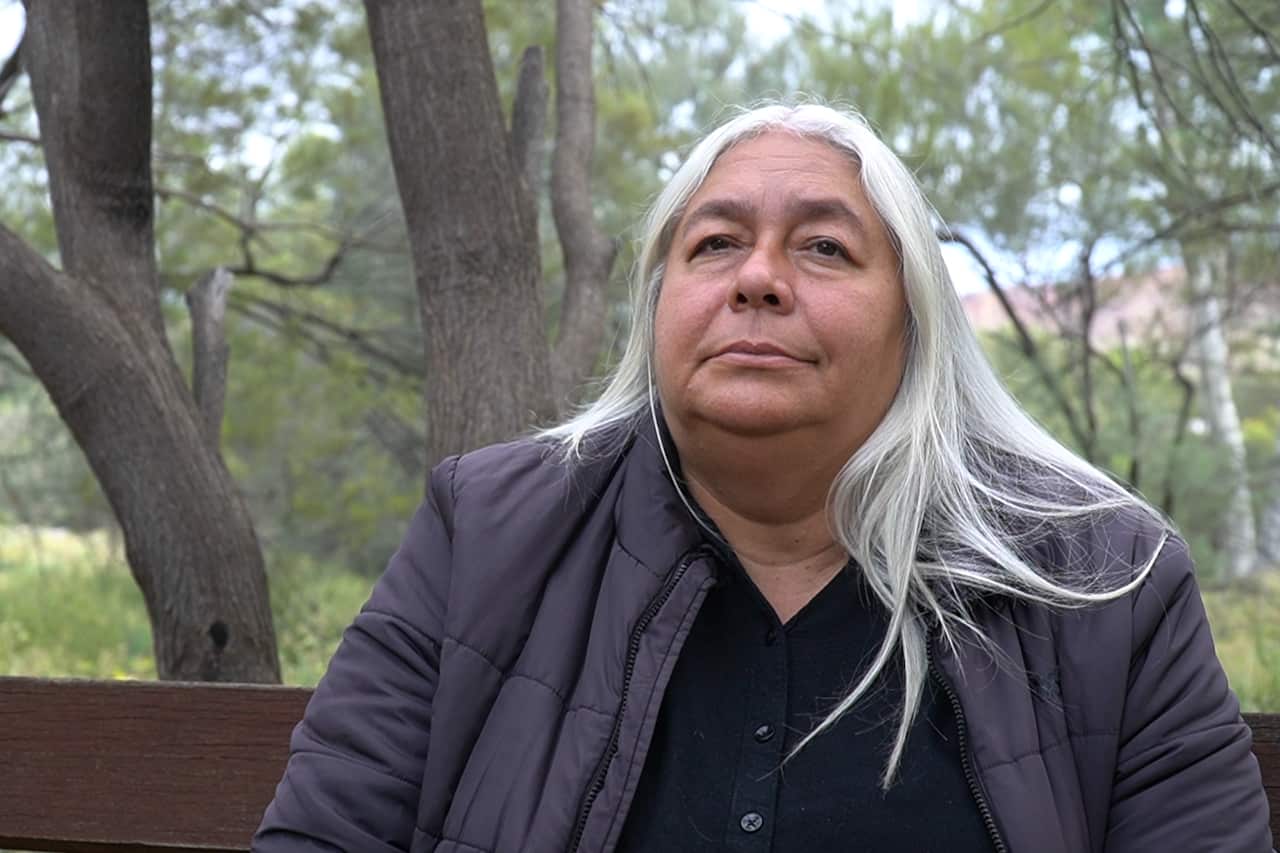
Eastern Arrernte woman Camille Dobson says around Alice Springs the "species is on steroids".
"People who have chronic illness suffered greatly because of the impact of the smoke from the fire and all of the ash that was falling onto the community," she tells SBS News.
But she says the impacts extend well beyond the bushfire.
"There's a story about one plant called the Alangkwe, which is a bush pear. Most of the people my age, which is around 50, have never seen nor know what that plant is because it competes with buffel, but it gets out-competed," Dobson says.
There's a lot of plants and animals that [this] has happened to that just sort of fade out of our memories and fade out of our language.
After this year's heavy rain, many locals and visitors celebrated the unusually green landscape. For Dobson, however, it represented something very different.
"I was flying in and looked out the window and I felt really, really sad for Country because the buffel's now up on top of the mountain ranges," she says.
"I had no idea where we were in the plane looking over the landscape, which is not something that's happened before … it made me so emotional."
Dobson was part of a delegation that travelled to Canberra earlier this year to lobby federal ministers for stronger action on buffel grass and greater recognition of its impacts on Country.
"There hasn't been a scientific study to kind of survey what plants we've lost, we're kind of relying on Aboriginal people's knowledge to kind of highlight the plants that have been lost in areas," she says.
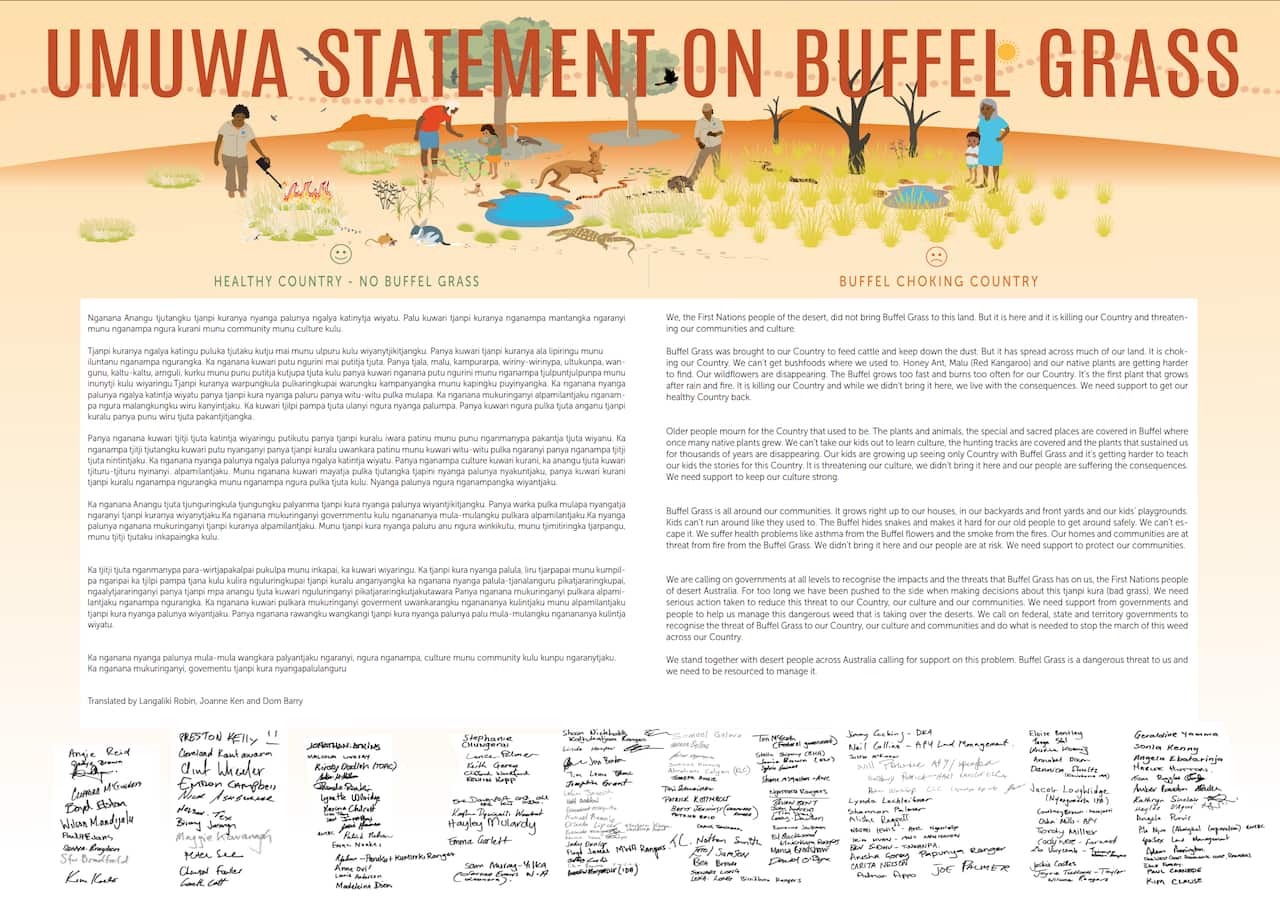
In 2022, rangers from Aṉangu Pitjantjatjara Yankunytjatjara (APY) Lands came together to sign a statement of concern about buffel grass.
The APY Lands cover about 103,000 square kilometres in remote north-west South Australia and are home to about 2,000 Aboriginal people living across communities and homelands dotted throughout desert Country.
Known as the Umuwa Statement, the declaration called for greater recognition of the Traditional Owners' role in managing the threat.
"For too long, we have been pushed to the side when making decisions about this tjanpi kura [bad grass]."
Buffel grass is a dangerous threat to us and we need to be resourced to manage it.
A call for national action
The spread of buffel grass has become a national issue, with infestations identified across all states and territories.
ALEC says more than 70 per cent of Australia's land area has conditions suitable for buffel grass growth, although the extent and severity of invasions vary significantly between regions.
A spokesperson from the Department of Climate Change, Energy, the Environment and Water said it "recognises the serious threat buffel grass poses".
"The Threatened Species Scientific Committee is currently assessing buffel grass for potential listing as a key threatening process under national environmental law," they said in a statement to SBS News.
The NT has received $4 million from the federal government to support fire management, buffel grass control and feral animal management in the MacDonnell Ranges, stretching east and west of Alice Springs, but critics say there is currently no dedicated national funding program specifically targeting buffel grass.
In response to this story, Burogyne said he "had spoken to the federal environment minister about buffel grass, and I will continue engaging with the federal government on this issue".
While responsibility for managing pests and weeds largely sits with state and territory governments, Traditional Owners and environmental groups say the scale of the challenge requires greater national support.
Dobson believes a solution is still possible but says it will require cooperation across communities, governments and industries.
"We can't just go, 'Oh, it's too much. It's too hard. We're not going to do anything because it's just gone too far.' I think we've really got to be dedicated to working on finding a solution and everyone needs to be part of that.
"We also need to be mindful about the territory being such a unique place and having very unique experiences, environments, animals, plant species, and what that means if we lose that."
For the latest from SBS News, download our app and subscribe to our newsletter.







