Egypt's new government warns of a "counter-revolution" following a series of deadly political and religious clashes blamed on diehards of the former regime.
The government said it "is fully committed to the interests of the people and to implementing the goals of the revolution; and it will stand firm against plans for a counter-revolution," according to state news agency MENA.
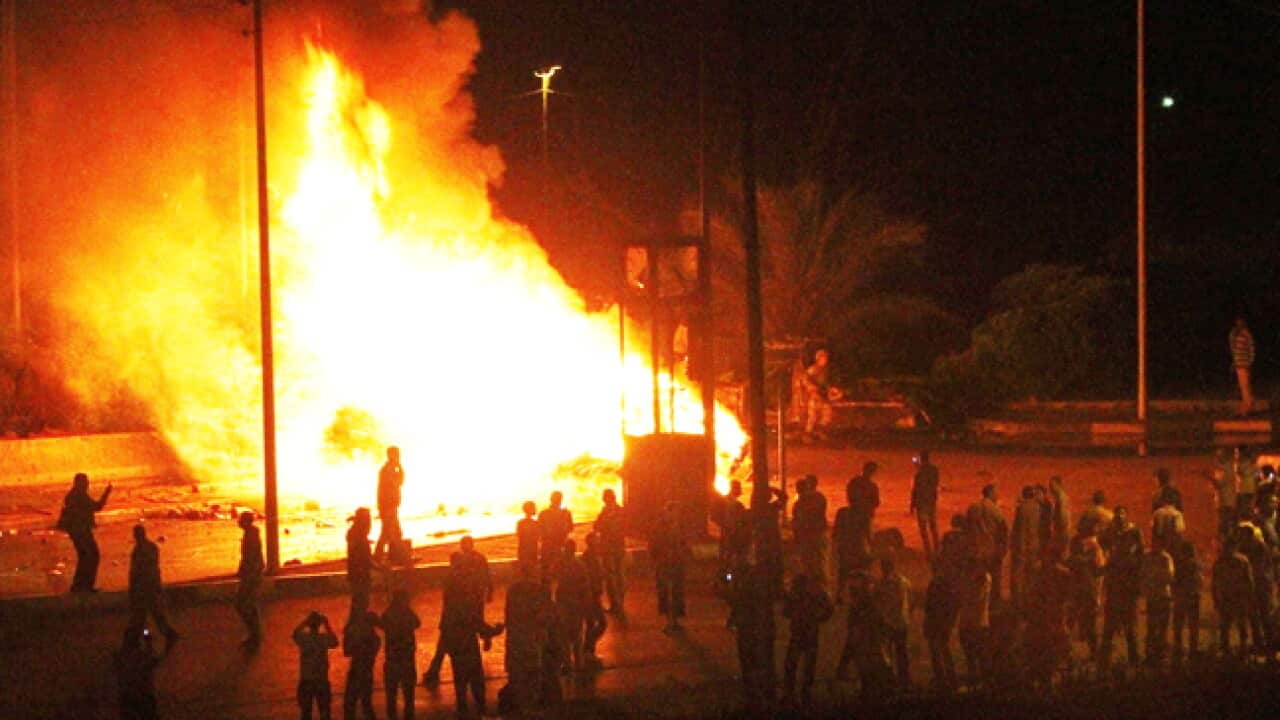
Sectarian clashes killed at least 13 in Cairo, the health ministry said.
News that makes sense
Your trusted source for staying up-to-date with the world around you. Get free daily news updates and analysis, straight to your inbox.
Bloody fighting broke out in the working class Cairo district of Moqattam when Muslims confronted 1,000 Christians who had been blocking a main road in protest at the burning of a church last week in the provincial town of Sol, south of Cairo.
Father Boutros Roshdy of a Moqattam church told AFP at least seven Coptic Christians were among the dead.
Meanwhile, in Cairo's Tahrir Square, the epicentre of anti-regime protests that toppled president Hosni Mubarak, attackers armed with knives and machetes waded into hundreds of pro-democracy activists, witnesses said.
Stone-throwing skirmishes raged, and activists were gathering sticks and stockpiling rocks to defend themselves.
By early evening, the army had restored order in the square, dismantling tents pitched by protesters shortly after anti-regime riots erupted on January 25, and detaining several protesters, MENA said.
Armed civilians attacked protesters outside state security headquarters in Cairo as they attempted to storm it to retrieve files kept on the population by a powerful regime apparatus long accused of rights abuses.
The violence, widely blamed on remnants of Mubarak's regime, revealed the security vacuum created by police, who disappeared from the streets during January protests that led to Mubarak's resignation.
Human rights group Amnesty International condemned what it called the Egyptian army's "heavy-handed actions to clear Cairo's Tahrir Square."
"It is absolutely unacceptable that the army should participate in violently breaking up the peaceful protests", said the London-based watchdog's deputy director for the Middle East and North Africa, Hassiba Hadj Sahraoui.
"The Supreme Military Council has the duty to uphold the right to peaceful protest," Hadj Sahraoui said.
The clashes took place as the newly appointed cabinet met with the ruling Supreme Council of the Armed Forces to propose a law criminalising threatening behaviour, MENA said.
A statement later said the cabinet had discussed "developments in the country, specifically the acts that have hindered daily life, acts of thuggery, incitement, intimidation and tensions affecting national unity."
Accordingly, it has "ordered the swift return of police forces, in their full capacity, back to the streets" and "urged citizens to cooperate with the police."
The Muslim Brotherhood, the country's largest opposition movement, blamed diehards of the Mubarak regime of inciting the violence.
It called on "everyone to stand together to support our armed forces and the cabinet so that they can fulfill the demands of the revolution."
Egypt's military rulers have been battling to steer the country through a fragile transition since Mubarak was overthrown on February 11, promising to pave the way for a free democratic society.
The military council vowed to have the Sol church rebuilt and to prosecute those behind the arson attack.
Coptic priest Samann Ibrahim told AFP earlier that those killed and wounded in the Moqattam clashes had been shot.
Some people among the crowd of Muslims opened fire on the demonstrators, he said, adding the mob had also petrol-bombed houses and workplaces.
Before the Moqattam violence, Copts had protested for several days outside the radio and television building in Cairo demanding the torched church be re-built, and that those responsible be brought to justice.
The Shahedain (Two Martyrs) church was set ablaze after clashes between Copts and Muslims that left two people dead.
Christians, who make up about 10 percent of Egypt's 80 million population, complain of systematic discrimination and have been the target of several sectarian attacks.







