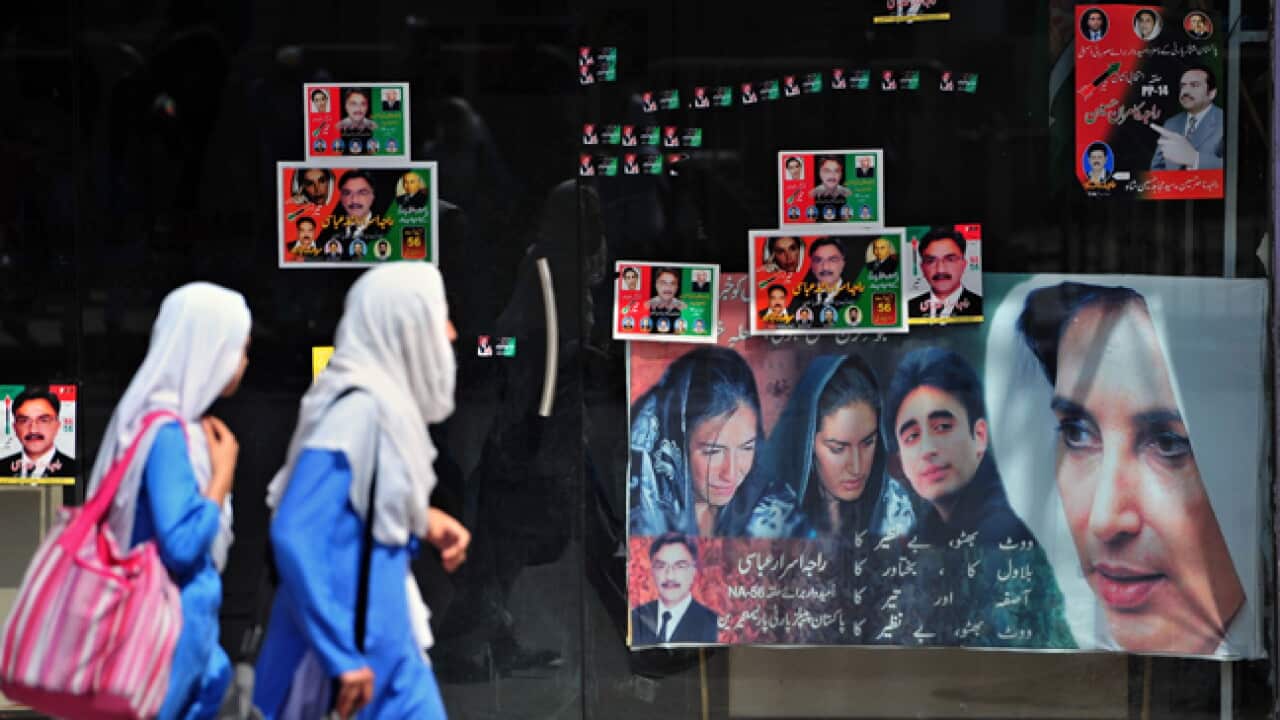
History is being made in Pakistan this weekend as the country's 86-million registered voters go to the polls in national and regional elections.
It is the first time in the nation's history that a civilian government has completed a full term and handed over power to another civilian government at the ballot box.
But the campaign has been marred by unrest with over 100 people killed in the past month.
Pakistan has had a turbulent political history since it gained its independence from Britain in 1947, but the current election campaign has seen some of the worst bloodshed in recent decades.
The unrest reflects the decades-long tension in the country between Sunni and Shi'ite Muslim groups in Pakistan as well as between secular political groups on one hand and some Islamist groups on the other.
News that makes sense
Your trusted source for staying up-to-date with the world around you. Get free daily news updates and analysis, straight to your inbox.
The Pakistani Taliban has claimed responsibility for much of the campaign-related unrest.
It has condemned the current elections as un-Islamic and it has directly threatened the main parties in the outgoing coalition including the left-leaning Pakistan People's Party.
One of the deadliest attacks in the campaign took place at an election rally in the Kurram region, an ethnic Pashtun area near the Afghan border.
At least 25 people were killed and dozens of others wounded when a suicide bomber blew himself up at the rally, organised by the right-wing religious party, the Jamiat Ulema-e-Islam.
The Taliban claimed responsibility for the attack.
A campaign worker for the JUI Mohammed Shaheen says it was a peaceful rally that should never have been disrupted.
"We were holding a rally for Islam and for the greater glory of religion. We condemn the attack on this rally whether a suicide bomber or a timed blast. We are against blasts in markets, in mosques and in such rallies. We are totally against this and we condemn it."
The head of the political party which organised the rally, Maulana Fazlur Rehman, urged his supporters not to be intimidated by those who carried out the attack.
"Now the election cannot be postponed no matter how many people die. Those groups who wanted the elections to be postponed have lost, despite all their efforts and trouble-making. God willing elections will be held. Sabotaging the elections will not be in anyone's favour. It will cause anarchy in the country."
Voting has been postponed in three key areas of the country where candidates have been killed.
They are in the south-western province of Baluchistan, in Pakistan's biggest city of Karachi, and in the southern city of Hyderabad.
And one high-profile candidate, former test cricketer Imran Khan, has had to spend the last stage of campaigning in hospital after he fell at an election rally in Lahore, suffering head and spinal injuries.
Some observers of Pakistani politics believe there is a real mood for political change, which could see the current coalition forced from office.
The coalition, led by the left-leaning Pakistan People's Party is facing a strong challenge from the Pakistan Muslim League, led by former Prime Minister and free-market advocate Nawaz Sharif.
Pakistan-born Professor Samina Yasmeen from the University of Western Australia believes Mr Sharif could end up winning after gaining the support of smaller parties, including the Tehreek-e-Insaf party led by Imran Khan.
Professor Yasmeen believes there could be a strong sympathy vote for Mr Khan because of his campaign rally injuries.
She says the current government has run a poor campaign.
"The other contender- the Pakistan Muslim League led by Nawaz Sharif - has been a very strong contender and in fact the Pakistan People's Party has been relatively less dominant in the debate. So that's led many people, including me, to think there would be a hung parliament".
Professor Yasmeen believes a new coalition government could be formed relatively quickly between Mr Sharif and Mr Khan's parties.
The Pakistan Association of Australia says there has been a strong local interest in the elections with some dual Australian-Pakistani citizens travelling over to the country to cast a vote.
The association's president Iftikhar Rana says many Pakistani-Australians are concerned about the welfare of friends and relatives because of the heightened unrest over recent months.
However he believes there is a strong movement for political change in Pakistan.
"The Pakistan people are very desperate for a good and positive change in Pakistan and for a chance to wipe out instability, corruption, poverty and violence and have a say on that as a whole.
This coming election is very important for Pakistan and the Pakistani community who have settled in Australia because it will hopefully bring positive and successful change for Pakistan and remove all forms of corruption, violence and all threats whatever they're facing."







