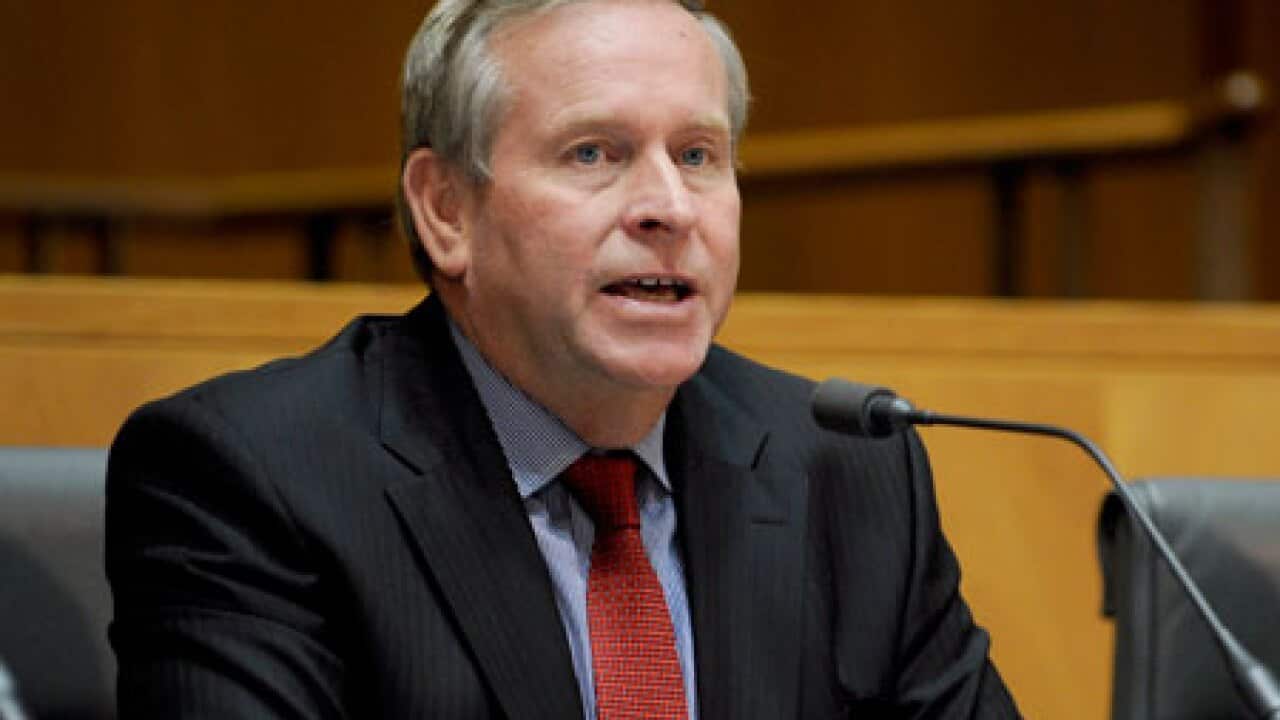
West Australian Premier Colin Barnett believes Canberra is in danger of becoming irrelevant in his state, as he battles with the federal government over GST payments and a new mining tax.
Prime Minister Julia Gillard announced a review of the way the GST is carved up during a visit to WA last week.
The move was seen in Perth largely as a ploy to butter up the Liberal premier to soften his anti-mining tax stance and opposition to freezing state-based royalties.
If that was indeed her ploy, Ms Gillard may need a plan B.
The premier remains steadfast in his opposition to federal plans to strip the states of their rights to raise royalties in future.
News that makes sense
Your trusted source for staying up-to-date with the world around you. Get free daily news updates and analysis, straight to your inbox.
"We see issues such as the mining tax legislation and certainly royalties as entirely separate," Mr Barnett told Sky News on Sunday.
He emphasised it was the state which owned the minerals within its borders, not the people of Australia.
"The state owns the minerals (and) sells those minerals to mining companies," he said.
Mr Barnett acknowledged WA should cross-subsidise some of the weaker states, as it was in the past under the GST, but not to the extent it was heading now, Mr Barnett said.
Under the current system WA risks getting just 40 cents in the dollar back in future, with Mr Barnett calling for a 75-cent floor in the state's return.
"At that point you get to a situation where commonwealth-state financial relations become not irrelevant, but very much second or third order issues.
"In other words, the state will then determine entirely its future and the relationship with Canberra will progressively fall down, just through irrelevance."
Mr Barnett said no one wanted to see state-federal relations get to that point.
"If the commonwealth cannot fix up this issue, they will have almost a (US-style) Tea Party situation where Western Australia, as it's probably already doing, will just simply engage with Asia."
If it did, the state's relationship with the rest of Australia would diminish to the point WA would simply not deal with the rest of the nation.
"I'm not a secessionist," Mr Barnett added, saying the issue was dealt with in the 1930s when West Australians voted yes in a referendum to secede but the party pushing the yes vote was not elected.
With 10 or 20 years of strong economic growth ahead and $170 billion of resource projects in the pipeline, Mr Barnett predicts that by 2020 WA will account for more than 50 per cent of Australia's exports.
West Australians look over the ocean and horizon to Asia already, a fact the rest of Australia needed to understand, he said.
"We do not look and follow all that closely what's happening in Canberra.
"That's not an anti-Canberra sentiment; it is just a reality.
"This state is entwined with the Asian growth, not with what's happening in Sydney and Melbourne."
States like Tasmania should be pressured to drive economic development, Mr Barnett said.
"If they continue to reject any sort of development, well what right is there to simply take the spoils of hard work in other states?"
Skilled workers from Sydney and Melbourne should go to WA, work in the Pilbara, make good money and go home later if they wanted to, the premier said.
A skills shortage has long been a problem in the state.
If Australians didn't want the jobs the federal government should be more generous to foreigners who did, Mr Barnett said.







