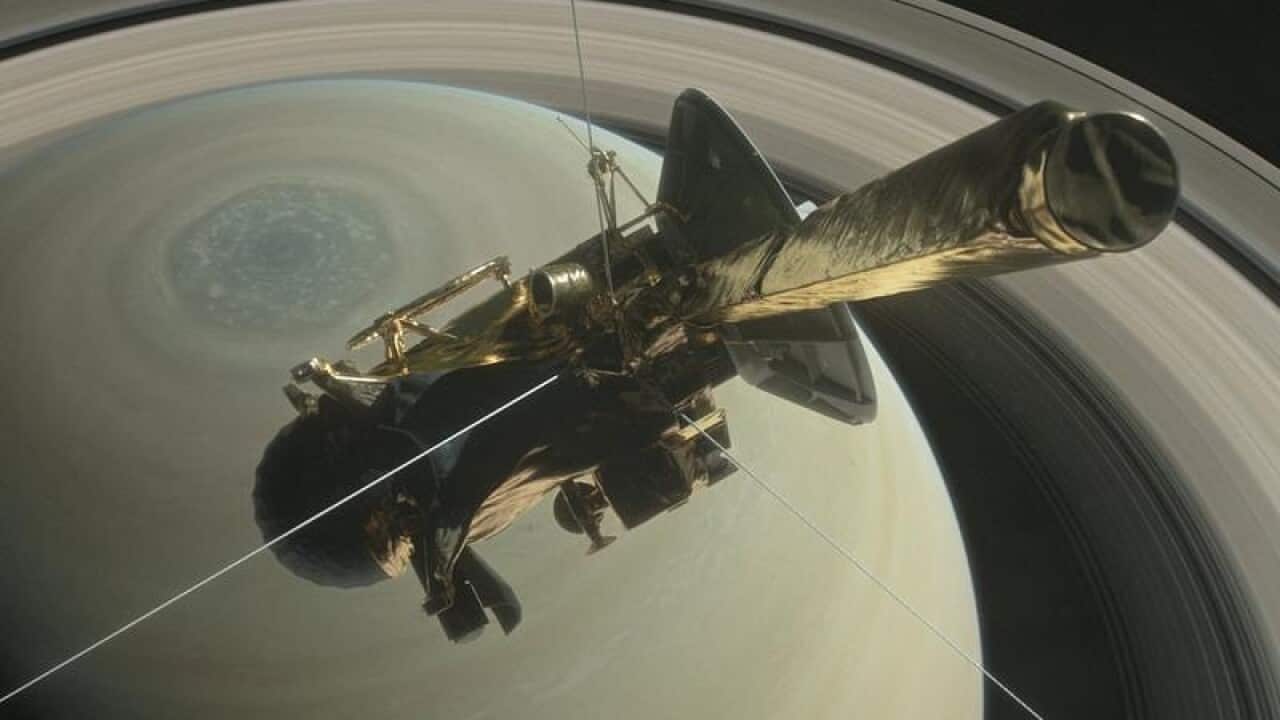
The Cassini spacecraft will end its 13-year mission to Saturn in mid-September by transmitting data until the final moment before it plunges into the ringed planet's atmosphere, officials say.
Cassini, the first spacecraft to orbit Saturn, will make the last of 22 farewell dives between the planet's rings and surface on September 15. The spacecraft will then burn up as it heads straight into the gas giant's crushing atmosphere.
Cassini's final dive will end a mission that provided groundbreaking discoveries that included seasonal changes on Saturn, the moon Titan's resemblance to a primordial Earth, and a global ocean on the moon Enceladus with ice plumes spouting from its surface.
"The mission has been insanely, wildly, beautifully successful, and it's coming to an end in about two weeks," Curt Niebur, Cassini program scientist, said on a conference call with reporters from NASA's Jet Propulsion Laboratory in California.
Cassini's final photo as it heads into Saturn's atmosphere will likely be of propellers, or gaps in the rings caused by moonlets, said project scientist Linda Spilker.
News that makes sense
Your trusted source for staying up-to-date with the world around you. Get free daily news updates and analysis, straight to your inbox.
The spacecraft will provide near real-time data on the atmosphere until it loses contact with Earth on September 15, the National Aeronautics and Space Administration said.
Spilker said Cassini's latest data on the rings had shown they had a lighter mass than forecast. That suggests they are younger than expected, at about 120 million years, and thus were created after the birth of the solar system, she said.
During its final orbits between the atmosphere and the rings, Cassini also studied Saturn's atmosphere and took measurements to determine the size of the planet's rocky core.
Cassini has been probing Saturn, the sixth planet from the sun, and its entourage of 62 known moons since July 2004. It has provided enough data for almost 4,000 scientific papers.







