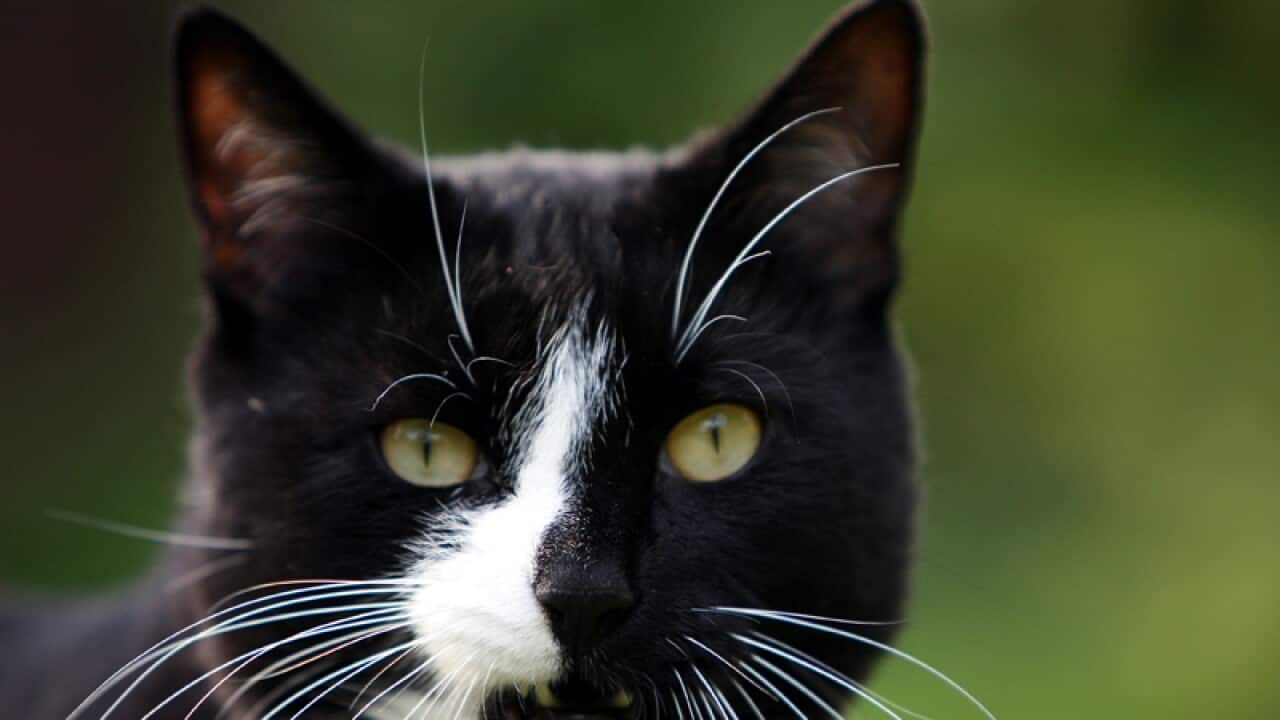
Cats with black and white patches have their distinctive colouring determined in the womb, research suggests.
The study found the two-tone fur colour, known as piebald, forms when pigment cells fail to follow instructions during early development.
Scientists hope the research will enhance understanding of medical conditions such as holes in the heart, which are also caused by problems with cell movements in the womb.
Piebald patches, also apparent in some horses, occurs when pigment cells move and multiply randomly as an embryo grows, without complex cell-to-cell communication sending them in one direction.
As there are not enough pigment cells to cover the whole of the skin, the animal gets a white belly, the study said.
News that makes sense
Your trusted source for staying up-to-date with the world around you. Get free daily news updates and analysis, straight to your inbox.
"We already know cells move through the developing skin to create pigment. We have discovered that they move and multiply at random which is not what was expected," the University of Edinburgh's Dr Richard Mort said.
"Using a mathematical model we were then able to show that this simple process could explain piebald patterns."
This mathematical model could now be used for further research tracking different cells during early development.
Researchers at the Universities of Bath and Edinburgh carried out the research on mice and believe it debunks earlier theories that the odd colouring is the result of slow-moving pigment cells.
"Piebald patterns can be caused by a faulty version of a gene called kit. What we have found is counter-intuitive," the University of Bath's Dr Christian Yates said.
"Previously it was thought that the defective kit gene slowed cells down, but instead we've shown that it actually reduces the rate at which they multiply.
"There are too few pigment cells to populate the whole of the skin and so the animal gets a white belly.
"In addition to kit, there are many other genes that can create piebald patterns, the mathematical model can explain piebald patterns regardless of the genes involved.''
The findings were published in the journal Nature Communications.







