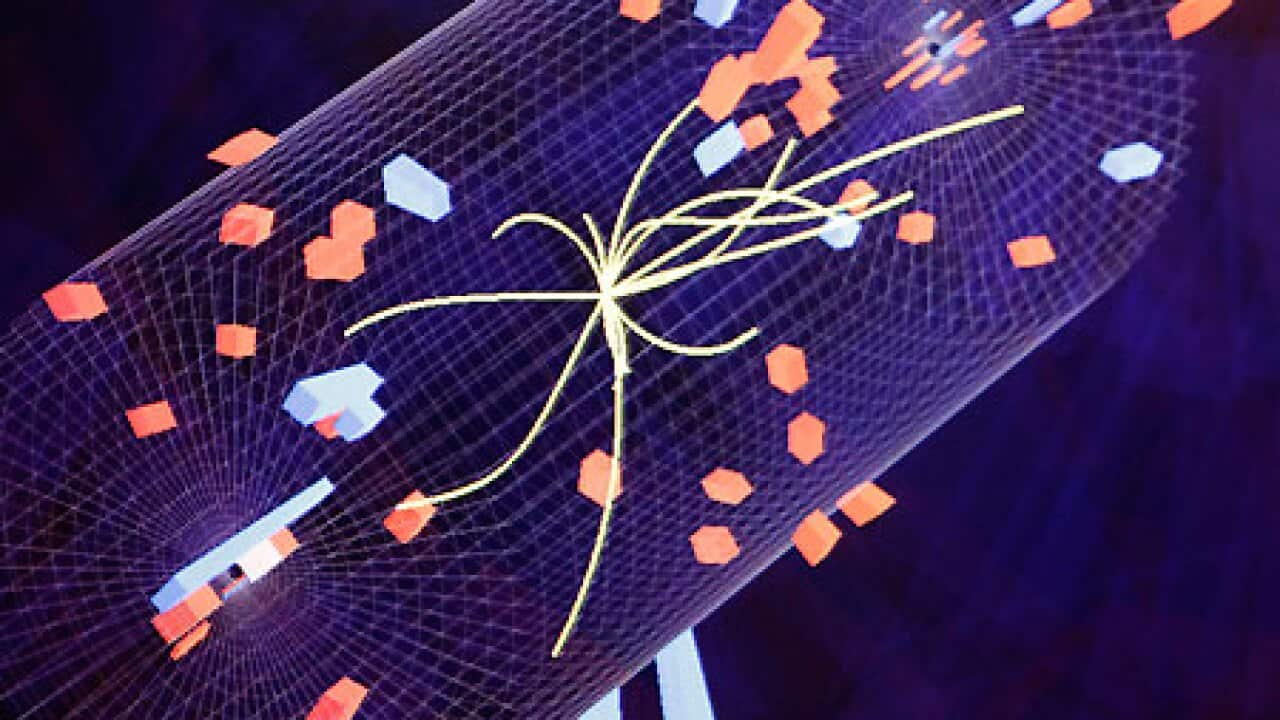
They reported that the giant subterranean machine was in fine shape after a 10-week shutdown and that particle beams circulating in it again since the weekend would be boosted to top speed by the end of the day.
"Everything is going very well indeed. Progress has been extremely rapid since we switched the LHC on again late on Saturday," Mike Lamont, head of operations at the LHC control room just outside Geneva, told Reuters.
The LHC was closed down on December 6 for technical checks of its hugely complex apparatus after eight months of operations.
News that makes sense
Your trusted source for staying up-to-date with the world around you. Get free daily news updates and analysis, straight to your inbox.
"We hope to ramp up to full beam within the next few hours," said Lamont, referring to the highest energy achieved so far in the machine -- 3.5 tera electron volts, or TeV -- since it first went into operation on March 31 last year.
"Our analyst teams are preparing to work on 'new physics' data that will start flowing once collisions start up again in about three weeks," said Oliver Buchmueller, team leader on the LHC's CMS detector, one of the project's four major experiments.
NEW PHYSICS
New Physics, the motto of the LHC, refers to knowledge that will take research beyond the "Standard Model" of how the universe works that emerged from the work of Albert Einstein and his 1905 Theory of Special Relativity.
"We will be focusing this year on super-symmetry, extra dimensions, how black holes are produced, and the Higgs boson. We expect some first results by the summer," said Buchmueller.
Super-symmetry, dubbed SUSY, is a theory allowing for the existence of unseen doubles of elementary particles and if proven correct would explain the mystery of dark matter, believed to make up nearly a quarter of the known universe.
It could also help back up the string theory concept which provides for extra dimensions other than the known four -- length, breadth, depth and time -- and for the existence of parallel universes.
Black holes are collapsed stars, observed in many galaxies in the known universe, around which the force of gravity is so strong that nothing, not even light, can escape. But scientists want to know more about how they come about.
The Higgs boson has been posited for over 30 years as the agent that gives mass to matter, and made formation of the universe possible immediately after the Big Bang 13.7 billion years ago. But proof that it exists has still to be found.
Information on all these is expected to emerge as CERN -- the 21-nation European Organization for Nuclear Research -- pursues its simulations of the Big Bang with billions of high-energy collisions in the LHC.







