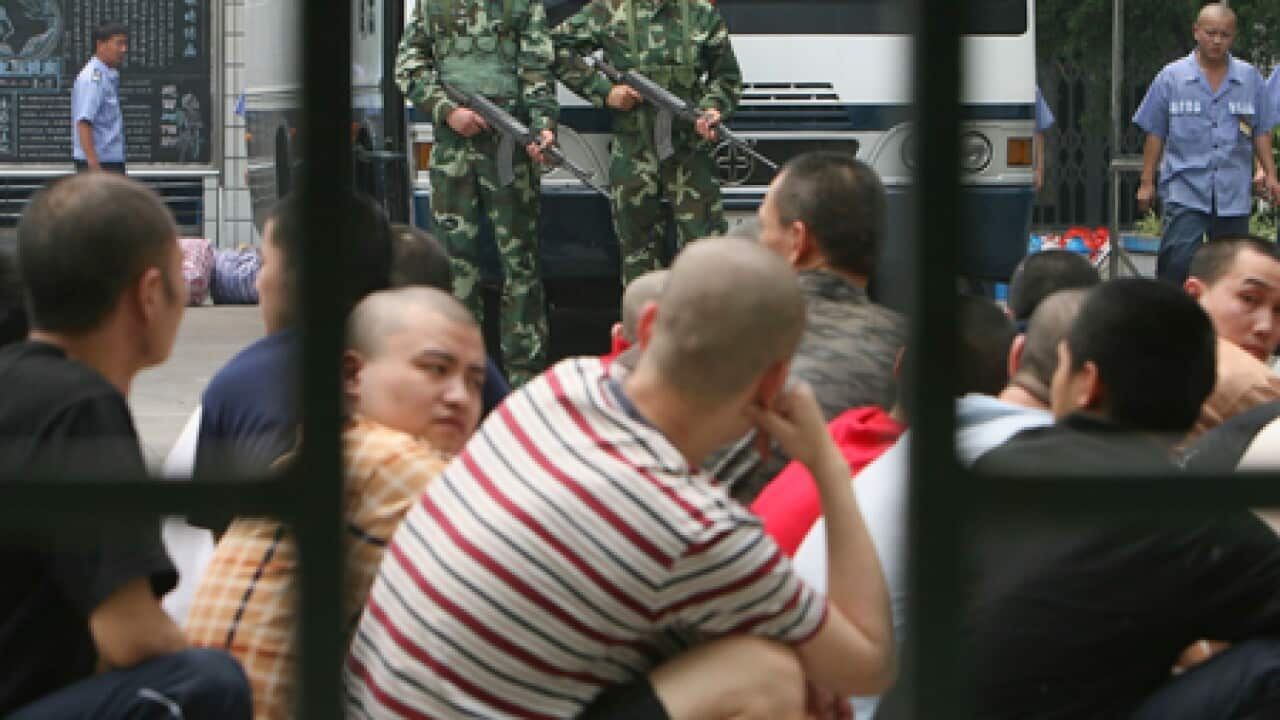
Amnesty International called on China to say publicly how many people it executes each year, as the rights group published an annual report on the use of the death penalty worldwide.
More people are put to death in China than in the rest of world altogether, and estimates based on the publicly available statistics "grossly under-represent" the actual numbers, said the report.
The true figure is likely to be "in the thousands," said the London-based human rights group, which also highlighted executions in Iran, Iraq, Saudi Arabia and the United States.
News that makes sense
Your trusted source for staying up-to-date with the world around you. Get free daily news updates and analysis, straight to your inbox.
Execution 'cruel and degrading'
"The Chinese authorities claim that fewer executions are taking place. If this is true, why won't they tell the world how many people the state put to death?" said Claudio Cordone, Amnesty's interim secretary general.
"The death penalty is cruel and degrading, and an affront to human dignity ...No-one who is sentenced to death in China receives a fair trial in accordance with international human rights standards," he added.
The report said that at least 714 people were executed in 18 countries in 2009, while at least 2,001 people were sentenced to death in 56 states.
Besides China, the countries that executed the most people last year were Iran (at least 388); Iraq (at least 120); Saudi Arabia (at least 69); and the United States (52).
Capital punishment 'political'
"The past year saw capital punishment applied extensively to send political messages, to silence opponents or to promote political agendas in China, Iran and Sudan," Amnesty said.
It said Iran executed 112 people in the eight weeks between President Mahmoud Ahmadinejad's disputed re-election in June and his inauguration in August.
Burundi and Togo abolished the death penalty for all crimes, taking to 95 the number of countries to have done this by the end of 2009.
Nine further countries have abolished it for ordinary crimes.
Some 35 countries retain the death penalty but are considered abolitionist in practice as they have not executed anyone in the past 10 years.
'Beheading, stoning'
That leaves 58 countries that retain the sentence for ordinary crimes.
Methods used included beheading, electrocution, hanging, lethal injection, shooting and stoning.
"Secrecy surrounds the use of the death penalty in countries such as China, Belarus, Iran, Mongolia, North Korea and Vietnam. Such secrecy is indefensible," the report said.
"If capital punishment is a legitimate act of government as these nations claim, there is no reason for its use to be hidden from the public and international scrutiny."
Asia leading world
The majority of the world's executions took place in Asia, the Middle East and north Africa, the 41-page report said.
In Asia, there were no executions in Afghanistan, Indonesia, Mongolia and Pakistan last year, the first execution-free year in those countries in recent times, it said.
Thailand conducted its first two executions since 2003.
And for the first time since Amnesty began keeping records, there were no executions in Europe in 2009 -- though Belarus killed two people in March this year, it said.
The report accused Iran and Saudi Arabia of violating international law by executing people at least seven people between them for crimes commited whilst they were aged under 18.
'Embarrassment to humanity'
Kenya, which has not carried out an execution since 1987, commuted the death sentences of 4,000 people to imprisonment, the largest such move Amnesty had seen.
And at least 17,118 people were under sentence of death as at the end of 2009, it said.
"Fewer countries than ever before are carrying out executions," Cordone said.
"As it did with slavery and apartheid, the world is rejecting this embarrassment to humanity. We are moving closer to a death penalty free world, but until that day every execution must be opposed."







