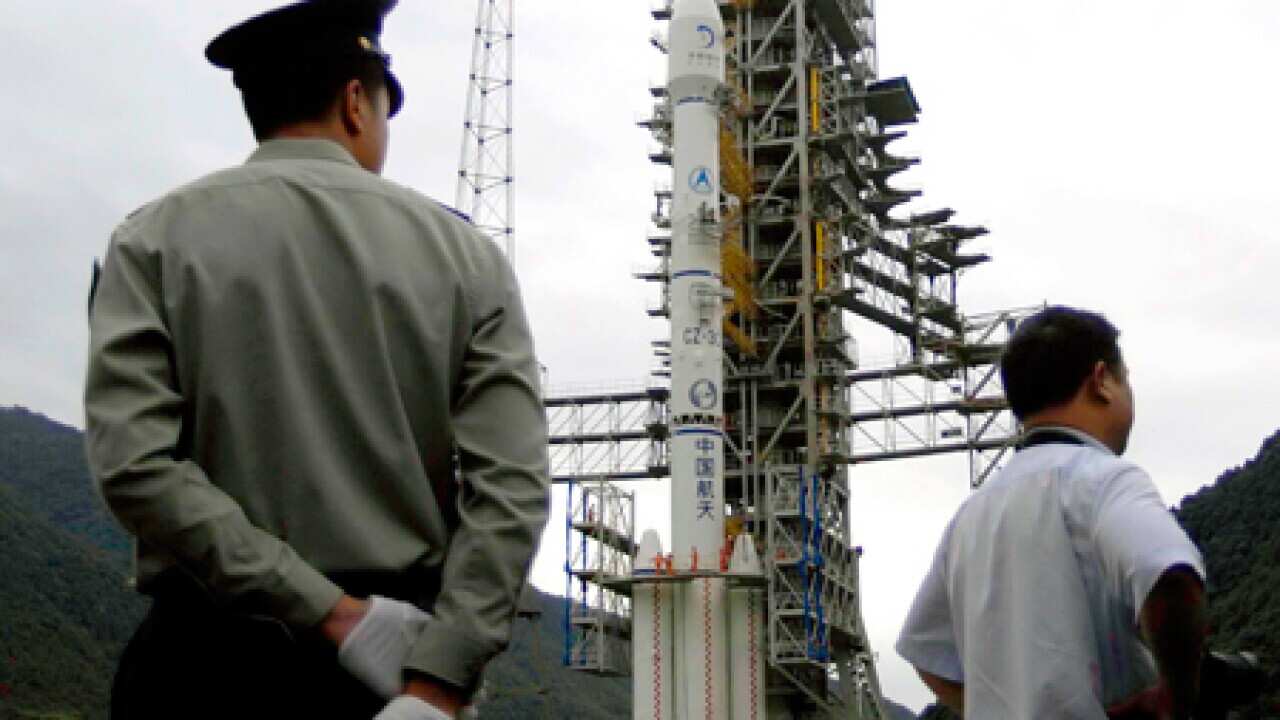
A launch rocket carrying the Chang'e-2, which will go orbit within 15 kilometres (nine miles) of the moon, has been set up in Xichang city in southwestern Sichuan province.
State media says it should take off Friday evening.
News that makes sense
Your trusted source for staying up-to-date with the world around you. Get free daily news updates and analysis, straight to your inbox.
People arrived early to watch the take-off, an employee at the launch site's tourism department, who refused to be named, told AFP.
"A stand has been built for them, and tickets cost 800 yuan (120 dollars)," she said, adding the whole area had been sealed off.
Weather authorities in Xichang have forecast light rain during the launch window, adding the probability of thunder and high-altitude winds is low, China's National Space Administration said.
"At present, the October 1 launch will not be affected," said Li Shangfu, head of the launch site's mission command, according to a statement on the administration's website.
"But we are still closely monitoring any weather changes."
The planned launch day is symbolic as it is also China's National Day, which marks Mao Zedong's proclamation of the founding of the People's Republic in 1949.
The lunar probe will conduct various tests in preparation for the expected launch in 2013 of the Chang'e-3, which China hopes will be its first unmanned landing on the moon, state media has reported.
The Chang'e programme, named after a mythical Chinese goddess who flew to the moon, is seen as an effort to put China's space exploration programme on a par with those of the United States and Russia.
Beijing hopes to bring a moon rock sample back to earth in 2017, with a manned mission pencilled in for around 2020, according to state media.
China became the world's third nation to put a man in space independently -- after the United States and Russia -- when Yang Liwei piloted the one-man Shenzhou-5 space mission in 2003.







