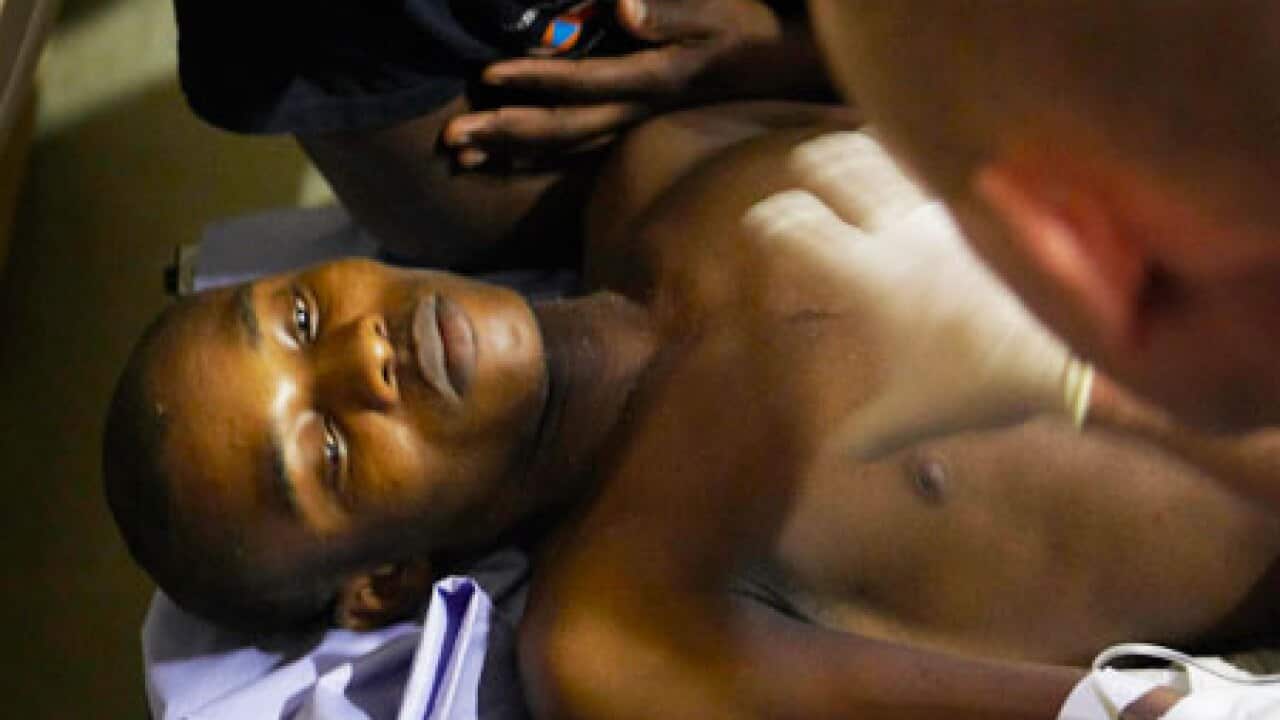
Rescuers have pulled a man alive from the rubble 11 days after Haiti's devastating earthquake, raising hopes more survivors could be found even search efforts have been officially called off.
Wismond Exantus, 25, said after his rescue on Saturday that he survived his ordeal in the ruins of the grocer's shop where he worked by drinking Coca-Cola and eating snacks, a rare tale of hope from a disaster that has claimed more than 112,000 lives.
His rescue came as thousands of survivors wept outside the capital's shattered cathedral for the funeral of the archbishop of Port-au-Prince in a ceremony that symbolized the deep mourning of the Caribbean nation.
News that makes sense
Your trusted source for staying up-to-date with the world around you. Get free daily news updates and analysis, straight to your inbox.
"I feel good," Exantus told AFP in Creole from his hospital bed after French, American and Greek search and rescue teams removed him from the debris on a stretcher.
"I survived by drinking Coca-Cola. I drank Coca-Cola every day, and I ate some little tiny things."
Exantus' brother said he had been unable to approach the shop, in a dangerous area plagued by looters, because of the police. His family eventually alerted a Greek rescue team to his cries deep under the remains of the shop.
"We can say it's really a miracle and we can hope that it's not the last," said French rescue team commander Lieutenant Colonel Christophe Renou.
The United Nations announced just hours earlier that Haiti's government had on Friday declared an end to search-and-rescue efforts so aid workers could focus on getting supplies to the estimated 600,000 people left homeless by the quake.
But more than 60 international rescue teams continued to search for signs of life, having already saved 132 people across the razed city since the January 12 disaster.
The tragic aftermath of the quake was on display at the funeral mass for popular Archbishop Joseph Serge Miot in front of the city's destroyed Roman Catholic cathedral.
He died when his office adjoining the cathedral collapsed in the 7.0-magnitude quake.
President Rene Preval led a crowd of several thousand who wept and sang.
Several thousand people also took part in group prayers on the Champ de Mars, near the wrecked presidential palace, led by energetic evangelists.
"All the bad spirits in the presidential palace must disappear!" shouted one preacher. Participants prayed, shouted and waved their hands toward the palace.
The confirmed death toll had risen to 112,226 by Saturday, an official government tally said.
Aid workers increased the pace of deliveries to those living in squalid conditions beneath tents or in makeshift camps across the capital.
The UN World Food Program said it had distributed two million meals on Friday and a total of 150 health facilities were now running across the city, the World Health Organization said.
A US Marine unit had arrived off the coast of Haiti Saturday to bolster its aid contingent, the US military said. A total of 20,000 US military personnel are due to be in Haiti or on ships offshore by Sunday.
Normal life was also returning to parts of the capital, with some shops and street vendors back in business, traffic flowing and people lining up to wait for private banks to reopen.
But elsewhere some pillaging continued in the main shopping street of Port-au-Prince and UN troops fired warning shots and sprayed tear gas on survivors after a food delivery spiraled out of control on Saturday.
A spokeswoman for the UN Organisation for the Coordination of Humanitarian Affairs (OCHA) at its operations centre in Geneva said the incident appeared to be isolated, with little violence reported in Haiti.
"It's normal that there would be such isolated incidents due to exasperation and despair," Elisabeth Byrs told AFP.
"Such violence is not representative of the Haitian people, the population has been calm and dignified," in the wake of the quake, Byrs said.
A huge relocation of survivors out of the capital continued.
More than 130,000 people have taken advantage of the government's offer of free transport to other cities where it is setting up new tent camps, the UN said. An unknown number of other people had left the capital by private means.
World powers will discuss plans to rebuild the country at a major donor conference on Monday in Montreal.
Experts have warned that hundreds of thousands of Haitians will be living off foreign aid and in temporary housing for years to come as rebuilding the nation may take at least a decade. Thousands have also bee left disabled by the quake.







