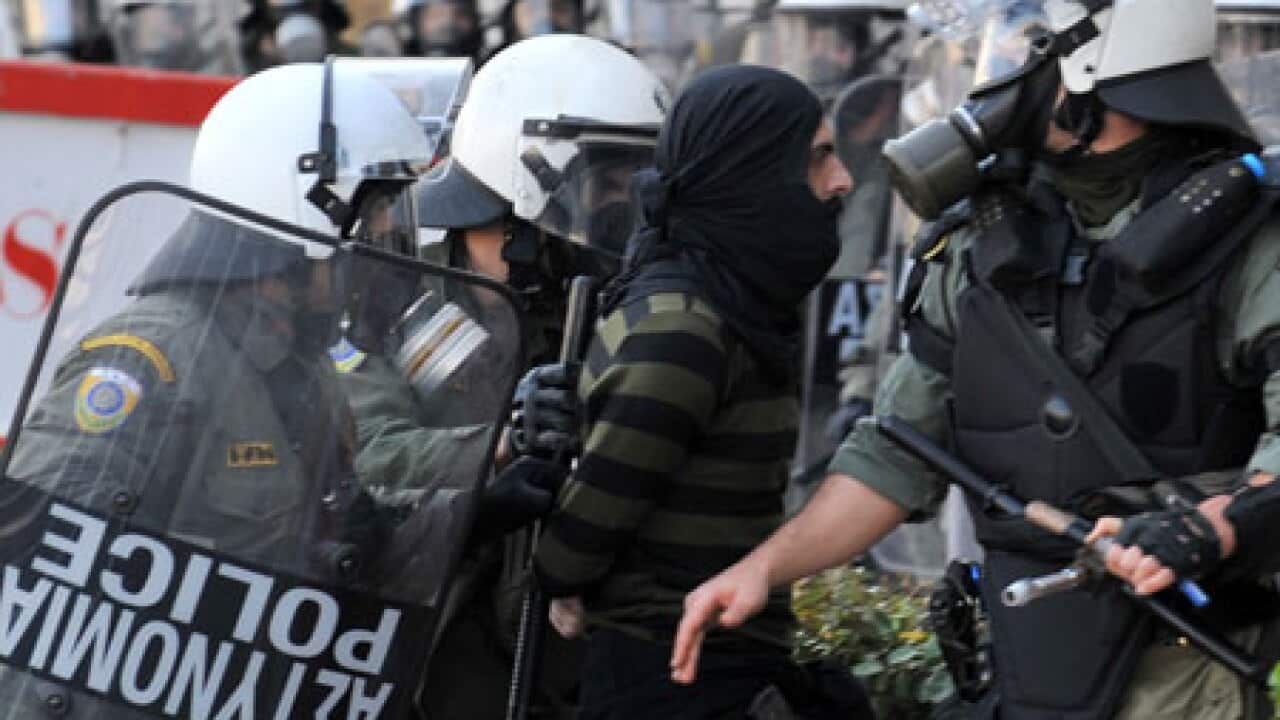
Clashes between riot police and rock-throwing, masked youths broke out during a demonstration in central Athens on Thursday by tens of thousands of striking workers protesting austerity measures that the Greek government has said it has no choice but to implement.
The debt-ridden country is under intense pressure from markets and the European Union to reduce its deficit from 12.7 per cent of economic output in 2009 to 8.7 per cent this year.
Last week, Greece introduced a harsh $A7.11 billion austerity package that cut civil servants' wages, froze pensions and raised consumer taxes.
News that makes sense
Your trusted source for staying up-to-date with the world around you. Get free daily news updates and analysis, straight to your inbox.
The new cutbacks, added to a previous $A16.67 billion austerity plan, sparked a wave of strikes and protests from labour unions whose reaction to the initial measures had been muted.
All day strike
Thursday's 24-hour general strike, the second in about a week, grounded airline flights, halted public transport, suspended news broadcasts and left public hospitals working with emergency staff.
Demonstrators took to the streets of Athens and Thessaloniki, banging drums and chanting slogans such as "no sacrifice for plutocracy", and "real jobs, higher pay".
They were joined by uniformed police, coast guard and fire service officers.
"The fight must be constant until the stability pact - these unpopular measures passed by the government - is overturned," said demonstrator Olga Raptou.
Market reaction
Analysts have warned that gathering unrest in Greece could complicate the government's efforts to implement the measures, seen as crucial to a bid to improve its credit rating -- and ability to borrow money -- on the bond market.
"Our key conclusion is that the adjustment remains a Herculean task, and the costs of the adjustment in terms of lost output could be larger than the policymakers currently appreciate," analysts at Deutsche Bank said.
In Lisbon, the Portuguese government, which like Greece is confronting a gaping public deficit, insisted that warnings of a relapse into recession were "premature" after data showed the economy shrank by 0.2 percent in the last quarter, putting its recovery in jeopardy.
Thousands protest
An unofficial police estimate put the Athens crowd at about 20,000; organisers said the actual number was much higher.
Clashes broke out soon after the march began, with riot police firing tear gas and stun grenades to disperse masked youths who smashed pavement, marble steps and building facades to use as projectiles to throw at police.
Businessmen in suits scurried for cover, their eyes streaming.
Clashes with police
About 200 black-clad youths in crash helmets and ski masks fought sporadic street battles with the police through central Athens, smashing shop, bank and hotel windows and bus stops, setting rubbish bins on fire, and punching and kicking motorcycle police.
After the march ended, the violence spread to a nearby square where tear gas sent customers running from open-air cafes.
Police said 13 policemen were injured and 16 people were detained, nine of whom were arrested.
Limited clashes also broke out during a demonstration by about 14,000 people in the northern city of Thessaloniki.
Public anger grows
While public anger has grown, it has been mitigated by a general understanding that something must be done to pull the country out of a crisis that has made its cost of borrowing skyrocket.
An opinion poll published last weekend, just after parliament approved the measures, found Greeks split - with 47 per cent opposing the austerity package and 46 per cent supporting it. The poll, in To Vima newspaper, did not give a margin of error.
"It is to be expected that there will be reaction to these measures. We took very difficult decisions that were very unpleasant, and they personally upset me a great deal," Deputy Prime Minister Theodore Pangalos said on Wednesday. "But we cannot do anything differently."
Prime Minister George Papandreou's Socialists, who came to power in a landslide election victory in October, enjoy a comfortable majority with 160 of parliament's 300 seats and easily pushed the measures through parliament on March 5.
"We have made a choice which could lead the country to a radical clean up of the past," Pangalos said on Mega TV. "We will find the way forward and we will not turn back. And no one can obstruct this given that a large section of Greek society supports us."







