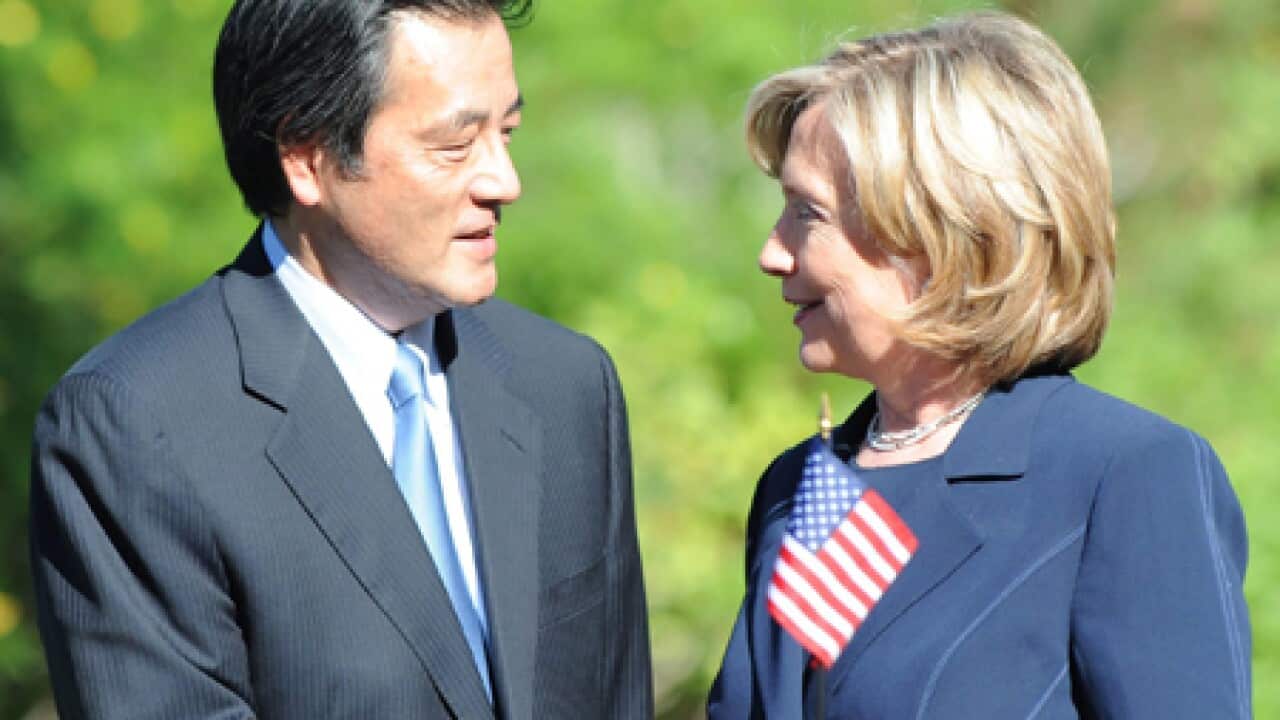
The US Secretary of State Hillary Clinton has kick-started Washington's campaign to re-engage with Asian Pacific nations.
In Hawaii, she met with the Japanese Foreign Minister to discuss the future of the US air base on the southern Japanese island of Okinawa.
She pressed Katsuya Okada to stick by a deal on moving the controversial US air base, but got no commitment from Tokyo during the meeting.
At the hastily-arranged talks, Clinton said she had stressed the need to resolve the fate of the Futenma base.
News that makes sense
Your trusted source for staying up-to-date with the world around you. Get free daily news updates and analysis, straight to your inbox.
But she also expressed confidence the row would be resolved, saying Tokyo understands that the 50-year-old alliance with Washington is "fundamental to the future" of both Japan and the region.
The meeting with Okada was added to the beginning of an Asia tour by Clinton amid growing concerns of a rift between Washington and the new centre-left coalition government in Tokyo, which includes elements opposed to the presence of the US base on Okinawa.
"I have stressed again today ... that it is important to move on Futenma," Clinton said at a press conference with Okada in the garden of a luxury hotel on the Pacific Ocean.
She reiterated the US view that a 2006 base deal known as the "realignment road map" is "the way forward". The accord was to move the base from an urban area on the island of Okinawa to a coastal region.
Alternative sites
Okada said the government of Prime Minister Yukio Hatoyama would decide by May where to relocate the base, even if the decision risks breaking up his coalition.
The government is considering alternative sites for the base, with various options including moving it off Okinawa altogether.
The 2006 accord was part of a broader realignment of US forces in Japan and includes the redeployment of around 8,000 Marines from Okinawa to Guam.
Soon after coming to power, Hatoyama's center-left government announced a review of the agreement, provoking irritation in Washington, which has long guaranteed security for Japan.
Hatoyama's junior partners in government, the Social Democrats, have threatened to quit the coalition if it agrees to the original relocation plan.
The United States, which defeated Japan in World War II and then occupied the country, now has 47,000 troops stationed there, more than half of them on Okinawa, the site of one of the bloodiest battles of the war.
Clinton said the US view is that 2006 agreement offers the best solution for both the security of Japan and the residents of Okinawa.
"We want to get a decision by May because much of the rest of the work around the realignment roadmap has already proceeded," the chief US diplomat said.
"The United States has already made decisions based on that roadmap, which was accepted by prior governments," referring to the previous administration of president George W. Bush and the conservative government in Japan.
She did not answer a question on whether she received an explicit commitment from Okada not to move the base off Okinawa altogether.
She said she was confident the two sides would find a solution that reflects the "very best of our alliance" and provides the security guarantees Japanese want.
Okada said: "we must make the Japan-US. alliance sustainable for the next 30 or 50 years, and further deepen this alliance."
The security treaty, signed on January 19, 1960, has formed the bedrock of the post-war Japan-US alliance, under which pacifist Japan relies on a massive US military presence to guarantee its security.
The two chief diplomats also discussed problems in Afghanistan, Iran, North Korea, and Myanmar as well as global warming, nuclear non-proliferation and disarmament, a broad range of issues that Okada said testify to the importance of the alliance.
Asia-Pacific tour
Clinton will travel Wednesday to Papua New Guinea for talks on climate change and economic development before heading to New Zealand and Australia, where she will discuss similar issues as well as international security.
Making her fourth tour of Asia since she became secretary of state a year ago -- the first stop of her first tour was in Japan -- Clinton is due back in Washington on January 20.
In a speech at the East-West Center in Honolulu, Clinton said President Barack Obama's administration would work more closely with Asian countries and regional organizations than in the past.
"Half of diplomacy is showing up," she said in a dig at the previous administration of president George W. Bush which skipped high-level meetings of the Association of Southeast Asian Nations (ASEAN).
"I want to underscore we are back to stay," she said.







