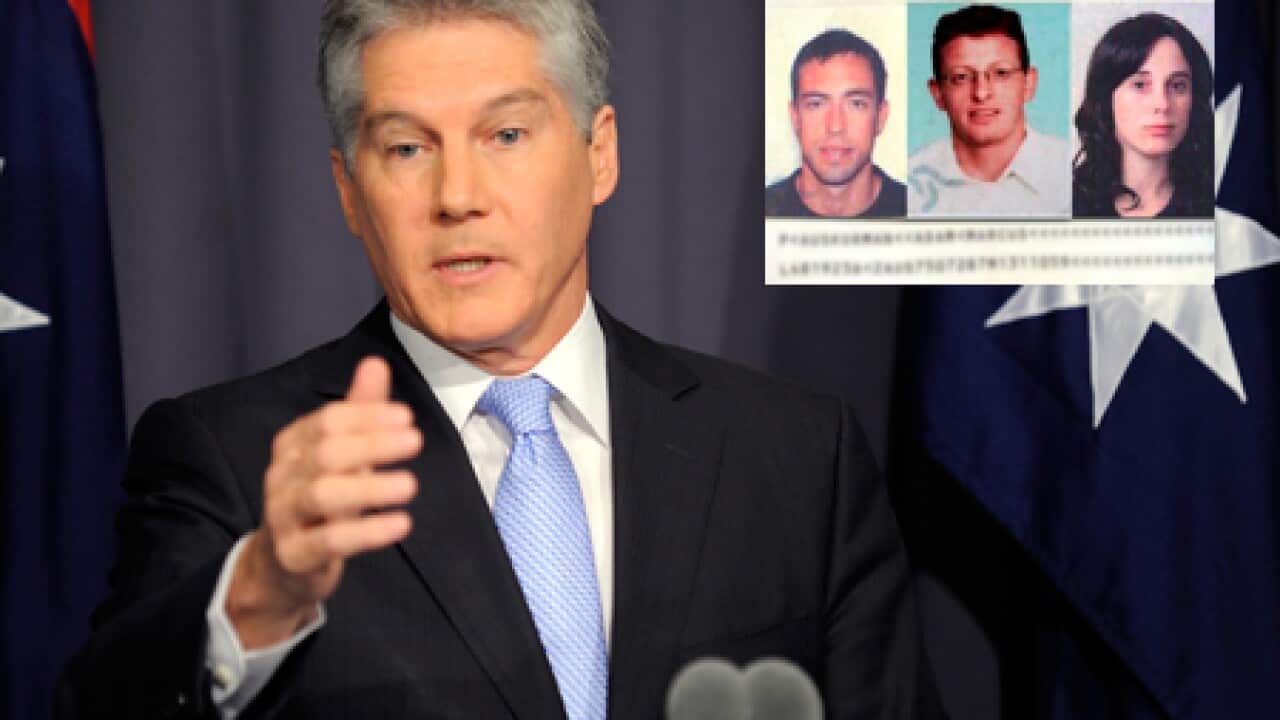
Foreign Minister Stephen Smith has accused the opposition of turning a blind eye to the abuse of Australia's passport system and sovereignty.
The Coalition today described as an over-reaction the government's decision to order the expulsion of a Mossad agent in response to a wide-ranging investigation that found Israel was involved in the forging of Australian passports.
A clearly angry Mr Smith rebuked the opposition for suggesting the government was currying favour with Arab nations in a bid to win votes for Australia's bid for a temporary seat on the United Nations Security Council.
"They are not fit to manage our national security interest," he told Sky News on Tuesday.
"We will not ... stand idly by and turn a blind eye to the shredding of our national security interest, to the abuse of our passport system and to the trampling of our sovereignty."
News that makes sense
Your trusted source for staying up-to-date with the world around you. Get free daily news updates and analysis, straight to your inbox.
The expulsion follows a three-month investigation which found Israel was involved in the forging of Australian passports to enable the January murder of Hamas operative Mahmoud al-Mabhouh in Dubai.
Mr Smith said he found as "frankly extraordinary" the opposition's response to the government's decision because its foreign affairs spokeswoman, Julie Bishop, had been given the same briefing as he had from security agencies.
He dismissed as "arcane" Ms Bishop's claim there was insufficient hard evidence to support the government's decision.
"In these matters you have to make a judgement and that's what we did. "On the basis of the advice we had ... we were left in no doubt that Israel was responsible for the abuse of Australian passports."
Opposition frontbencher George Brandis dismissed Mr Smith's criticism, saying the expulsion decision was a "terrible over-reaction".
"It pays no heed to the fact that Israel is a very strong ally and friend of Australia," he told Sky News.
"It ought to give (Israel) the benefit of the doubt." Senator Brandis said the parliament had not seen any evidence to support the government's decision.
"One would have thought that he (Mr Smith) would have produced evidence ... at least referred to the existence of it."
Diplomatic expulsion 'unhelpful'
Jewish leaders say they are greatly disappointed over the decision.
"We consider that decision to be an over-reaction," Robert Goot, president of the Executive Council of Australian Jewry, said in a statement on Monday.
He expressed concern that Mr Smith did not reveal any evidence to support his conclusions that Israel or its agents were involved in using the fake passports.
"Little good can come from taking punitive action in relation to this matter against Israel, which is the Middle East's only stable democracy and the only Middle Eastern country that can be relied on to act resolutely against international terrorism," he said.
Colin Rubenstein, executive director of the Australia-Israel and Jewish Affairs Council, described the decision to remove a diplomat over the affair as "unhelpful."
"We would note in this regard, while Australia followed a British precedent in its over-reaction, no similar step has been taken by Ireland, France, or Germany, all of whom also allegedly had forged passports implicated in the killing," he said.
Despite the uproar, both groups say they are confident the relationship between the governments can be repaired and continue to flourish.
Jewish-Australian political activist Antony Loewenstein, whose book My Israel Question finds fault with the Jewish state for its part in the conflict with Palestine and ongoing tensions in the Middle East, described the relationship between Australia and Israel as "complicit."
"Australia has long been treated like fools by Israel, and has often been more than happy to be seen as a fool, in many ways," he told AAP.
Australian Jewish leaders say the decision to expel an Israeli diplomat is an over-reaction, while Australians for Palestine spokesman Michael Shaik said the government's reaction "was vital to breaking the culture of impunity under which Israel has operated for so long."
"It would carry even more weight if our government followed the British example and refused to allow a replacement diplomat until Israel commits to no further misuse of Australian passports," he said.
Pro-Palestinians hail expulsion
Australians for Palestine spokesman Michael Shaik said the government's reaction "was vital to breaking the culture of impunity under which Israel has operated for so long."
"It would carry even more weight if our government followed the British example and refused to allow a replacement diplomat until Israel commits to no further misuse of Australian passports," he said.







