Amy Maguire, University of Newcastle
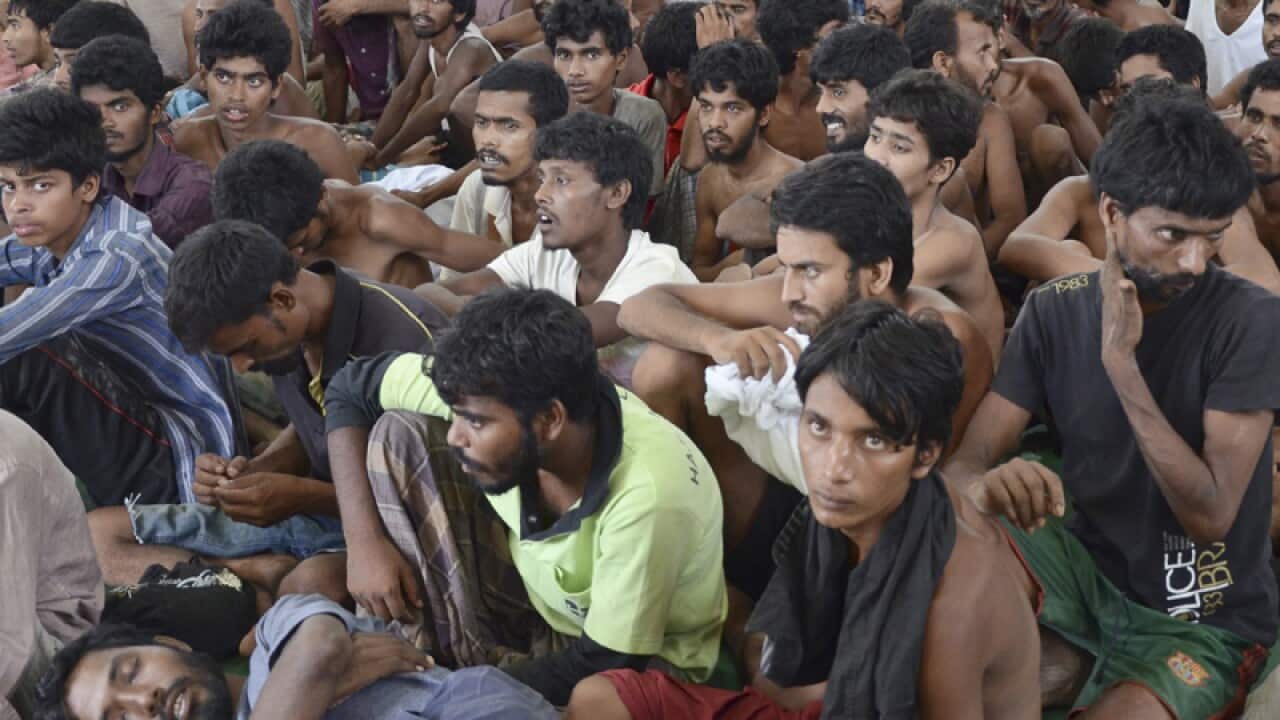
Officials from Myanmar, Bangladesh, Malaysia, Indonesia, Australia, Cambodia, Laos, the US, Vietnam and other countries and international organisations are in Bangkok to discuss a regional crisis involving thousands of people in desperate circumstances after being stranded on boats in the Bay of Bengal, Andaman Sea and Strait of Malacca.
Thailand is hosting the May 29 Special Meeting on Irregular Migration in the Indian Ocean in response to the crisis that has unfolded in April and May. Most of the people involved are ethnic Rohingya, fleeing insufferable persecution in Myanmar. Others are from Bangladesh, fleeing persecution or severe poverty.
Indonesia, Malaysia and Thailand denied them safe landing for several weeks. The Rohingya plight was broadcast globally and their suffering finally became impossible to ignore. Indonesia and Malaysia relented and offered temporary shelter to some.
Thailand has described the situation as an “unprecedented” human-trafficking crisis. These countries appealed for regional co-operation to arrange the permanent resettlement of refugees in other countries, including Australia.
News that makes sense
Your trusted source for staying up-to-date with the world around you. Get free daily news updates and analysis, straight to your inbox.
Prime Minister Tony Abbott’s response was heard around the world:
Nope, nope, nope… I’m sorry. If you want a new life, you come through the front door, not through the back door.
Tony Abbott has ruled out accepting any Rohingya refugees for resettlement.
Abbott’s reply is characteristic of the dehumanising tone of much of the Australian debate on asylum seekers. While the UN High Commissioner for Refugees (UNHCR) expressed dismay, Opposition Leader Bill Shorten endorsed the refusal to accept some Rohingya refugees. Shorten said there were alternatives to Abbott’s “dumbed down” approach:
… but the answer doesn’t mean that we take these people here.
Australian response alienates neighbours
Indonesia has criticised Australia’s attitude. Foreign Minister Retno Marsudi said it was “not fair” to depict the crisis as Indonesia’s problem.
Indonesian foreign affairs spokesman Arrmanatha Nassir depicted Australia as hypocritical:
… countries that are party to the Convention on Refugees have a responsibility to ensure that they believe in what they sign … If you believe it when you sign it, you should act upon it.
Such comments could be read to imply that Australia’s response is ungenerous. Asian neighbours may even regard Australia’s attitude to the problem as racist.
Can we move beyond the “stop the boats” rhetoric and recast this debate in humane terms? We have had more than two decades of increasingly punitive policy from both sides of politics.
In 2015, asylum seekers who attempt to reach Australia by sea are called “illegal maritime arrivals”. This echoes the pejorative term “queue jumpers”, a notion reinforced by Abbott’s determination to prevent asylum seekers from using the “back door”.
Such language leaves little space for recognition that people seeking asylum from persecution are exercising fundamental human and legal rights.
Finding legal and humane alternatives

A Malaysian policeman carries human remains from mass graves discovered in people-smuggling camps. EPA/Fazry Ismail
Australia and other countries must work to prevent people smuggling, which trades in human suffering and risks lives. This was clear in the gruesome discovery of people-smuggling camps and mass graves in Malaysia this week and in Thailand earlier this month.
Yet the suffering of those who take to the seas in search of asylum obliges us to find legal and humane alternatives to current policy.
Significant re-orientation is required to bring Australia’s policy into line with international law. Australia has been criticised for its boat turn-back policy, which may result in the refoulement of refugees. The UN has accused Australia of committing human rights violations, including torture and inhumane treatment, through its offshore detention program. Australia’s detention of child asylum seekers causes particular harm.
Australia claims to be part of Asia when it suits, but has reduced the regional challenge of asylum seekers to a unilateral policy of deterrence. This is a politically self-serving and short-sighted strategy, which avoids the burden of working co-operatively on regional solutions.
How can Australia contribute to a regional solution?
Australia should show regional and global leadership by developing policy that centralises concern for human rights and well-being.
In relation to the stranded Rohingya and Bangladeshis, Australia should support the ten-point action plan put forward by the UNHCR and associated organisations. This calls on countries to attend to the immediate needs of asylum seekers, including rescue, safe disembarkation, food and medical care and speedy status determinations.
Origin countries Myanmar/Burma and Bangladesh must attend to the root causes of this migration. These include the effective statelessness suffered by the Rohingya in both countries.
The Refugee Council has proposed a range of means by which Australia could recast its broader policy:
- Australia could lobby neighbours to adopt the Refugee Convention and incorporate refugee protection into domestic law.
- Asia-Pacific states could agree on standards for refugee status determinations.
- The region’s nations could find alternatives to detaining asylum seekers arriving by boat, rather than collaborating in their costly and inhumane detention.
- Australia could shift its primary focus from people smugglers to refugee-origin countries, promoting peace-building and human rights to reduce the pressure on people at risk to flee their homeland.
- Rather than drastically reducing its foreign aid, Australia could fund the UNHCR and NGOs to support asylum seekers in the region and improve their living standards.
The European Community is debating a proposed quota system for settling refugees throughout the European Union to ensure a shared regional response. Perhaps Australia and its neighbours could consider similar co-operation on resettlement, according to the relative capacities of the countries involved. The Philippines has shown principled leadership in this regard by offering safe landing to the stranded asylum seekers while its neighbours persisted in towing boats back to sea.
Australia ought to acknowledge what appears clear to EU member states: there is a massive global refugee crisis. The UNHCR notes the challenge of resettling the stranded Rohingya and Bangladeshis, considering the vast scale of the global crisis. In response, Australia should prioritise human well-being over self-interest or the politicisation of human tragedy.
It remains to be seen whether the Bangkok summit will situate concern for humanity at the centre of this debate. The chances seem slim, considering that Myanmar/Burma has agreed to participate only following an assurance that the term “Rohingya” will not be used. Instead, the people at the centre of this humanitarian tragedy are to be referred to as “irregular migrants”.

Amy Maguire does not work for, consult to, own shares in or receive funding from any company or organisation that would benefit from this article, and has no relevant affiliations.







