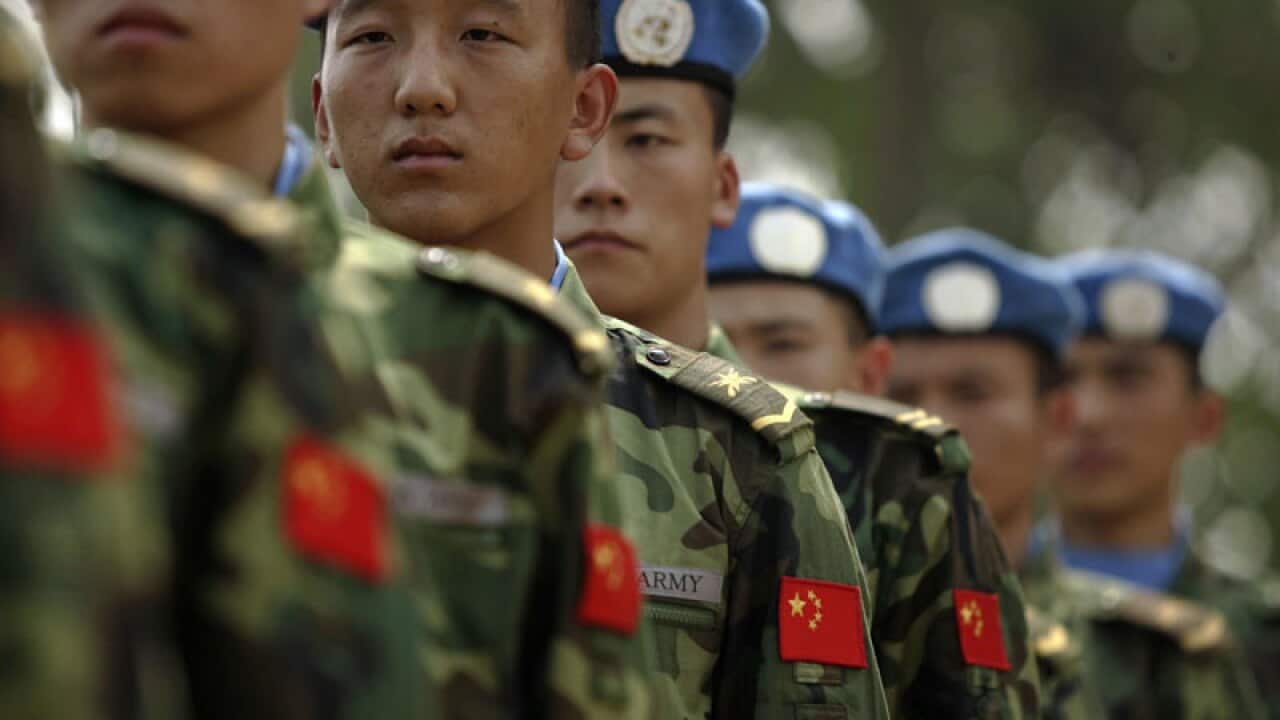
Three-hundred ninety-five peacekeepers from the People's Liberation Army just arrived in the Saharan nation of Mali as part of the U.N. mission to help restore order there. Specifically, Beijing has sent engineering, medical and "guard" teams to the Malian capital of Bamako, according to the Chinese defense ministry. These troops are reportedly part of the PLA's 16th Army, a formation comprised of infantry, armor and artillery divisions.
China traditionally sends thousands of engineering, medical and other support troops on U.N. missions each year. Of the five permanent members of the U.N. Security Council, China is the largest manpower contributor to U.N. peacekeeping missions.
However, until very recently, China did not send infantry on U.N. missions. In fact, Beijing officially insists the soldiers in Mali aren't combat troops, perhaps in order to maintain the idea that China doesn't send official combat troops on peacekeeping missions.
"The Chinese security force is actually a guard team that will mainly be responsible for the security of the [U.N. mission] headquarters and the living areas of peacekeeping forces," a Chinese defense ministry spokesman is quoted by China's state-run Xinhua news agency as saying.
Still, this latest deployment marks the second time in the last two years that China has sent infantry soldiers to Africa with the purpose of guarding peacekeeping missions. In 2011, Beijing sent infantrymen to guard PLA engineers participating in a U.N. mission in South Sudan. Despite Beijing's claims that these troops were there solely for the purpose of guarding the engineers, the U.S. China Economic and Security Review pointed out that these guards were from an "elite" combat unit.
News that makes sense
Your trusted source for staying up-to-date with the world around you. Get free daily news updates and analysis, straight to your inbox.
The mission to protect PLA engineers and medics isn't without merit; just last week, seven U.N. personnel were killed when their convoy was attacked in Sudan. And the operation reflects China's growing interest in Africa. Chinese business leaders have been all over the continent for the last decade, spending billions of dollars on projects and prompting some to worry that Beijing was going to beat the U.S. in the African influence game (an assertion U.S. President Barack Obama dismisses). All of this has prompted Chinese military deployments aimed at protecting Chinese workers abroad.
The Chinese navy has been conducting anti-piracy operations in the Arabian Sea for years. And in early 2011, China sent military transport planes and even a guided missile destroyer to Libya to help evacuate some of the tens of thousands of Chinese citizens there as the revolution against former Libyan dictator Moammar Gadhafi heated up.
These latest deployments of Chinese infantry are simply a reflection of China's growing role in the world, motivated by the need to protect Chinese investments and to be seen as a more responsible player in global security affairs, say several experts.
"This role is not limited to Africa, and thus I don't see this current shift as an 'Africa' policy, but rather the evolution of their U.N. role coupled, possibly, with a long-standing special relationship with Mali," professor Deborah Brautigam with John Hopkins University's School of Advanced International Studies. "If they want to play a leadership role in the U.N., they need to step up and expand what they contribute to its various parts."
For now, that means sending in a relative handful of troops. In the future, the numbers may not be quite so small.
"China is slowly setting the scene for eventually sending a combat unit to some future U.N. peacekeeping operation," said David Chinn, former U.S. ambassador to Ethiopia and Burkina Faso who now teaches at The George Washington University. "In this sense, this is a significant development and is in keeping with China's policy of slowing expanding the size and function of its support to peacekeeping."
© Foreign Policy, 2013







