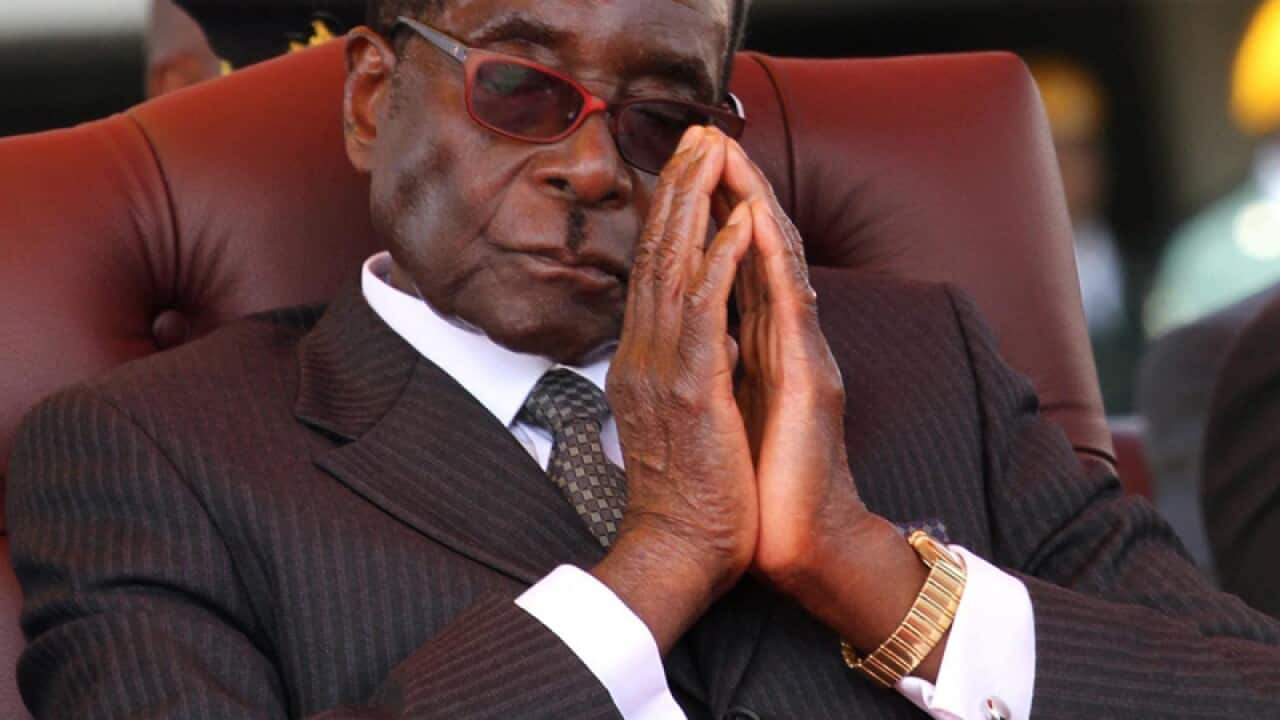
This Wednesday, Robert Mugabe will attempt to win re-election for yet another five-year term as president of Zimbabwe. Though he's seemed impressively spry on the campaign trail recently, his age is certainly a factor in this vote after a series of recent health scares. At 89, Mugabe, who has brutally ruled Zimbabwe as prime minister or president since 1980, is already the second oldest head of state in the world (Shimon Peres, the largely ceremonial president of Israel, has him beat by about 200 days) and has outlived the average Zimbabwean male's life expectancy by 35 years.
At this point, Mugabe's legacy for Zimbabwe's democracy, health and economy is pretty clear. But his attempt to stay in office until he's 95 — he'd still be just shy of the all-time record set by former Malawian President Hastings Banda who lost an election at the age of 96 — raises the question of how age changes a national leader's behavior.
A 2005 paper from the Journal of Conflict Resolution by Michael Horowitz of Harvard, Rose McDermott of U.C. Santa Barbara, and Allan Stam of Dartmouth, looks at the impact a leader's age has on the likelihood of him or her starting a war. There are a couple of potential causal factors here. In the case of male leaders, testosterone decreases with age, potentially making a leader less aggressive. On the other hand, there's a line of thought proposed by Robert Robins and Jerrold Post in their book "When Illness Strikes the Leader," which holds that when leaders' health is in question, their time horizons shorten, giving them the desire to solidify their legacy by taking bold action.
News that makes sense
Your trusted source for staying up-to-date with the world around you. Get free daily news updates and analysis, straight to your inbox.
The results in the paper are a bit mixed. Looking at 100,000 interstate pairs between 1875 and 2002, they found a "statistically significant relationship between the age of the leader of state A and international conflict. As the age of the leader of state A increases, the initiation and use of force against state B becomes more likely." This would seem to support the time horizon explanation.
However, when they looked specifically at "personalist" autocratic regimes — those in which political power is centered around one charismatic leader, the trend is reversed. As the Castros and Kims of the world age, they're less likely to initiate international conflicts, perhaps supporting the biological explanation: these are, after all, the regimes in which a leader's personal preferences and temperament matter the most.
It would be interesting to look at age impacts a leader's propensity to use force against domestic opponents. While Mugabe has embroiled Zimbabwe in international conflicts — the disastrous intervention in Congo, for instance — from Matabeland to the 2008 election, the worst violence of this regime has always been aimed at Zimbabweans themselves.
Mugabe's government would also seem to be an example of another phenomenon: the revolutionary regime that never seems to leave the stage.
© Foreign Policy, 2013







