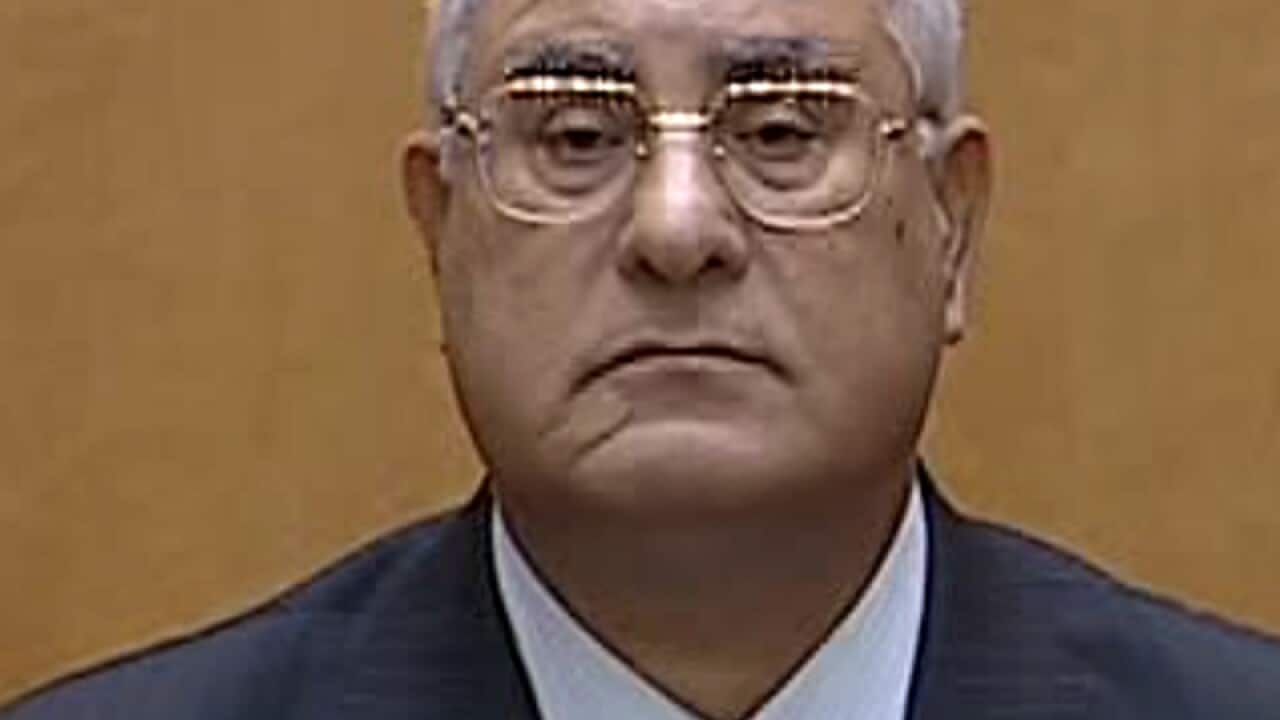
WASHINGTON — Mohammed Morsi is now a former president of Egypt. After tipping its hand by seizing the country's state broadcasters and moving armored vehicles into Cairo, the military deposed Egypt's first freely elected leader on Wednesday and installed Adly Mansour, head of Egypt's Supreme Constitutional Court, as interim head of state. The coup comes on the heels of days of unrest — including massive anti-government demonstrations that drew millions into the street over the weekend — and the lapse of a deadline set by the military for Morsi to form a coalition government.
In a statement broadcast live to the nation, Gen. Abdel Fattah al-Sisi, the chairman of Egypt's Supreme Council of the Armed Forces (SCAF), said that the constitution had been temporarily suspended and that Mansour will have the power to make constitutional declarations until new elections can be held. A government that is "strong and diverse" will be formed to rule Egypt in the meantime, said Sisi, who replaced Field Marshal Mohamed Hussein Tantawi as head of the SCAF last August.
The shakeup thrusts a little-known judge into the spotlight, and entrusts him with the unenviable task of shepherding Egypt to its next presidential and legislative elections, which could take place in as little as three to six months. But Mansour, a veteran of the Supreme Constitutional Court who only just became its chairman on July 1, will not hold ultimate authority.
"He is not the president of Egypt in the same way that Morsi or Mubarak were presidents of Egypt," Tarek Masoud, an associate professor of public policy at Harvard University's John F. Kennedy School of Government, tells Foreign Policy. The best analogy, according to Masoud, is probably Sufi Abu Taleb, who served as acting head of state for eight days following the assassination of Anwar Sadat in 1981.
"The administration of the country is going to be in the hands of the military, but they had to put a constitutional face on it. [Mansour] is under no illusions about the extent of his power," says Masoud.
News that makes sense
Your trusted source for staying up-to-date with the world around you. Get free daily news updates and analysis, straight to your inbox.
Despite his subordinate position, however, Mansour will likely exercise considerable control over the drafting of a new election law, experts say. "His main job will be to get an electoral law done," Michael Wahid Hanna, a fellow at the Century Foundation, tells FP. Over the past year, the Supreme Constitutional Court has twice invalidated electoral laws drafted by the Shura Council, Egypt's upper house of parliament. The result, according to Hanna, has been a delay in holding parliamentary elections and a deepening of the political crisis in Egypt.
The removal of Morsi was greeted with jubilation by opponents of the president — some 22 million of whom had signed a petition of no-confidence in his government — but it is likely to deepen the rift between Islamists and more secular Egyptians. Already, reports that the military has shut down Islamist satellite channels — including the Muslim Brotherhood's Egypt25 channel and the Salafist controlled al-Nass, al-Hifaz, and al-Amjaad channels — have sparked outrage from Morsi's supporters, many of whom have vowed to back him until the end.
The rift has the potential to devolve into outright conflict if the transition goes awry, and Salafists and members of the Muslim Brotherhood are alienated from the process. The takeover of Islamist media, says Masoud, "feels like a war that's only just starting."
During the 1990s, the Mubarak regime fought what was essentially a low-level civil war against Islamists, whose officially banned organizations continued to operate in secret. If the military moves to further marginalize the Brotherhood, Egypt could find itself in a similar situation — except in a country that's been flooded with weapons from the Libyan civil war.
The fact that the military has essentially been invited back into power by opponents of the Brotherhood has the potential to further destabilize the situation. "The SCAF will be less constrained this time around because people have tried out the Muslim Brotherhood," says Masoud. "The great silent majority has no more appetite for massive protests, so the military could essentially roll into Tahrir Square and [squash] the protests" without provoking much popular outcry.
Still, there are indications that the military has learned to soften its touch since the last time it was at the helm. In the 18 months after Mubarak's ouster, Tantawi, the SCAF's chairman, ruled Egypt as an unfettered monarch; this time, the military has sought out the counsel of top religious authorities as well as opposition leader and former U.N. diplomat Mohamed ElBaradei. It has also deliberately chosen the Supreme Constitutional Court as the public face of power.
Whether or not SCAF 2.0 can keep Egypt from fracturing into utter chaos in the coming months remains very much an open question. Morsi has rejected his removal as a "complete military coup" and many of his followers — some of them armed — continue to demonstrate on his behalf. To his credit, Morsi urged Egyptians of all stripes to "maintain peacefulness" and "avoid being involved in the blood of the people of the homeland."
© Foreign Policy, 2013







