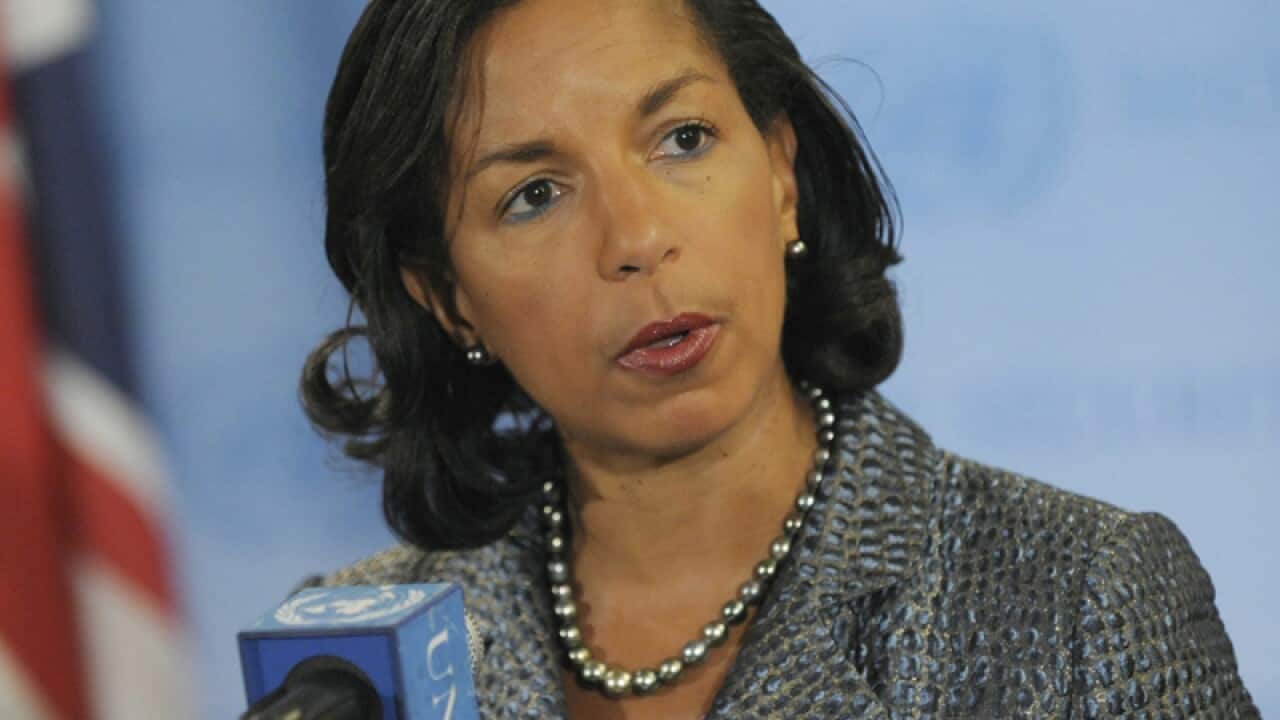
With her appointment as national security adviser, Susan Rice stands to become the most important figure on President Obama's foreign-policy team — except for Obama himself.
This administration famously makes policy from the top down. In no realm is this more true than foreign policy. And in her new post (which, significantly for her, does not require Senate confirmation), Rice will have access to the man at the very top, several times a day, at a moment's notice.
National security advisers fill whatever role their president wants them to fill. Some, like McGeorge Bundy under John F. Kennedy or Colin Powell under Ronald Reagan, focus on making the interagency machinery run like clockwork. Some, like Condoleezza Rice under George W. Bush, focus on briefing the president and codifying his instincts into policy. Some, like Brent Scowcroft under George H.W. Bush, do both.
Susan Rice will be the third person to have the job in the Obama White House. The first, retired general James Jones, was picked for his close contacts throughout the defense establishment, but the new president soon realized that he needed someone with more political agility. He turned more and more to Jones' deputy, Thomas Donilon, who'd worked on Obama's presidential campaign.
When Jones washed out after less than two years, Donilon succeeded him, to the dismay of some, including Defense Secretary Robert Gates, who at least initially saw him as a sharp-elbowed politico out of his depth on policy matters. Donilon has grown in the office, though he is still rough-edged in manner, and some see his incessant demand for more and more briefing papers, and longer and longer meetings, as reflecting not just the complexity of the issues but also a tendency to view each emerging crisis on its own terms, not as one piece of a broader mosaic.
News that makes sense
Your trusted source for staying up-to-date with the world around you. Get free daily news updates and analysis, straight to your inbox.
This shortcoming may be the result of factors beyond any administration's control: the rapid reshaping of the international system in the post-Cold War era; the emergence of new, possibly revolutionary actors in long-stable (even long-stagnant) regions of strategic importance; and the resulting diminution of leverage held by any nation, even one as powerful as the United States.
And yet the Obama administration could be shaping the world a bit more actively than it's managed to do so far. Even some of Obama's most avid defenders concede that decision-making is too centralized and dissenting voices are too marginalized.
The State Department is not likely to be the locus of new ideas or fresh thinking. The new secretary of state, John Kerry, is spending most of his time on the road, putting out fires and trying to form common ground with other leaders. He's well suited for these urgent tasks, but they leave little room for mulling the wider implications, and he seems to have developed no inner circle, no corps of trusted, bright advisers to help direct the broader thinking.
Over at the Pentagon, Defense Secretary Chuck Hagel is still finding his footing, and his most challenging tasks concern ways to cut the budget while preserving the military's missions and the service chiefs' vested interests — a complex enterprise but not necessarily the stuff of geostrategy.
This is where Susan Rice can step in.
She's no Brent Scowcroft, though she does have years of experience in the world of foreign policy, having served as a senior official on President Bill Clinton's National Security Council as well as Obama's U.N. ambassador.
Even her admirers wince at her abrasive style, which they say makes Donilon's most ill-tempered moments seem mild by comparison. When the Russians vetoed a U.N. Security Council resolution against Syria, Rice threw a public fit, declaring that the United States was "disgusted" at their "shameful" behavior — not exactly diplomatic behavior and oddly impervious of the fact that we too have been known on occasion to block the condemnation of horrible allies. When the Europeans were pushing for action on Libya and Obama was still deciding what to do, Rice snapped at the French ambassador, "You're not going to drag us into your sh--ty war."
And yet she has proved herself an effective player when the agenda is in place. For instance, she evolved into a leading force in the campaign, within the Obama administration and the Security Council, to help the Libyan rebels overthrow Moammar Gadhafi
Ultimately, though, President Obama is his own national-security adviser. He has appointed Susan Rice to fill the formal slot because — as he said when he was considering her to be secretary of state — she reflects his views on foreign policy to a T.
Rice was one of the first foreign-policy advisers to join his presidential campaign. (Samantha Power, a National Security Council official who has now been nominated to replace Rice at the U.N., was another early joiner.) He has continued to consult with Rice routinely, and, in her new job, she is likely to be as close to Obama's ear as any national security adviser has been to any president.
What's not clear is whether she has the bureaucratic moxie, the intellectual chops, and, above all, the creative flexibility not just to put the boss' orders into action but to widen the sphere, open the chutes, bring in new ideas, and weave them — along with the administration's own disparate strands of thinking — into a cohesive whole. One thing is clear: If she can't do it, no one else is in a position to do so.
---
Kaplan is Slate's "War Stories" columnist and author of the book "The Insurgents: David Petraeus and the Plot to Change the American Way of War." He can be reached at war_stories@hotmail.com.
© 2013, Slate







