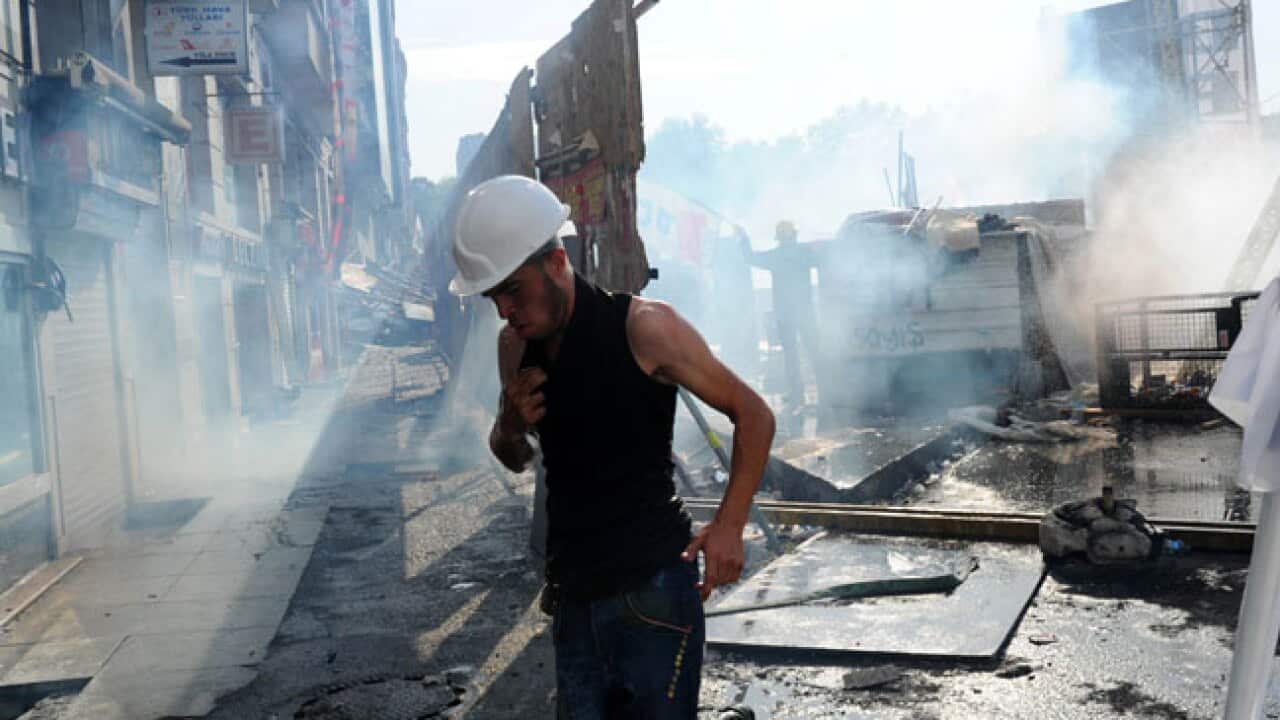
Old friends make the worst enemies. As Turkish security forces used tear gas and water cannons in an attempt to clear Istanbul's Taksim Square of protesters last night, Syria's state media reacted with a tone approaching glee.
The official Syrian Arab News Agency (SANA) argued that Turkish Prime Minister Recep Tayyip Erdogan was enlisting the help of his Islamist allies to withstand the country's wave of demonstrations. "Being his Muslim Brotherhood partner, [Qatar-based cleric Yusuf] al-Qaradawi issued a fatwa prohibiting protests against Erdogan to protect the latter from the wrath on the Turkish streets," SANA reported. "Like al-Qaradawi and his devilish fatwas against the Syrian people, Erdogan is involved in the bloodshed in Syria."
Since the beginning of the protests, the Syrian government and state media have had some fun with their denunciations of Erdogan, a previously close ally of President Bashar al-Assad. The Syrian Foreign Ministry issued a travel warning for Turkey, cautioning that "the violence practiced by Erdogan's government against peaceful protesters" could put Syrians at risk. And SANA reported that the Syrian information minister had called on the Turkish prime minister to "respect the will of his people and leave for Doha."
These condemnations of Erdogan may seem like pure schadenfreude -- a way to tweak Ankara for its long support of the Syrian revolt. But there also seems to be a deeper purpose at work here: The coverage marks an attempt to blur the distinction between the events in Turkey, where three people have died, and those in Syria, where more than 80,000 people have been killed since the beginning of the uprising.
Both the Syrian regime's travel warning and suggestion that Erdogan leave for Qatar mimic previous statements that the Turkish government has directed at Damascus. But the Syrian state media's descriptions of Erdogan's statements also bear a striking resemblance to how Assad has described the unrest in Syria. The Turkish prime minister is quoted as saying he will not let a "minority" impose conditions on the "majority," and will "defend the public areas and institutions." Meanwhile, SANA notes that Erdogan described the protests as stemming from "an internal and external conspiracy" -- the same language that Assad uses to explain the instability in his country.
News that makes sense
Your trusted source for staying up-to-date with the world around you. Get free daily news updates and analysis, straight to your inbox.
The Syrian state media's purpose here is not to justify Erdogan's actions -- on the contrary, it editorialised that the premier's description of a conspiracy "showed hypocrisy and double standard." Rather, it is to create an equivalence between the events in Syria and Turkey, thereby minimizing Assad's brutality and exaggerating Erdogan's excesses.
As SANA wrote on June 9, while reporting on a solidarity protest organized by Syrians in France for the Turkish opposition, the protesters "expressed rejection of the ... double-standard policy of the Turkish Justice and Development Party which brags about supporting democracy and freedom of the peoples while the recent events in Turkey exposed the falsity of its allegations."
Events in Turkey are bad. Happily, however, they are not as bad as Damascus would have you believe.
© Foreign Policy, 2013







