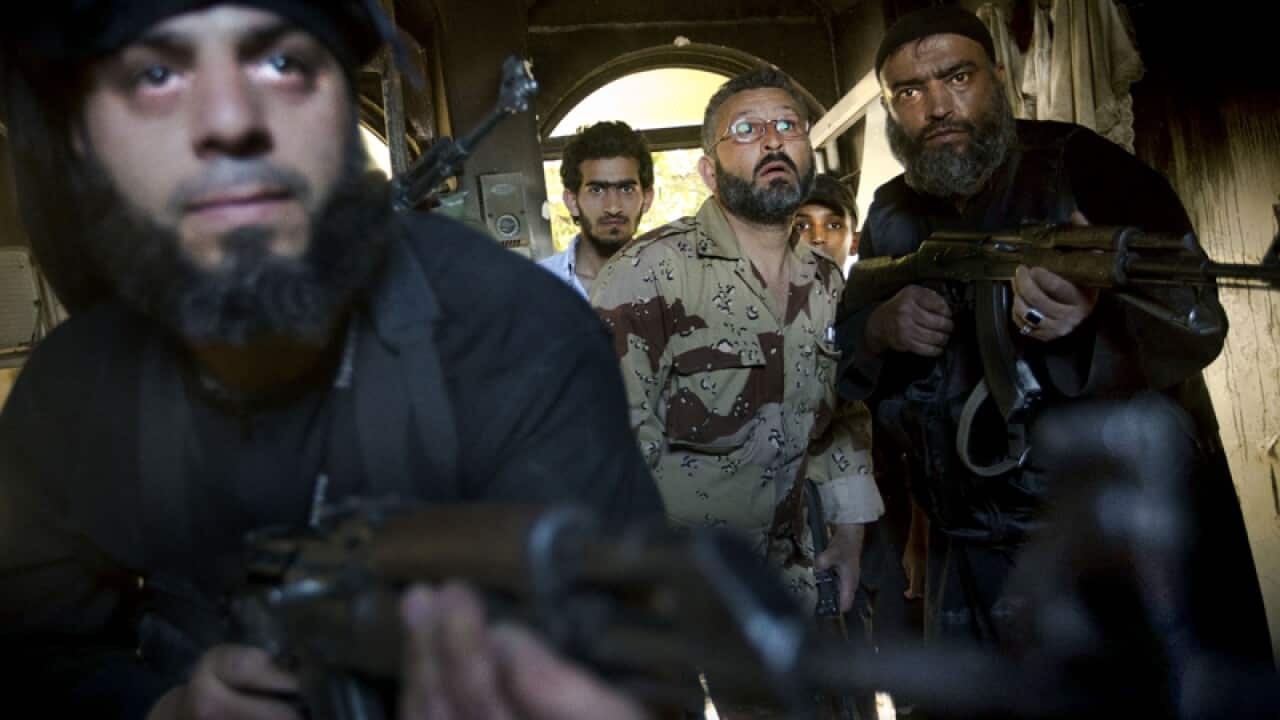
As my colleague David Kenner writes over at Passport, we're starting to get more information about Nicole Lynn Mansfield, the Michigan woman killed along with two other foreigners in Syria, apparently while fighting alongside anti-Assad forces. Along with the recent case of "Phoenix jihadist" Eric Harroun, Mansfield's case is likely to attract more attention to American Muslims -- both converts in these cases -- choosing to fight in Syria.
In a new book-length study, the University of Melbourne's David Malet looks at the history of "foreign fighters." In Malet's view, modern transnational jihadist fighters are part of a long historical tradition that includes Communists like Che Guevara and William Alexander Morgan who fought in the Cuban Revolution, Zionists like future haircare pioneer Vidal Sassoon who fought in the 1948 Arab-Israeli war, anti-fascists like Andre Malraux and George Orwell who fought in the Spanish Civil War, Americans like Davy Crockett who fought in the Texas Revolution, or nationalist romantics Lord Byron, who fought in the Greek War of Independence.
Malet argues that while the causes change, the methods of recruitment has been pretty consistent over time. Foreign fighters tend not to be motivated by money -- though he excludes professional mercenaries from the study -- and "recruiters typically explicity inform volunteers prior to their enlistment that their services will bring minimal nonguaranteed payments, often in a nonconvertible currency."
News that makes sense
Your trusted source for staying up-to-date with the world around you. Get free daily news updates and analysis, straight to your inbox.
Rather, recruiters typically appeal to a global sense of community, be it a common religion, ethnic identification, or political ideology:
"Recruitment occurs when local insurgents, who always begin conflicts as the weaker faction because they do not control the instruments of the state, attempt to broaden the scope of conflict to increase their resources and maximize their chances of victory. However, due precisely to their lack of resources, they typically must motivate outsiders to join them for reasons other than material gain. They therefore frame their victory in the conflict as necessary to the interests of outsiders with whom they share connections and who might be credibly convinced by these claims. Ironically, as U.S. forces engaged with transnational insurgents in Iraq to "fight them over there so we don't have to fight them at home," their opponents offered precisely the same argument. [...] "Transnational recruiters ... find recruits in roles that make them amenable to messages of duty to the Islamic ummah , common Philhellene community, Albanian diaspora, or other such group that encompasses local combatants. The data available from the case studies do indeed indicate that membership in standing transnational organizations provided recruiters access to pools of prospective combatants and that membership roles in existing groups were sometimes used to justify or coerce enlistment."
I was a little curious about how this worked in the Texas Revolution context -- one of the book's primary case studies. Malet writes that New Orleans in the 1830s was a hotbed of political activity related to the nascent Texas Republic. While recruiters did often promise land or financial compensation to potential fighters, the offers were vague and rarely followed through on. Rather, most of the recruitment pitch focused on politics -- "the revolution was "portrayed by its leaders as the 'last rallying point of liberty' for the 'republicans of Mexico" -- or racial solidarity: the "defense of fellow Anglo-Americans under foreign rule."
Freemasonry was often the link between the financial backers of the revolution -- many of whom were actually interested in a potential new slave state for the union -- and idealistic fighters, with Masonic lodges serving as effective recruitment centers.
There's a quantitative portion of the study as well, with data showing that the number of civil conflicts involving foreign fighters has increased since the 19th century -- this could be due either to globalization or just to better reporting -- and that insurgencies involving foreign fighters tend to be more successful at toppling governments. I suspect this is because it tends to be more organized and formidable insurgencies that have the resources for international recruitment, not because foreigners are any more effective on the battlefied. (Remember this guy?)
Malet also argues that despite all the attention on Internet radicalization, the global recruitment of jihadist fighters "probably remains as much a product of insurgencies developing transnational recruitment mechanisms as it was in the days of Lord Byron and the Friendly Society."
In other words, whether you're in a mosque, a union hall, or a Masonic Lodge, when you're trying to convince someone to lay down their life for the cause halfway around the world, the personal touch helps.







