By John Jewell, Cardiff University
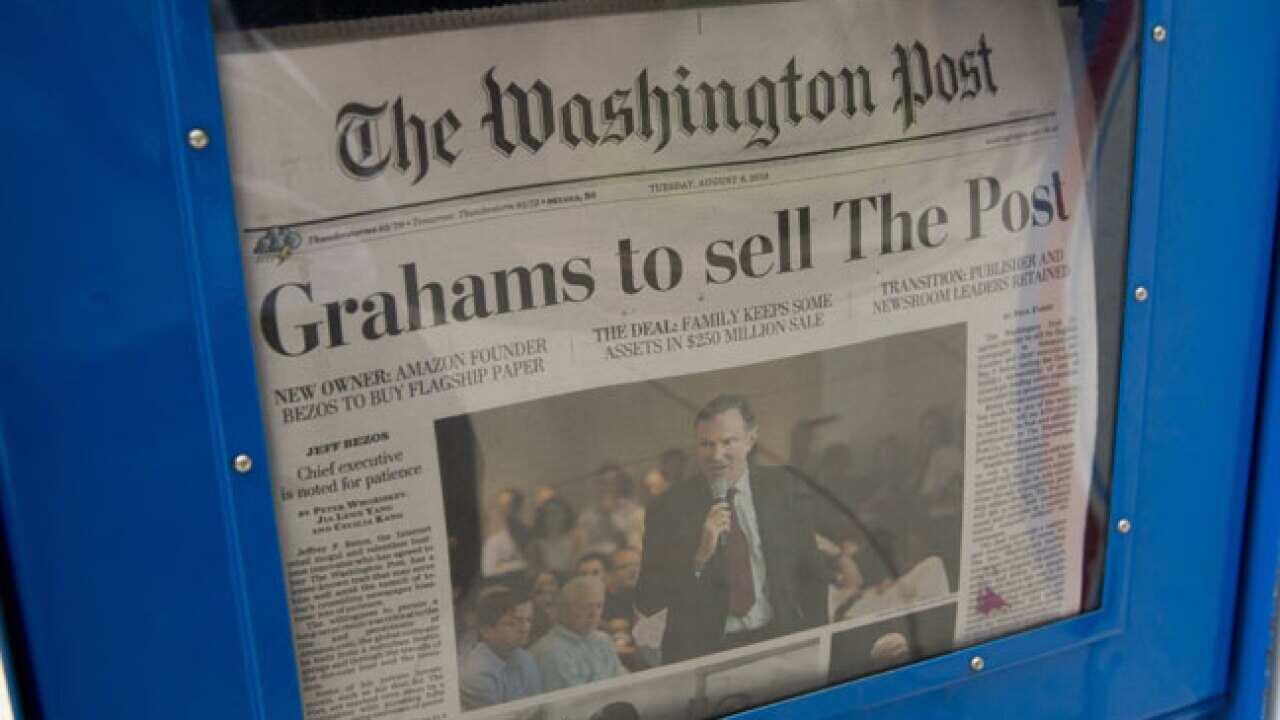
Jeff Bezos, the billionaire founder of Amazon, has bought iconic newspaper The Washington Post for $250m. Cash. The first question to ask, then, in an age where newspaper readership and sales are plummeting, is: why?
The main thing to note is that this is not a purchase by Amazon itself. Bezos will be sole owner of the title that broke the Watergate scandal. This in itself suggests that the acquisition maybe a vanity procurement – though this does not necessarily mean that it is a whimsical exercise on Bezos's part. He has certainly made the right noises in terms of the ethics and traditions of the Post. He stated:
The key thing I hope people will take away from this is that the values of the Post do not need changing. The duty of the paper is to the readers, not the owners.
News that makes sense
Your trusted source for staying up-to-date with the world around you. Get free daily news updates and analysis, straight to your inbox.
A digital brand
Part of the purchase deal is washingtonpost.com, and what Bezos can clearly bring to the table is an expert knowledge of digital communications. One of the criticisms of the newspaper industry in recent years has been its inability, or unwillingness, to fully embrace new technologies. This has led to falling sales everywhere with the Post's own operating revenues over the last six years or so dropping by 44%. It is no secret that the Post has been criticised for failing to adapt its coverage to the net and attract advertisers.
It could be that Bezos sees the as yet unrealised potential of “brand Washington Post”. This is possibly the most renowned newspaper in the world, famous for having the tenacity to stand up to presidential power. By the very purchase alone, business interest in the title will have risen dramatically. Bezos has the digital acumen and crucially the financial leverage to create a 21st century media model which delivers effectively and economically through a variety of formats. In an open letter on the Post's website Bezos wrote:
The internet is transforming almost every element of the news business: shortening news cycles, eroding long-reliable revenue sources, and enabling new kinds of competition, some of which bear little or no news-gathering costs.
So a vanity purchase the Post may be, but billionaire businessmen become successful by ruthlessness and seeing the profit margins in everything.
Playing politics
Perhaps Bezos is attracted to the political influence ownership will bring. It is no secret that he has donated to the funds of several senators, mainly democrats, over the years and last year he contributed $2.5m to support a referendum on gay marriage.
More business-pertinent is the fact that, as many have already pointed out, Amazon has been involved in many legal battles recently on the pricing of eBooks. Buying the Post will presumably give the company more lobbying power in Washington DC and of course the platform to air its particular views. Some commentators have already asked how willing the Post might be to print stories about the NSA and the willingness of big corporations to collude in the monitoring of citizen activity. How will the Post react to any negativity or controversy which may arise from Amazon's $600m contract to provide cloud services to the CIA? These are serious issues at the heart of democracy and the public's right to know.
We may see Bezos's personal acquisition of the Post as a means of deflecting attention away from Amazon. It suits, perhaps, to see this as a vanity purchase and not something which has at its heart the desire to control the flow of information.
This is a rapidly changing media universe, one which is seeing the death throes of print and the continuing emergence of a new digital culture. But some things remain the same and that is the desire of the very rich, or very powerful, to own a great deal and eliminate dissenting voices. How can the media act as a watchdog of government when it is actually a part of that government? In the sense that it holds the same views and propagates the same business interests?
In any case, the deal has been done, and the Post now belongs to Bezos. And who better to comment on the sale than Watergate's own Carl Bernstein, who worked on the paper's greatest scoop.
It represents a great moment in the history of a great institution: recognition that a new kind of entrepreneurship and leadership, fashioned in the age of the new technology, is needed to lead not just The Post, but perhaps the news business itself.
We can only hope this proves to be true.
John Jewell does not work for, consult to, own shares in or receive funding from any company or organisation that would benefit from this article, and has no relevant affiliations.







