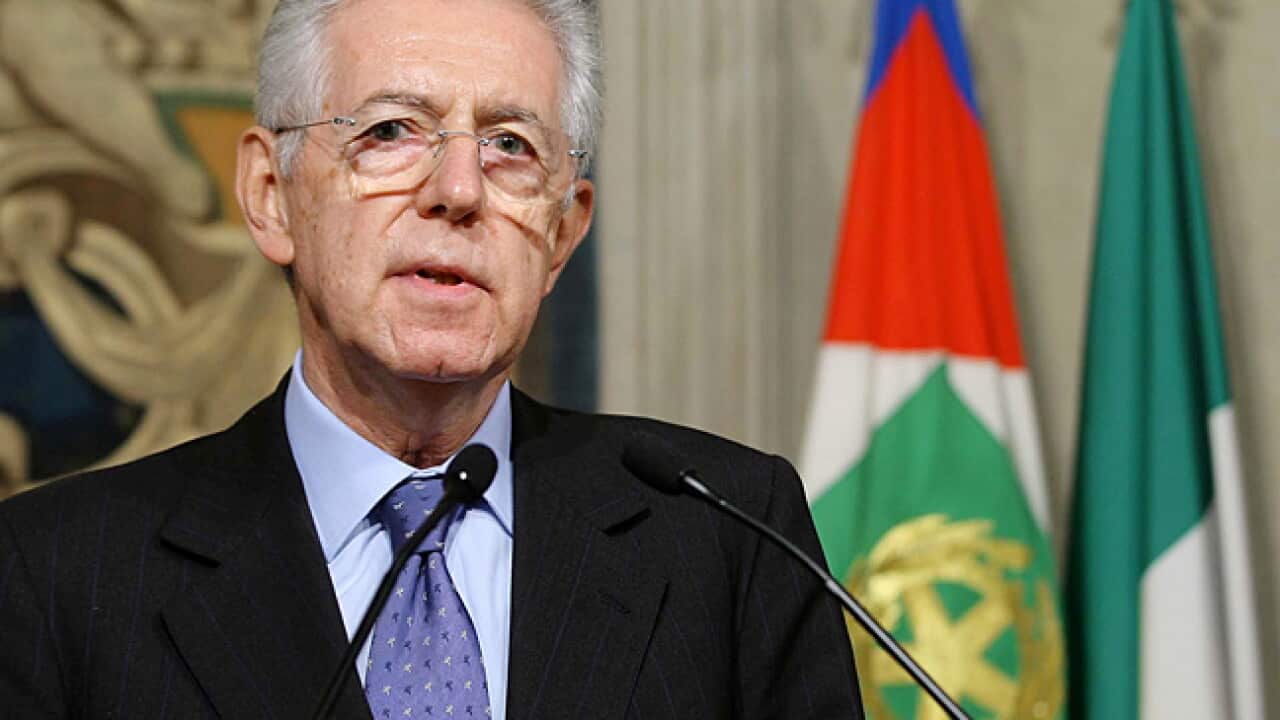
Financial market pressure eased as the 68-year-old former European Union competition commissioner prepared to formally accept the nomination from President Giorgio Napolitano and unveil his new cabinet later on Wednesday.
Monti will then be sworn in and there will be a handover ceremony with the departing Silvio Berlusconi, the flamboyant tycoon who resigned on Saturday to cheers in the streets of Rome after ruling for 10 of the past 17 years.
News that makes sense
Your trusted source for staying up-to-date with the world around you. Get free daily news updates and analysis, straight to your inbox.
A confidence vote in parliament expected as early as Thursday will then launch the new government, which will have to move quickly to reassure the international community that Italy is serious about implementing reforms.
As he scrambled to put together his cabinet this week, Monti has sought to build consensus around the idea that Italians will have to make "sacrifices" to stave off bankruptcy and has called for "economic, social and civil growth."
Monti has won endorsements from all of Italy's main political forces but he faces a major challenge in steering a course through a fractious political world, with particularly intense sniping from Berlusconi's allies.
"He Can't Last Long," read a headline in the Berlusconi-owned Il Giornale daily, while some loyalists from Berlusconi's People of Freedom party have called for the colourful billionaire to return to head Italy.
A scathing editorial in business daily Il Sole 24 Ore said: "Political forces are divorced from reality, busy negotiating on names (of ministerial appointments) with no concern about weakening the incoming government."
Despite his 10-year stint in Brussels, the technocrat has never held office in Italy but has already shown mettle by insisting that his government has to stay in power until 2013 -- the scheduled date for the next general election.
As European commissioner, Monti famously fined US technology giant Microsoft nearly 500 million euros ($672 million at current exchange rates) and blocked a massive $42-billion merger between General Electric and Honeywell.
Speaking during a visit to Australia, US President Barack Obama said he was "deeply concerned" about the turmoil in the eurozone.
He said the problem in Europe was one of "political will".
US Treasury Secretary Timothy Geithner said European countries were making incremental progress in addressing the debt crisis, but added: "We hope they will make progress more quickly."
The reserved technocrat Monti, a starkly different figure to his famously larger-than-life predecessor, has said he is "absolutely convinced" Italy can overcome its debt crisis but will have to move quickly.
The European Union already gave its firm approval to Monti even before his formal confirmation, but has warned that Italy may need to impose extra budget cuts on top of two austerity plans approved earlier this year.
The EU and the International Monetary Fund this month imposed a humiliating auditing mechanism on the country, the eurozone's third largest economy and an EU founding member, to ensure it is fulfilling its reform promises.
Italy's high public debt of 1.9 trillion euros ($2.6 billion) is relatively stable and its deficit relatively low, but the country's anaemic growth rate and recent political weakness have pushed up borrowing costs.
The rate on Italian 10-year bonds on Tuesday smashed through a 7.0-percent threshold that analysts warn could trigger cash-flow problems within months.
Stocks were also under pressure this week, particularly after aerospace and defence giant Finmeccanica and Italy's biggest bank, UniCredit, revealed heavy losses. Italian stocks closed 1.08 percent lower on Tuesday.
On Wednesday however Italian stocks were up nearly 2.0 percent even as other European stock markets retreated in opening deals.
Borrowing rates also eased from the peaks reached on Tuesday.







