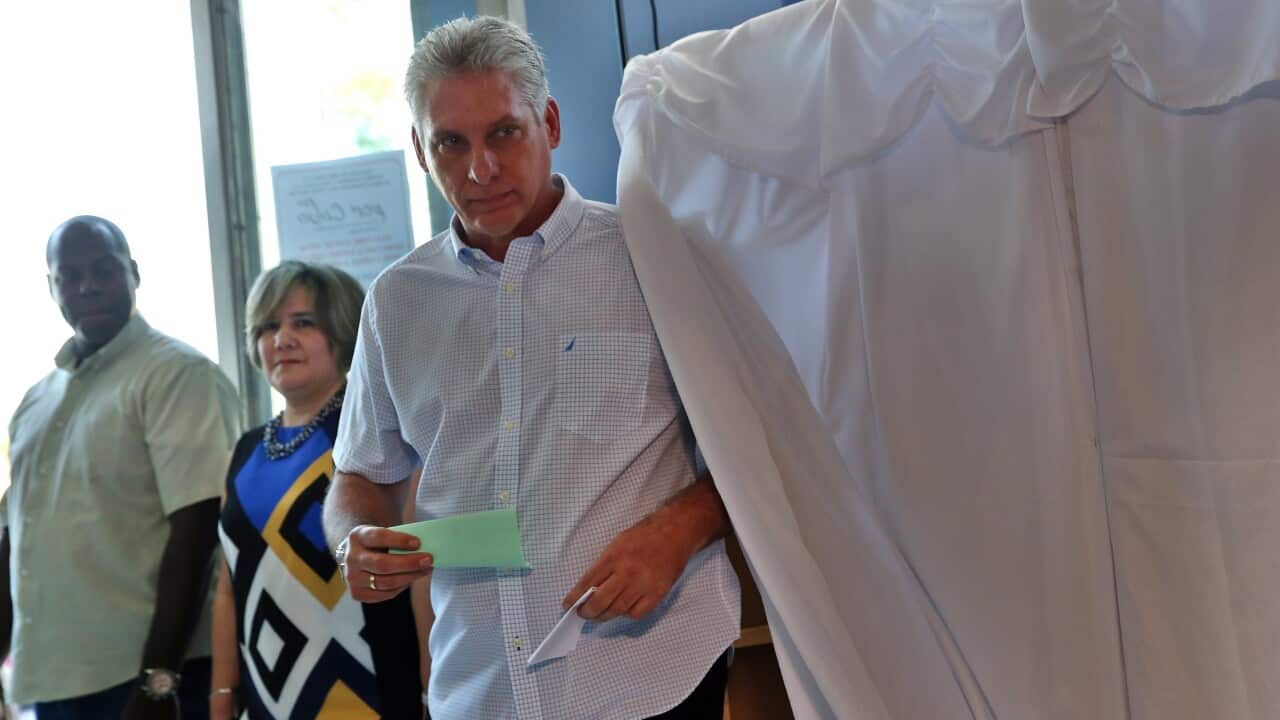
The new members of the National Assembly will be tasked with choosing a successor to 86-year-old President Raul Castro when he steps down next month.
Castro voted in the southeastern province of Santiago de Cuba while his first vice president and likely successor, Miguel Diaz-Canel, cast his ballot in the central Santa Clara province.
"The triumphal march of the revolution will continue," Diaz-Canel said after voting, promising "peace, liberty, independence and the sovereignty of the people will endure."
Raul Castro took over in 2006 from his ailing brother Fidel, who had governed since seizing power during the 1959 revolution.
Eight million Cubans are expected to turn out to ratify 605 candidates for an equal number of seats in the Assembly, a process shorn of suspense and unique to the Communist-run Caribbean island nation.
News that makes sense
Your trusted source for staying up-to-date with the world around you. Get free daily news updates and analysis, straight to your inbox.
"They're the most important elections of recent years, because we are going to vote for new people who will govern from then on," day-care center guardian Ramon Perez told AFP.
Sunday's general election is the first since the death in 2016 of Fidel Castro, and marks the beginning of major change at the top in Cuba.
The change "will be a challenge but it's the natural law of life. We get old and have to retire," said retired lieutenant colonel Rigoberto Celorio, 82.
"This is the right moment," he added. "Raul will stay on as first secretary of the Communist Party, so whoever comes out of the process will be well oriented."
Candidates may be either members of the Cuban Communist Party or not, and may also belong to trade unions or be students.
"The designation of candidates is based on merit, abilities and the commitment of the people," Raul Castro said when he announced the elections last year.
Succession
More than half of the candidates, 322, are women.
The new National Assembly selects a 31-member Council of State, whose head is automatically president of the country.
Cuba's president is designated by a 31-member Council of State, whose head is automatically president of the country. But the Council of State first has to be selected by the National Assembly.
Castro had already announced that he would not be seeking a new term, although he is expected to remain head of the all-powerful Communist Party until 2021.
Diaz-Canel, 57, is widely expected to succeed him and is committed to guaranteeing continuity.







