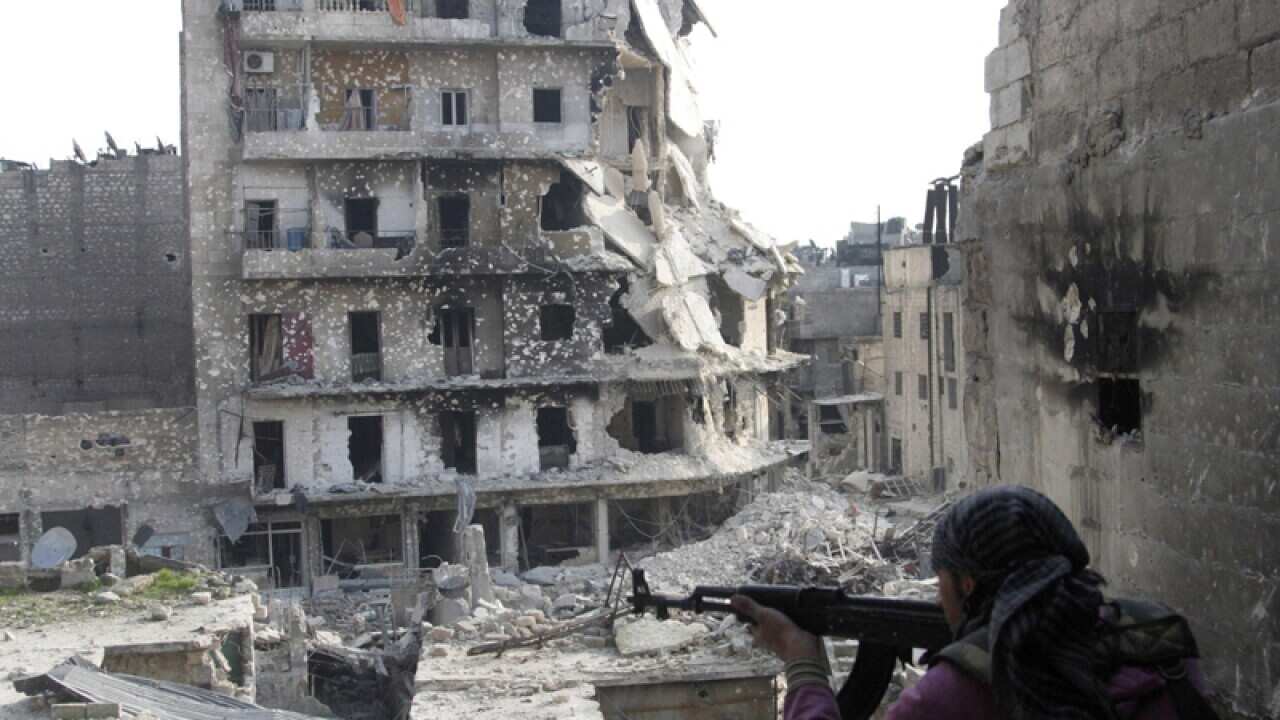
The army targeted several villages near the key Damascus airport road that has come under sustained rebel attack, a monitoring group said.
The 27-kilometre (17-mile) highway remained perilous a day after troops said they had reopened the link to the outside world in heavy fighting, said the Syrian Observatory for Human Rights.
News that makes sense
Your trusted source for staying up-to-date with the world around you. Get free daily news updates and analysis, straight to your inbox.
Troops were in action against rebels entrenched in both the southwestern outskirts of the capital and the eastern suburbs, where the ariport lies, human rights monitors and opposition activists said.
Southwest of the capital, "the army shelled orchards that extend from Kfar Sousa to Daraya and are taking on rebels who control the region," said the Observatory, which relies on a network of activists and medics on the ground.
Observatory director Rami Abdel Rahman told AFP there had been intermittent battles from early morning between Damascus and the international airport.
"The army used warplanes, helicopter gunships and tanks to shell several villages in that area, including Babila, Beit Sahn and Aqraba," he said. "The army's operation to secure that area has continued."
Analysts say President Bashar al-Assad's regime has been trying to establish a secure perimeter around Damascus at all costs in a bid to be in a position to negotiate a solution to the 20-month conflict that monitors say has cost more than 41,000 lives.
The repeated firing on the airport road prompted the cancellation of a string of international flights.
Airport officials said flights had resumed on Friday but a military source acknowledged several days' more fighting lay ahead to fully secure the road.
Meanwhile, two car bombs rocked the capital, said the Observatory. One, in the southern district of Tadamun, killed at least four people, while another in northern Damascus killed one, the watchdog added.
In the northern city of Raqa, a third explosion killed at least eight people, said the Observatory.
Clashes between troops and rebels rocked Syria's second city Aleppo, scene of urban warfare for more than four months, the Observatory said, and 14 rebels were killed in fighting near an air base southwest of the city.
In the east, troops re-entered the Al-Omar oilfield, three days after pulling out, the Observatory said.
"Despite Thursday's pullout, rebels did not enter the oilfield for fear that it was mined," said Observatory director Rami Abdel Rahman.
The oilfield is one of the regime's last positions east of the city of Deir Ezzor. Last week, rebels seized a huge swathe of territory stretching from the city to the Iraqi border, the largest in Syria outside government control.
Early last month, the rebels seized control of the Al-Ward oilfield, the first it had captured. The army has since also lost control of the Al-Jofra oilfield and the Conoco gas reserves, according to the Observatory.
Syria's oil and gas production is now largely for domestic consumption as a result of embargos on its exports by its biggest pre-conflict customers. But rebel activity has also taken a mounting toll on output.
Violence nationwide killed at least 116 people on Saturday, among them 43 civilians, according to the Observatory.
Internet and telephone services resumed in several provinces, with state news agency SANA saying the outage was due to maintenance work but activists claimed was a deliberate move to deprive the opposition of communications.
"Internet is back in Damascus and in parts of Damascus province," said an AFP correspondent, adding that mobile phone lines were also back up, and SANA confirmed that.
"All communication lines are back up in Damascus, after maintenance works were completed," the agency said.
People in Aleppo and Raqa in the north, as well as Damascus province, contacted AFP via the Internet, to confirm services had resumed.
Activists and human rights monitors said ordinary civilians were harder hit by the blackout than the opposition as they were unable to use cell phones even to call for emergency assistance.
An activist in one rebel-held area contacted by AFP from Beirut said that it was primarily people in zones still under government control who were affected by the blackout.







