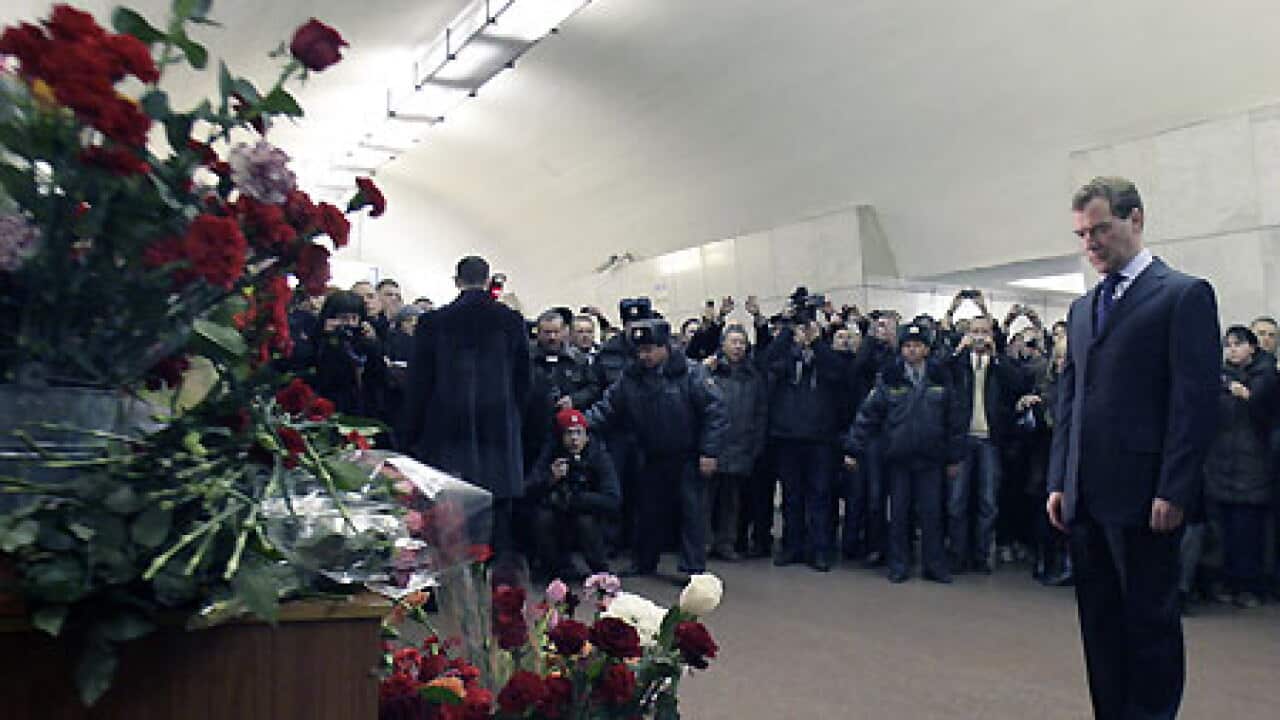
Moscow is holding a day of mourning on Tuesday for the 38 victims of twin rush-hour suicide bombings on packed metro trains in the city.
Prime Minister Vladimir Putin has vowed those responsible for Monday's bombings would be "destroyed" as authorities pointed the finger at militants from the Northern Caucasus for the deadliest attack in the Russian capital for half a decade.
President Dmitry Medvedev, visiting the site of one of the bombings to lay a wreath of red roses, pledged "we will find and wipe out" those behind the blasts, calling them "wild beasts".
News that makes sense
Your trusted source for staying up-to-date with the world around you. Get free daily news updates and analysis, straight to your inbox.
The first explosion, shortly before 8.00am local time, ripped through a train that had stopped in the Lubyanka station below the headquarters of Russia's FSB security service, the successor to the Soviet KGB.
About 40 minutes later, a second explosion went off in a carriage of a train on the platform at the Park Kultury metro station, named after Moscow's iconic Gorky Park.
Officials said the attacks were carried out by women wearing belts packed with explosives, marking a return of the so-called 'Black Widows' who terrorized Moscow a decade ago with a string of attacks.
Search on for bombers' accomplice
"Body parts of two terrorists - female suicide bombers - were found at the scenes of the blasts," FSB chief Alexander Bortnikov said in a televised meeting at the Kremlin.
"According to preliminary information, these people had links to places of residence in the Northern Caucasus," he added.
Bortnikov said the bombers' belts were packed with the explosive hexogen and metal shrapnel.
Russian Foreign Minister Sergei Lavrov said that foreign involvement in the attacks had not been ruled out.
"We all know very well that clandestine terrorists are very active on the border between Afghanistan and Pakistan," the Interfax news agency quoted Lavrov as saying.
"We know that several attacks have been prepared there, to be carried out not only in Afghanistan, but also in other countries. Sometimes, these journeys go as far as the (Russian) Caucasus."
Russian police are searching for two women who accompanied the suicide bombers, plus a man who may also have been an accomplice, after identifying them and the bombers through surveillance footage, Interfax reported citing a security source.
Putin pays visit to victims
Emergency officials said the death toll had reached 38, not including the bombers.
Another 64 people were wounded, including a woman from the Philippines and two women from Malaysia who were released from hospital after treatment.
Putin - who cut short a visit to Siberia to return to Moscow - visited some of those injured in a central Moscow hospital on Monday evening.
He earlier warned that "law enforcement agencies will do everything to find and punish the criminals... The terrorists will be destroyed."
Western leaders offered their condolences to Russia, and US President Barack Obama pledged Washington would "help bring to justice those who undertook this attack" while Secretary of State Hillary Clinton called trrrorism a "common enemy".
"Whether you are in a Moscow subway or a London subway or a train in Madrid or an office building in New York, we face the same enemy," Clinton said.
There was no immediate claim of responsibility, but the so-called "Caucasus Emirate" group led by Chechen militant Doku Umarov has repeatedly warned in recent months it was planning to strike the capital.
Metro system back up and running
Umarov's group claimed responsibility for last November's bombing of a passenger train that killed 28 people.
Lubyanka Square is home to the Federal Security Service (FSB), the successor to the Soviet KGB secret police, and still housed in the notorious building where dissidents were interrogated and shot in Joseph Stalin's purges.
The Moscow metro continued working despite the disaster, with only one line temporarily shut down, and by the end of the day Lubyanka station had reopened to passengers with only minimal damage to its marble walls.
The Moscow city government declared Tuesday would be a day of mourning.
Monday's explosions were the deadliest suicide attacks in Moscow since 2004 when the bombing of a metro train killed 41, part of a string of attacks carried out by Chechen militants.
Chechnya has seen rising violence in recent months as pro-Kremlin regional authorities seek to clamp down on an Islamist insurgency that has also spread to the neighbouring majority-Muslim regions of Ingushetia and Dagestan.







